



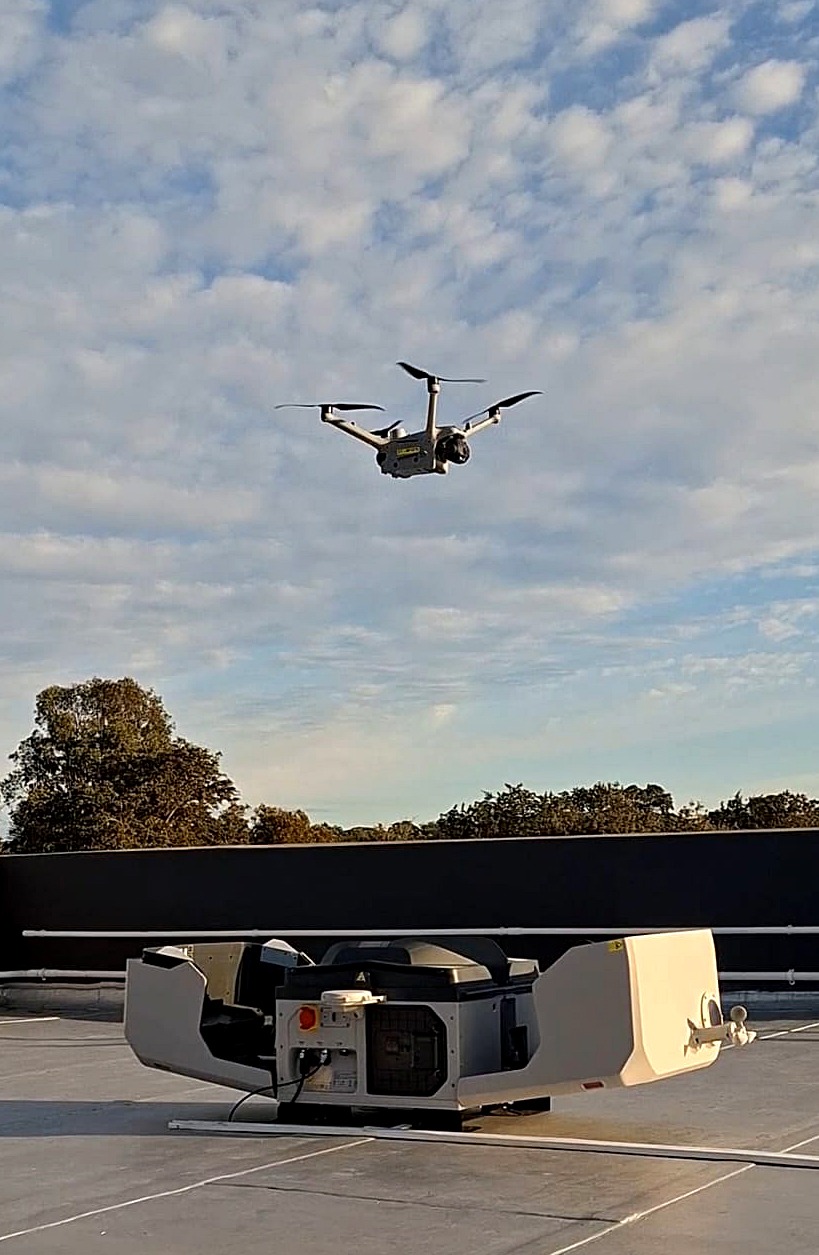
 The drones use specialised docking stations placed in secret locations around Nelson Mandela Bay to get the maximum coverage. (Photo: Supplied / Afrisec)
Police K9 Unit members are dispatched to the remote coastline on the outskirts of Gqeberha, armed with GPS coordinates and the knowledge that they will find a perlemoen poacher’s illicit booty.
Within seconds of arrival, their dogs search the area and recover thousands of rands worth of illegally harvested perlemoen, wetsuits and diving equipment hidden among the bushes near the Cape Recife Nature Reserve.
Their job is made infinitely easier thanks to the detailed information provided to them by Nelson Mandela Bay’s latest safety and security asset – drone technology.
While this innovation was officially launched by the Mandela Bay Development Agency and deputy mayor Gary van Niekerk earlier this month, the contractor responsible for the drones has been piloting the project for months to augment the capabilities of law enforcement in the metro.
“This is the latest weapon in our crime-fighting armoury. Along with our camera network infrastructure, these drones will play a vital role in our fight against violent crime, as well as our efforts to counter vandalism of crucial infrastructure across the city,” Van Niekerk said during the launch at the Nelson Mandela Bay Stadium.
/file/attachments/orphans/MBDADrones1_945873.jpg "An example of drones used by Afrisec and the Mandela Bay Development Agency to monitor the city and deploy additional law enforcement resources where and when they are required. (Photo: Riaan Marais)")
The venue for the launch was chosen specifically to showcase the versatility of the latest phase of the Mandela Bay Development Agency’s (MBDA’s) ongoing roll-out of safety and security assets.
Entering the stadium’s security control room, the active screens showed what cameras around the sport facility could see. However, one screen showed an aerial view of Walmer Township on the other side of the city.
This was a live feed from a drone launched from one of seven secret docking stations scattered around the city, and the pilot was relaying real-time information to his colleagues seated in the control room of the stadium.
“Violent crime, vandalism, kidnappings – all these criminal activities will become increasingly more difficult now that we have this new technology deployed,” Van Niekerk said.
The first phase of the MBDA’s safety and security roll-out was initiated in February 2024, when it signed a contract in a joint venture between three security companies in the city, namely M Security Service, City Wide Security and Afrisec Group.
Explaining the intricacies of the multi-phased project, Afrisec chief operations officer Johan Barnard explained how each partner in the joint venture brought something unique to the table.
“Each of the companies has its own strengths. M Security Services provided the guarding personnel at crucial facilities identified in the contract, while City Wide’s control rooms provide the perfect base from which to monitor an extensive network of security cameras throughout the city.
“And Afrisec provides the current technology while also exploring other possible future developments that could assist the city in improving safety and security,” Barnard said.
/file/attachments/orphans/MBDADrones3_130958.jpg "Afrisec COO Johan Barnard shared details about the successes its systems had already recorded after it piloted the project earlier in 2026. (Photo: Riaan Marais)")
Through the first two phases, boots were placed on the ground, and a wide network of security cameras was installed at selected locations.
The present phase will see an additional 360 CCTV cameras deployed across the city, of which 45 will have Automatic Number Plate Recognition (ANPR) capabilities for advanced vehicle tracking.
It also entails a significant investment in fibre connectivity to the far reaches of the city to improve the efficiency of the camera network.
Key points along the new fibre line will include Summerstrand, the NMB Stadium, Gelvandale, the police’s 10111 Centre in Schauderville, along Stanford Road and through Missionvale into Kariega and Kwanobuhle.
While this is an MBDA initiative, these lines will allow the police, private security and other law enforcement agencies access to the security camera network, through fast connectivity, so that real-time information can be shared among the security roleplayers.
Eye in the sky
To further augment these assets, the seven drone docking stations have been placed in strategic locations about 5km apart, to ensure maximum coverage across Nelson Mandela Bay.
There will also be mobile units available for deployment in emergency situations where additional resources are required.
For the drone deployment, Afrisec has partnered with experts in the field, Hussar, which has a proven track record and highly trained and experienced operators. The company is recognised by the South African Civil Aviation Authority, and each drone has its own unique registration number. The pilots are authorised to communicate directly with air traffic controllers to ensure safe paths and no interference with other aircraft.
The location of the drones and their pilots is kept secret as an additional security measure.
/file/attachments/orphans/MBDADrones5_309725.jpg "NMB deputy mayor Gary van Niekerk played a crucial role in the roll out of the drones project, and attended the official launch at the NMB Stadium earlier this month. (Photo: Riaan Marais)")
“When a crime incident is reported, the impact of a drone is immediate. The nearest drone is in the air within seconds, tracking the activity and relaying real-time information to assets on the ground.
“They can track a suspicious vehicle’s movement; they have technology to analyse suspects’ actions and behaviour and identify potential weapons they could be carrying; they have thermal imaging to track fleeing suspects at night.
“All these aspects will help law enforcement officers to better plan their operations so that they do not run blindly into ambushes or dangerous situations,” Barnard said.
Crucial assets such as security cameras and electricity infrastructure will also be equipped with transmitters that will trigger the drones when they are tampered with.
/file/attachments/orphans/MBDADrones4_923765.jpg "With the newly deployed drone technology, Nelson Mandela Bay law enforcement agencies have a clear view of activities on the street, either to deploy additional resources or record events as evidence. (Photo: Riaan Marais)")
Besides their reactive capabilities, Barnard said that drones had been used at protests, sporting events, music festivals and other public gatherings to monitor for potential threats.
To prove their efficacy, Afrisec began testing drones privately about a year ago and ramped up operations in the three months before the official launch.
“In that three-month period we assisted the police recovering more than R10-million in narcotics, illegal prescription medicines, counterfeit goods, illegally harvested perlemoen and poaching equipment,” Afrisec chief executive officer Gary Cowper-Johnson said.
He said the drones’ impact was only made possible through the joint venture with the other security companies, partly because the control rooms monitoring the cameras and drone movements were certified with the relevant authorities and manned by well-trained staff, who in turn were also monitored to adhere to a highly specialised code of conduct.
“This also answers the inevitable questions around privacy and professionalism by the operators. Everyone involved is strictly and continuously monitored to ensure adherence to the relevant laws and code of conduct,” Cowper-Johnson said.
Contract controversy
The MBDA’s contract with a joint venture that included Afrisec had come under scrutiny due to previous legal clashes between the company and the Nelson Mandela Bay Municipality (NMBM). This included a protracted legal battle linked to a R92-million contract dating back to 2013 for the provision of security equipment.
The outcome of the case resulted in a settlement between the municipality and Afrisec after the high court dismissed the municipality’s claims of contractual irregularities.
“Outside of that matter, Afrisec was awarded more contracts with the municipality without any problems. We maintain a business relationship with the city,” Barnard said.
The Mandela Bay Development Agency’s Luvuyo Bangazi further explained that while the agency was a municipal entity, the latest R27-million infrastructure project was completely run by the MBDA.
“We would like to clear up any confusion around the ownership of this project. While the municipality is an important partner, the project sits with the MBDA.
“All matters between [the municipality] and Afrisec, whether in or outside of court, remain between them and have nothing to do with the contract between the company and the MBDA,” Bangazi said.
Future developments
While the present contract with the MBDA does not make provision for further phases in the project, Afrisec continues to explore other technologies which it hopes to see rolled out in Nelson Mandela Bay.
One such innovation, which Barnard and Cowper-Johnson are exploring, is the gunshot detection technology used by security operatives during the 2024 Paris Olympic Games.
While NMB officials have on various occasions spoken about reviving the contentious Shot Spotter programme, the alternative could see more effective and wider coverage.
“While Shot Spotter is dependent on a stationary unit with a limited range, the newer technology utilised an app that activates any cellphone’s microphone to detect gunshots. This information can be relayed to law enforcement officials instantly, and the necessary resources can be deployed,” Cowper-Johnson said.
Any police officer, security operative, city official or private resident could become a valuable asset in this safety initiative, he said.
“This option is still being explored. For now, we look forward to seeing how our new infrastructure, camera network and drones assist in our fight against crime,” he said. DM
Comments
Scroll down to load comments...