




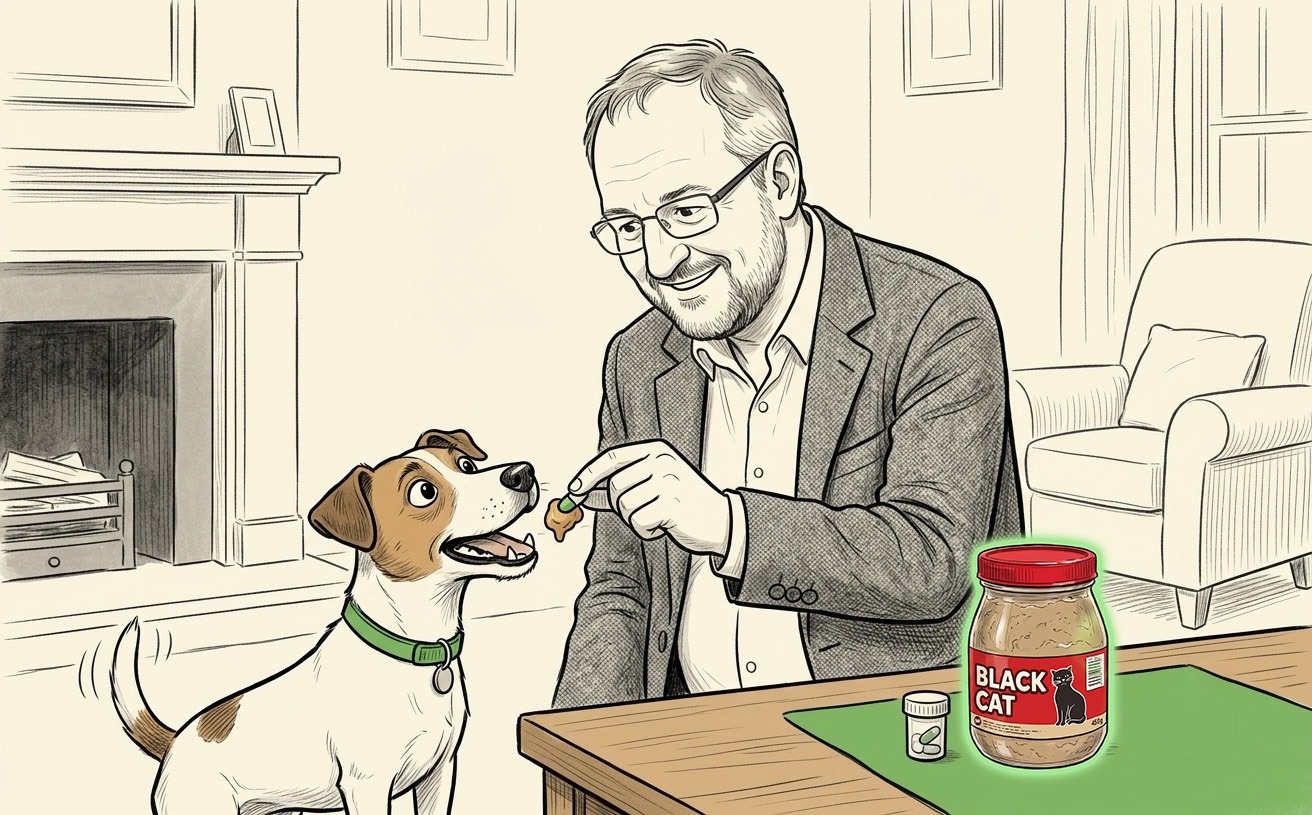
 Illustrative image: Generated with Google Gemini Flash Image 2.5
 I am probably the only person in the country whose first thought when I read that tariffs are being imposed on peanut butter was about a sadly departed dog.
When I was growing up peanut butter was literally the thing in a sarmie. It was the music that made bread sing. Especially if there was a crunch involved.
For some reason, the exact tone of the voiceover in the [adverts](https://youtu.be/0eY033cDo5Q?si=xW5W7guaKgssuKoM) for Black Cat Peanut Butter still gurgles around in my head from time to time.
It features a pre-anabolic steroid bodybuilder on a beach assaulting a nerd who plaintively cries “Hey, you kicked sand in my face”. Ten seconds and one peanut butter sarmie later and that same guy is flying over the nerd’s shoulder before asking “Black belt, huh?”
If you grew up in the Eighties I don’t need to remind you of the rest.
Even now, peanut butter is a big feature in our home.
It still makes sarmies sing for the wonderful teenagers.
But more importantly, when we had an elderly Jack Russel (who, sadly, is no longer with us… although his name still lives on when I lose my mind at the dogs and shout his name through sheer habit) he refused to take his pills.
I don’t know if you’ve ever tried to get a dog to take a pill, but it’s probably easier to make your phone connect to your car’s bluetooth automatically than to get a pill down that particular throat.
In the end we followed the advice of someone wiser. It was simple: we would take a blunt butter knife, scoop some peanut butter out of the plastic bottle, put the pill inside it, and hold out the knife for him to lick.
It became part of my routine and worked like a dream.
The only problem was that it inevitably led to a long-running family fight about whether he preferred crunchy or smooth (by the way, if you are in the minority of brave people who are owned by a cat and you’ve tried to get them to take a pill, I hope the scratches didn’t leave too much of a scar. Next time, try chicken liver…)
Now, the International Trade Administration Commission (ITAC) has decided it needs to change the tariff for imported peanut butter.
They obviously received a complaint, conducted an investigation and found that our peanut butter production had dropped during the period in question, while imports rose significantly.
As a result they are moving the tariff from 99c/kilogram to 25% of the value (for the linguists that’s now an ad valorem tax on value). In case you’re wondering (and never have enough time to read the label) most of our peanut butter imports are actually from India.
One of the other big discussions of the moment is about tariffs on sugar. Our sugar producers have been complaining loudly about imports and the impact it’s having on them.
Of course, our major sugar problems tend to be domestic.
Tongaat Hulett is battling to recover because of the accounting fraud perpetrated by its former CEO, Peter Staude (he’s still battling the whole thing and every finding against him in the courts).
The other problem is that we simply eat too much of the stuff. It seems to be everywhere.
For a long time there has been a big campaign around the world to make it more expensive. The argument is that, like booze, if you make it more expensive, people will buy and then eat less of it.
When the sugar tax came in here the corporates were ready. And cunning. Coca-Cola didn’t increase the price of their cans. They [made the can smaller](businessday.co.za/bd/companies/industrials/2017-10-27-a-bitter-taste-in-the-mouth-as-coca-cola-reduces-can-sizes--but-not-prices/). In the name of protecting you from inflation they introduced shrinkflation (I would like to claim that line but it’s not mine).
You can imagine the argument: introducing a relatively high tariff on sugar would protect our producers and help us to consume less of the stuff.
I get the argument, but it all seems to be a little much like wanting to have your cake and to eat it. I don’t know if you can really do both things at the same time with the same policy instrument.
The people at ITAC have been quite busy lately. In the past few weeks there’s been a decision to maintain anti-dumping duties of 45% on gypsum plasterboard from Thailand and Indonesia, a preliminary determination on the alleged dumping of tubes and pipes from Mozambique, and a recommendation for an anti-dumping duty increase of precisely 43.77% on polyethylene terephthalate from China.
I have no idea what polyethylene terephthalate is, but I hope I never have to give some to an unfortunate dog.
The sheer breadth of things that have duties and tariffs and all sorts of other things is just breathtaking. And, I must admit, I find myself almost sucked into the vortex of how interesting and complex trade can be.
I wonder if the people at ITAC have time to enjoy their peanut butter sarmies… DM