




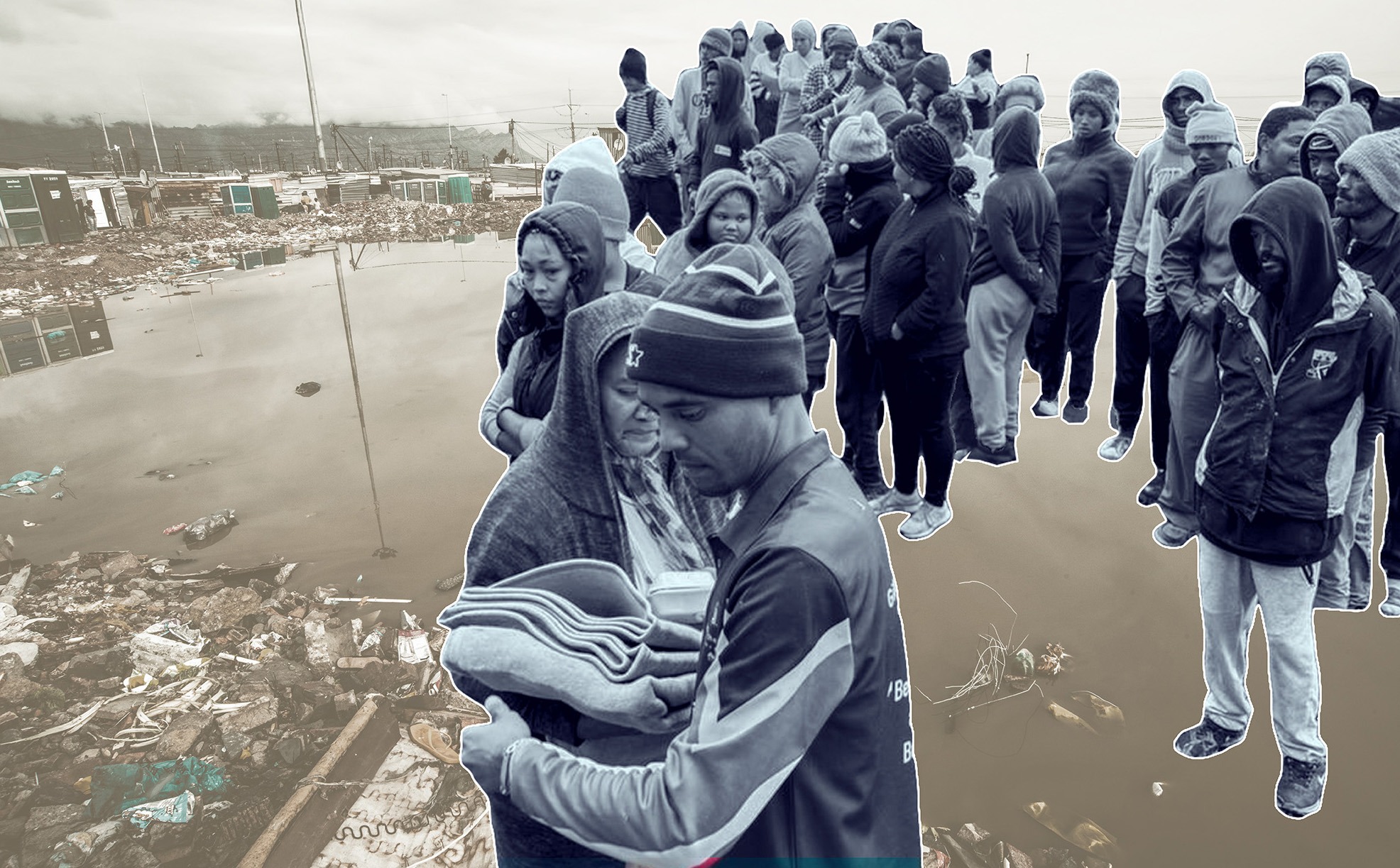
 Illustrative image: Flooding in Lwandle informal settlement in Strand, Western Cape, after heavy rains. (Photo: Gallo Images / Brenton Geach) | A Gift of the Givers member hands out blankets to flood victims. (Photo: Instagram / Gift of the Givers)
A little over two months have passed since rainfall exceeded 400%, 600% and even 1,000% above normal in some areas of the Western Cape, causing an estimated R9-billion in damage, claiming 11 lives and ultimately affecting the lives of 231,029 people.
The frequency of the headlines about the impact of the floods may have faded, while the Western Cape government frequently releases updates about its recovery efforts; however, on the ground, entire communities are still reeling after the May floods.
Daily Maverick visited some of the areas that were hit by the May floods. One such area was Rawsonville in the Cape Winelands.
“We lost a lot of things. People lost a lot of things, and we still haven’t recovered,” Madelyn Botha said.
/file/attachments/orphans/DJI_20260714125214_0020_D_506270.jpg "Madelyn Botha and her mother are still counting the costs of the damage caused by the devastating floods that hit Rawsonville in May 2026. (Image: Tamsin Meterlerkamp)</p>
<p>")
Botha, who had lived in a house nestled near the Breede River for 23 years, told Daily Maverick that the May deluge was the first time the river broke its banks to the extent that it did.
“There was one year when the river did flood, but not like this. Nothing was ever destroyed. My two daughters have lost their documentation,” and while she had been trying to get new birth certificates for the children, Botha said the process was very slow.
The floods washed away the bedroom where two of her children slept, forcing the family of five to share a single bedroom. Botha said she did not know if the house would be rebuilt.
/file/attachments/orphans/1208_544838.jpg "The room where Madelyn Botha’s children slept was washed away during the historic May 2026 floods in the Western Cape. (Image: Tamsin Meterlerkamp)</p>
<p>")
Botha is among 10 other families whose homes were destroyed. Standing where the houses once were, councillor for the area Meagan Goedeman told Daily Maverick that 10 houses that lined the riverbank were flattened by the flood.
/file/attachments/orphans/1220_845200.jpg "Councillor Meagan Goedeman details what the municipality has done to help flood-affected victims in the aftermath of the May 2026 floods. (Image: Tamsin Meterlerkamp)</p>
<p>")
When Daily Maverick visited the area, eerily, there was no sign that houses once stood there. All that was left were stones that the river washed up.
Goedeman said the area where Botha and her family lived had not had access to electricity since the floods, but Eskom was working to restore power to the area.
About 62km from Rawsonville, residents of the Raceway informal settlement in Kraaifontein, on the outskirts of Cape Town, had lived in waist-deep water for three weeks.
Lusanda Qhinga, who has lived in Raceway for six years, said that while the waterlogging began after the floods in May, she could not remember any similar occurrence at the settlement.
“We don’t know what happened; we just started seeing the water come up from the ground. We just saw it when we were asleep at night; the water just started coming into the rooms, and we could not control it. It damaged a lot of things. You could not even see the bed because the water was [so] much,” Qhinga said.
She described how living in waist-deep water for three weeks left her and the two children she cared for feeling cold while the stagnant water further exposed Raceway residents.
Residents reported health concerns, including flu-like symptoms and stomach issues, particularly among children, amid the cold and the presence of the water.
“The children became sick. They were always coughing and had a fever because we slept with the water around and woke up with it around again,” Qhinga said.
Families were advised to relocate and stay with relatives due to the living conditions, but people like Qhinga had nowhere else to go and were forced to stay.
While councillor for Ward 101 Siyabonga Duka told Daily Maverick that the City of Cape Town was still investigating the cause of the Raceway waterlogging, it is a classic example of how groundwater levels can rapidly rise following floods and remain at high levels months after the event. Couple that with blocked stormwater drainage systems that are not connected to municipal services, and it creates an environment where residents are forced to live in waterlogged areas.
/file/attachments/orphans/1243_852645.jpg "Siyabonga Duka, ward 101 councillor in Kraaifontein, Cape Town, had to order pumps to remove stagnant water from the Raceway informal settlement. (Image: Tamsin Meterlerkamp)")
Duka has since organised a private company to pump the stagnant water, but said that the issue required intervention from the City of Cape Town for a sustainable solution.
Extreme weather to increase in frequency
At a special Western Cape government meeting in June, Premier Alan Winde described the weather event as the worst in recent history, and according to climate experts, storms of this magnitude were only going to increase in frequency.
/file/attachments/orphans/cape_of_storms_12_huge_381553.jpg "Two Portlands Primary School learners wade through the flooded Westpoort Road on their way to school in Mitchells Plain. (Photo: David Harrison)")
A study published in 2025 analysed weather-related disasters that had hit South Africa from 1980 to 2023. The report found that between 2020 and 2023 (exactly four years), there had been as many floods as those in the 10 years between 2000 and 2009. The study also found that extreme weather events were expected to increase as the global climate continued to warm.
/file/attachments/orphans/IMG_9264_164317.png "Storm damage at a store in Kenilworth, Cape Town. (Photo: Madeleine Fullard/ X)")
What is the government’s plan?
In a statement released on 11 May, President Cyril Ramaphosa contended that parts of the nation had become increasingly vulnerable to weather events, the intensity of which forecasters were unable to predict in specific locations.
“We are, however, making the best use of science to pre-empt some of these events and to respond to the aftermath,” Ramaphosa said.
But the question remains whether local governments, which bear the brunt of such shocks, are putting in the work to create climate-resilient communities.
The stories of Botha and Qhinga highlight how communities are still contending with the consequences of the May 2026 floods, and just how long the road to recovery actually is.
During a Standing Committee on Local Government, Environmental Affairs and Development Planning meeting held in June, the committee discussed the increasing frequency of extreme weather events and the need to move away from short-term recovery and rather prioritise long-term adaptation.
In response to questions from Daily Maverick, the Western Cape government said that while the province was actively incorporating “build back better” engineering practices where feasible in the more than R100-billion restoration work now under way, the province did not have enough money to completely rebuild every piece of vulnerable infrastructure.
Climate resilience
“Designing for full climate resilience can increase project costs by two to three times compared to conventional repairs, meaning that upgrades must often be executed incrementally and strategically as funding permits, especially on routes where costly alternatives are simply not financially viable,” the govenment said.
However, where it could, the government said it was adapting infrastructure designs to include enlarged culvert capacities, improved water flow pathways, reinforced bridge abutments and enhanced embankment protections.
On 17 July, the South African Local Government Association (Salga) in the Western Cape, announced that it was partnering with the African Climate Foundation to launch the Climate Action Support Project.
During the launch of the project, Deputy Minister of the Department of Forestry, Fisheries and the Environment (DFFE) Narend Singh emphasised that South Africa’s legislative framework under the Climate Change Act (Act 22 of 2024) had to translate into direct local protection. He highlighted that while national policies were robust, vulnerable communities would only see real safety through proactive municipal execution.
“The true test of our success lies not in the policies we adopt, but in the impact we deliver on the ground — particularly within municipalities, where citizens experience the realities of climate change most directly,” Singh said.
The project operates as a targeted technical intervention to bring local governments into full compliance with the Climate Change Act. Centred on a broader Local Government Support Strategy running through 2028/29, the DFFE and its partners will provide direct assistance to local authorities across four core areas:
- Developing response plans: Providing hands-on technical guidance to 44 district municipalities to create and formally adopt climate change response plans integrated into their Medium-Term Development Plans and Integrated Development Plans.
- Unlocking climate finance: Assisting 25 municipalities with drafting formal funding proposals to tap into financial pipelines managed by the Development Bank of Southern Africa and international climate funds.
- Expanding early-warning coverage: Ensuring at least 50% of municipalities effectively use real-time early-warning systems to protect lives during extreme weather events.
- Closing the technical skills gap: Deploying more than 3,000 environmental science graduates across South African municipalities via a R200-million Expanded Public Works Programme allocation to tackle severe municipal staff shortages.
Reflecting on disastrous flooding across KwaZulu-Natal, Eastern Cape and Limpopo, Singh issued a sharp call for municipalities to use spatial planning and strict by-law enforcement to prevent communities from settling in hazardous zones. He noted that settlement expansion on to wetlands and riverbeds could lead to catastrophic loss of life from extreme weather.
“Town and spatial planning remains one of the most effective tools to reduce climate risk and prevent avoidable disasters. It is through proper planning that municipalities, as the primary authorities responsible for land-use management, can guide development away from high-risk areas such as floodplains, wetlands and unstable land, and ensure that infrastructure is designed to withstand future climate impacts… In doing so, it shifts our approach from reacting to disasters to proactively preventing them,” he said.
On face value, Salga and the DFFE’s plans may be the answer to many flood-affected people’s prayers. But for Botha, it is not that simple.
“I don’t want to live here any more. I want to find another place to live. But the thing is, I’m looking for a house, but have been unable to find one. We are all scared of the river,” Botha said. DM


Comments
Scroll down to load comments...