



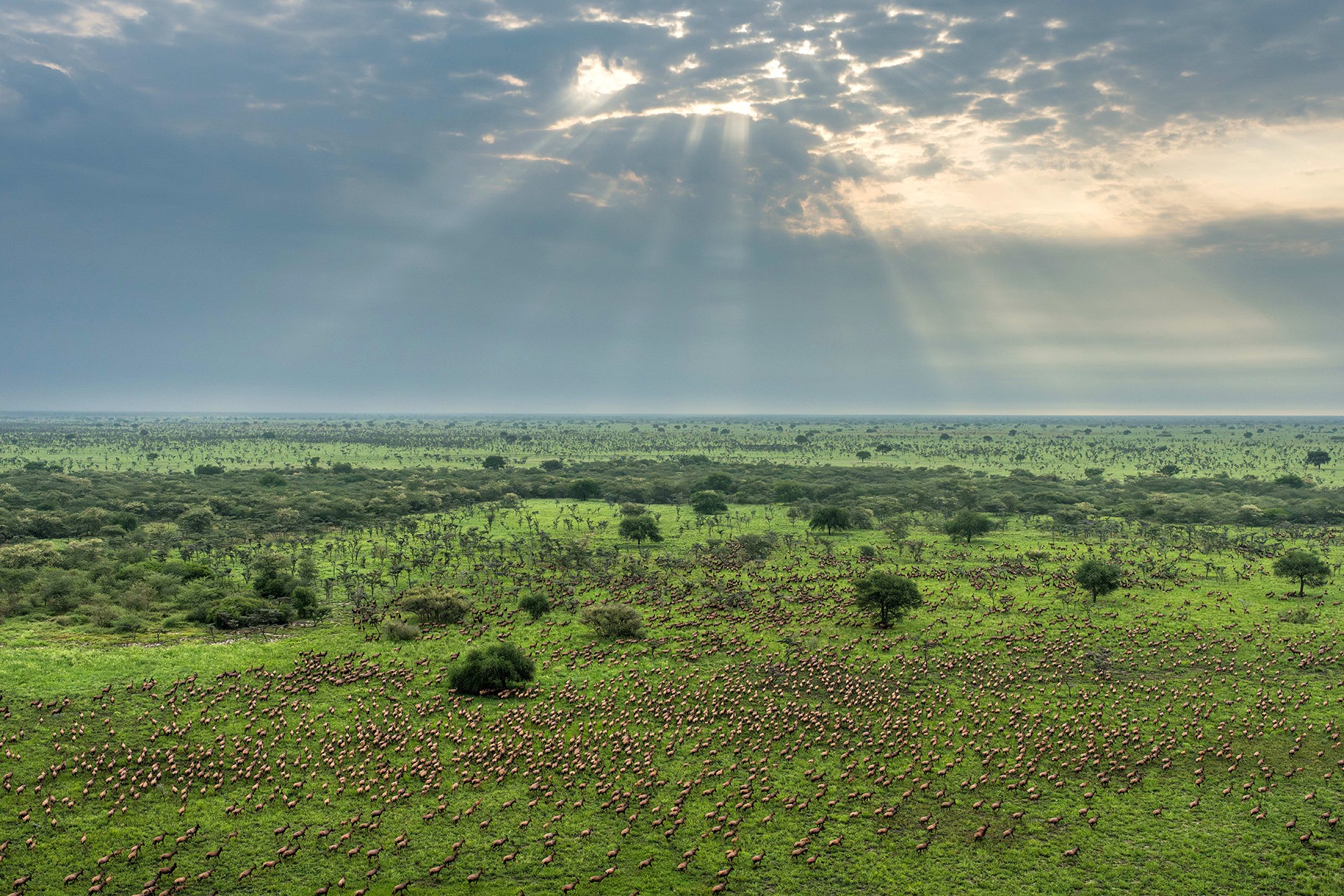
 A massive herd of tiang antelope migrates through the newly listed World Heritage Site in South Sudan. (Photo: Marcus Westberg)
A vast 11 million-hectare landscape in South Sudan, hosting the largest remaining land mammal migration on Earth, has just been added to the Unesco list of World Heritage Sites.
Listed on Sunday, 26 July at a Unesco meeting in the Republic of Korea, the Boma-Badingilo Migratory Landscape supports an annual migration of more than six million antelope, including white-eared kob, tiang, Mongalla gazelle and Bohor reedbuck.
/file/attachments/orphans/tonysudan7WhiteearedkobAntelopeintheGreatNileMigrationLandcsapeDavidSimpson_783253.jpg "White-eared kob race through a gully en route to new seasonal feeding areas. (Photo: © David Simpson)")
As South Sudan’s first Unesco World Heritage Site, the inscription acknowledges the landscape’s “outstanding universal value” and secures international recognition for one of the planet’s most remarkable migratory systems.
Sadly, however, the new site has simultaneously been added to the List of World Heritage in Danger due to several serious threats to this landscape. This includes continued armed conflict in the region, as well as commercial poaching, infrastructure development, “potential extractive industries” and incomplete protection and management arrangements.
The new heritage site stretches northward from the capital in Juba towards the famous Sudd wetland and the Ethiopian border, incorporating the Boma National Park and Badingilo National Park and a network of wildlife corridors that include savannas, floodplains, wetlands and woodlands.
/file/attachments/orphans/tonysudan2NileLechweinBomaBadingiloMigratoryLandscapeMarcusWestberg_443851.jpg "Nile lechwe gallop though an expansive wetland section of the Boma–Badingilo Migratory Landscape, adjoining the Blue Nile and Sudd wetland. (Photo: Marcus Westberg)")
Regarded as one of the largest intact and ecologically functional landscapes in Africa, it forms the heart of the Great Nile Migration ecosystem.
The Johannesburg-based African Parks conservation group, which manages 24 protected areas in 13 countries across the continent, has been working with the government of South Sudan since 2022 under a long-term, renewable management partnership for the Boma and Badingilo national parks and the wider landscape.
It said the agreement was grounded in the recognition that the landscape and its people could not be separated.
/file/attachments/orphans/tonysudan3CommunityherderinKassangorinBomaandBadingiloNationalParksphotoMarcusWestberg_591364.jpg "A livestock herder in the Kassangor area which forms part of the Boma-Badingilo Migratory Landscape. (Photo: Marcus Westberg)")
“As South Sudan grows and develops, the region will inevitably see new infrastructure and investment – an understandable and necessary part of the country’s future. The task is to balance competing demands on land, water and wildlife so that development and this living system advance together, rather than at each other’s expense,” it said in a joint statement with the government of South Sudan.
African Parks chief executive Peter Fearnhead remarked: “There are very few landscapes left on Earth where a natural system of this scale still exists. World Heritage status will not safeguard the landscape on its own, but it does shine an international spotlight on its importance and helps build the support needed to secure its future.”
Unesco said in a separate statement that the Boma-Badingilo nomination had been submitted in terms of the organisation’s emergency procedures because the area represents one of the world’s most significant remaining terrestrial migration systems – but was also currently exposed to “severe and escalating threats that require urgent international attention”.
/file/attachments/orphans/tonysudan8BomaandBadingiloNationalParksSouthSudanMarcusWestberg_947394.jpg "The newly listed Boma and Badingilo World Heritage Site covers more than 11 million hectares of South Sudan. (Photo: Marcus Westberg)")
/file/attachments/orphans/tonysudan5WhiteearedkobantelopeinGreatNileMigrationwideshotDavidSimpson_674965.jpg "White-eared kob antelope form one component of the Great Nile Migration. (Photo: David Simpson)")
In its recent evaluation report, the International Union for Conservation of Nature (IUCN) flagged several threats, including the fact that most of the migratory system outside Boma and Badingilo did not currently enjoy formal legal protection.
The boundaries of the two national parks had also not yet been fully rationalised, demarcated or legally formalised, and in some areas overlap with settlements and community use areas.
The IUCN evaluation team noted that conflict and violence have persisted since the independence of South Sudan in 2011 and this continued to affect the conservation of wildlife and the management of protected areas.
“IUCN considers that insecurity and conflict undermine the effective protection and management of the nominated property and constrain the ability of management authorities to monitor wildlife populations, undertake law enforcement activities and respond effectively to other threats.”
A further serious and growing threat was commercial poaching for bushmeat.
/file/attachments/orphans/tonysudan4TianginBomaandBadingiloNationalParksSouthSudanMarcusWestberg_427574.jpg "A small section of the tiang antelope herds that make up the largest remaining land mammal migration on Earth. (Photo: Marcus Westberg)")
/file/attachments/orphans/tonysudan6fromleftChagotrElEnanyandNyanathimageSouthSudanGovernmentonX_692075.jpg "South Sudanese Minister of Wildlife Conservation and Tourism Denay Jock Chagor and Culture, Museums and National Heritage Minister Sarah Nyanath (right) present their World Heritage nomination to Unesco director-general Khaled El-Enany. (Photo: South Sudan government / X)")
The opening of the Juba-Bor road was reported to have facilitated access to previously remote areas and contributed to the commercialisation of bushmeat hunting, although the government noted that widespread food insecurity had also increased pressure on wildlife.
“Whilst the large migratory populations remain substantial, IUCN understands the tiang population is being particularly acutely affected by unsustainable commercial hunting along roads intersecting its migration routes and notes the need for urgent conservation action to address this.
“The potential expansion of oil extraction and mining activities is identified as a major concern, in particular within the wider landscape outside the national parks... However, in its supplementary information, the State Party affirms that there are no active oil, gas or mining operations in the nominated property, and there are no plans to authorise extractive activities. IUCN notes the overlap between portions of the nominated property and existing oil and mineral concessions, whilst acknowledging the State Party’s confirmation that no active extractive operations are currently taking place within the nominated property.”
According to the Unesco inscription, the heritage site also reflects the important cultural and linguistic diversity of the region with the Murle, Dinka, Nuer, Anyuak and Toposa and other ethnic groups who had been custodians of this landscape through herding, farming and fishing for centuries and even millennia.
Boma-Badingilo also supports important populations of numerous large mammal species, including Nile lechwe, African savanna elephant, African wild dog, lion, leopard, northeastern Africa cheetah and Beisa oryx, as well as significant assemblages of waterbirds, raptors and migratory bird species. DM


Comments
Scroll down to load comments...