




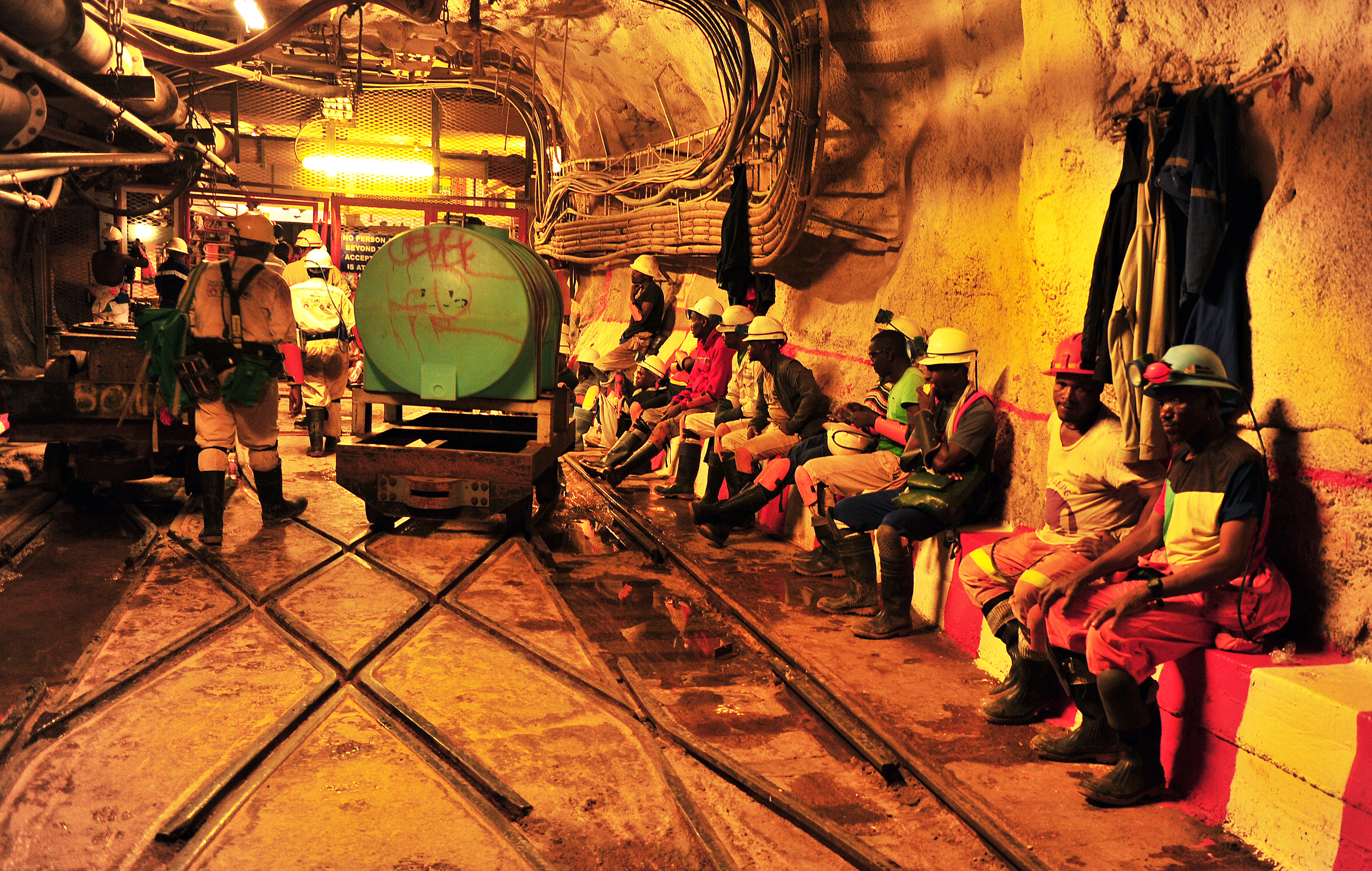
 Mine workers underground at the Sibanye-Stillwater gold mine in Carletonville. (Photo: Elizabeth Sejake / City Press / Gallo Images)
South Africa has the world’s deepest mines, which is testimony to how its engineers historically made a plan in the depths of the Witwatersrand.
Once a leader in mining technology and innovation, South Africa is now a laggard in this commercial arms race, undermining the domestic industry’s ability to tap a rich geological endowment for the wider benefit of the economy and country.
This is one of the key findings of a trifecta of reports released on Thursday, 23 July, by the Minerals Council South Africa (MCSA) at a mine modernisation conference.
“Modernisation is not a discretionary pursuit. It is what will keep this industry safe, healthy, competitive, and viable for future generations,” said MCSA CEO Mzila Mthenjane.
There are domestic exceptions on the innovation front such as African Rainbow Rainbow Minerals’ SmeltDirect initiative, which holds the promise of dramatically reducing electricity consumption in the smelting process – a potential lifeline as smelters fold in the face of surging power prices.
Another which comes to mind is Gold Fields’ South Deep operation, where the mining 3km underground is done remotely on computer screens.
But in many areas, as digitisation, automation and artificial intelligence (AI) take the global mining sector by storm, South Africa is falling behind, especially when it comes to domestic research and development.
/file/dailymaverick/wp-content/uploads/2022/07/GettyImages-832673164.jpg "A worker pours molten gold into a mould during the refining of bullion at the Rand Refinery plant in Germiston, South Africa. (Photo: Waldo Swiegers / Bloomberg via Getty Images)")
The Global Benchmarking Report, prepared by the Johannesburg Research Institute for Innovation and Sustainability (RIIS) and the MCSA, compares South African mining with its international peers on this front and finds it wanting.
On its scorecard of 10 major mining jurisdictions, it finds South Africa’s embrace of “advanced technology” to be low on a ranking system of low, medium and high.
“Competitors are investing billions in innovation, digitisation and value chains. South Africa must move faster to remain relevant in global mineral markets,” reads the report.
To address this, it recommends the reduction of bureaucratic red tape preventing mine permitting, which ultimately discourages investment across the board including in R&D. It also notes a lack of tax incentives to encourage the development of modernising technologies.
Australia and Sweden are ranked at the top of this scorecard as “visionaries” and the report says their success lies in “[...] aligning policy, infrastructure, R&D ecosystems and industry standards simultaneously – not in sequence”.
To address this shortfall domestically, the report’s recommendations include the bolstering of public-private R&D initiatives and the modernisation of rail, port and digital infrastructure.
There has been some work in this area between the private sector and Transnet but a lot more needs to be done and fast.
/file/attachments/orphans/2026-07-2409_10_15-Greenshot_351467.jpg "The Global Benchmarking Report lists Australia and Sweden as visionaries in the global mining sector, with South Africa scoring medium-low overall.")
Reluctance of mining firms
The RDI (Research, Development and Innovation) Survey Report, prepared jointly by HSRC-CeSTII and RIIS, also found a worrying lack of attention to this issue. In response to a question asking if they had employed advanced technology from 2021 to 2023 in their operations, only 35% of the roughly 60 companies surveyed said yes.
The main reasons given for doing so were to lift production and reduce safety risks, which are key concerns of investors in the South African mining space.
Innovation and technology advancement were low on this list, and this is where the future of mining ultimately lies.
One of the factors at play here is the reluctance of South African mining companies to develop their own technologies which could be commercialised.
This may speak to the fact that some domestic attempts in this regard have been duds. Anglo American Platinum’s much-hyped hydrogen-powered mine haul truck unveiled in 2022 turned out to be a flop and the project was quietly shelved.
“In-house technology development was notably limited. The most commonly developed technologies – computerised design and engineering, AI, telematics and green technologies – were each developed by only 15% of firms,” reads the report.
“This suggests firms prioritise solutions with immediate operational relevance over high-cost, technically complex or emerging innovations.”
Part of the challenge here stems from a “human capital” shortage – 66% of the companies surveyed reported a need for specialised skills, a number that rose to 70% among advanced technology adopters.
Slow AI uptake
Last but not least is a report by global consultancy PwC and the MCSA on the state of play of AI in South Africa’s mining sector.
The report points out that “AI is reshaping what is possible in mining”. This includes the use of satellite imagery to flag illegal mining activities. AI can also be deployed to detect hazards in advance and is seen as a game changer when it comes to exploration with “models capable of scanning vast geological datasets in seconds”.
“Mining generates millions of data points every day, yet much of this data remains underutilised. When supported by sound data governance and user‑focused design, AI enables predictive rather than reactive decision‑making, improving safety, productivity, compliance and sustainability,” notes the report.
“What we see clearly is that AI is not being viewed as a replacement for people,” said Ian Mackay, associate director of mining transformation at PwC South Africa.
“Mining leaders see it as a way to strengthen human capability, enabling safer operations, better decisions and faster responses in an increasingly complex operating environment. The value emerges when technology and people are designed to work together.”
But the report notes that in South Africa, the AI uptake in mining has been slow even as the revolution it has spawned unfolds at a bewildering pace that currently accounts for much of global economic growth and off-the-chart equity valuations.
Nearly half of the South African mining CEOs surveyed rated their AI strategy as “average” and only 23% saw it as “well-defined and aligned with their business goals”.
Taken together, this trio of reports points to a domestic mining sector that needs to up its technological game. They are a wake-up call for companies, policymakers, investors and South Africa more widely.
When South Africa was a technical leader in the shafts decades ago, it was in service to an exploitative colonial and apartheid economy. In a young but vibrant democracy that remains burdened by much of that insidious legacy, it would be a spectacular own goal to squander the country’s mineral wealth by falling behind in this race. DM
Comments
Scroll down to load comments...