




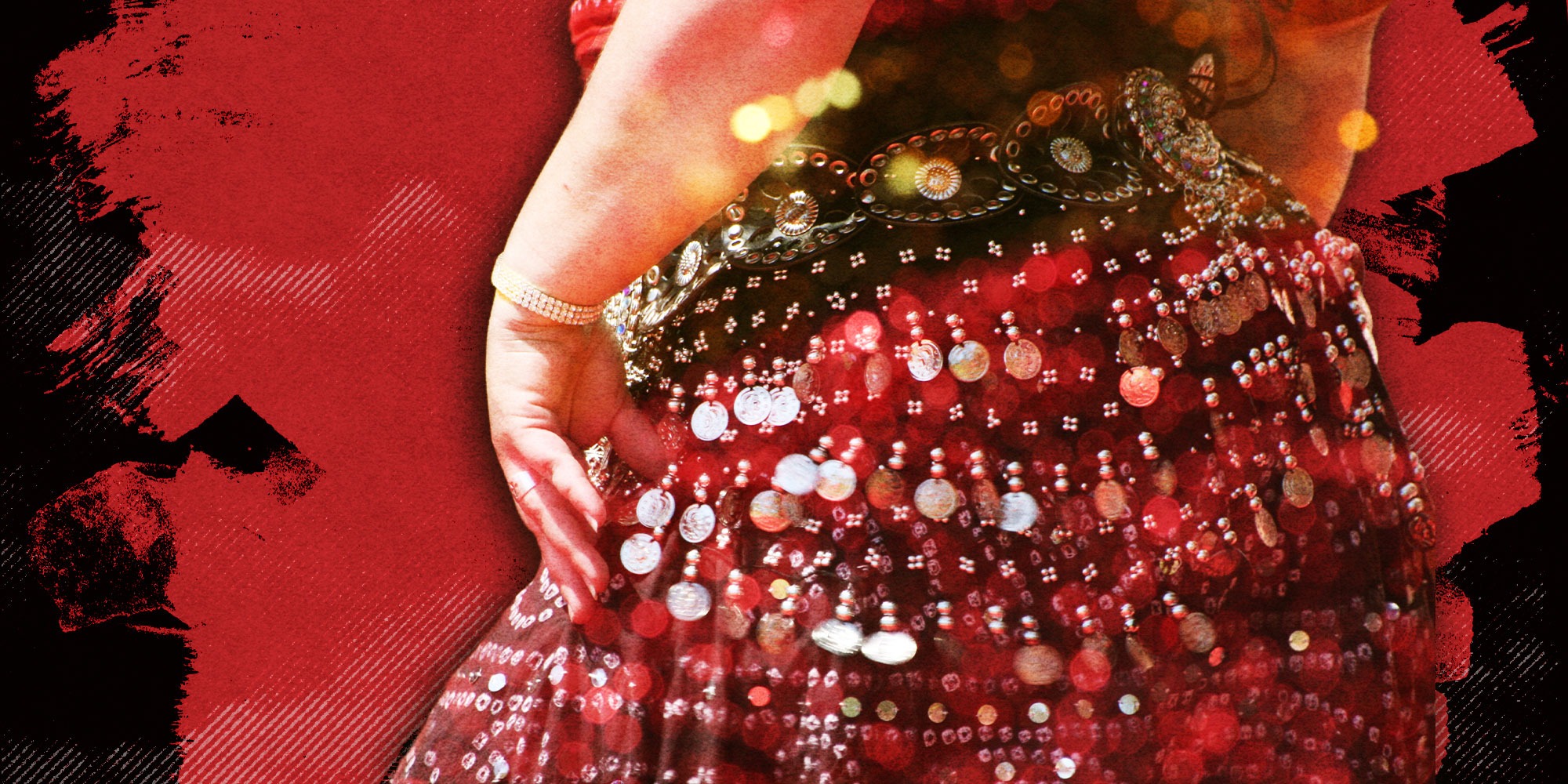
 Illustrative Image: Belly dancer. (Photo: Istock) | (By Daniella Lee Ming Yesca)
The music was Amr Diab. The air still carried cumin and roasted lamb. Dinner was done, the wine was open, and my friends were pressing me to show them what I’d been learning at belly dance class. I laughed it off, shy. They kept at it. Finally I tucked the hem of my top into the strap of my bra, pressed play, and repeated my teacher’s words to myself like a prayer: belly dance is not for the gaze of others. It is for you. Go inward and let it spill outward.
I closed my eyes. I traced slow figure eights with my hips, the music thudding low and insistent. At first I was stiff with self-consciousness, and then the rhythm loosened me, and something deep and unspoken rose up: a current moving through my arms, my spine, my hips, a language my body seemed to have known all along.
Then silence. The music cut.
I opened my eyes to find the man I was seeing standing in front of me.
“I think you should serve dessert,” he said flatly. “You’re making a fool of yourself.”
The shame was instant and searing. I wanted the floorboards to open and swallow me. The next morning I could barely get out of bed. A week later, still haunted, I confessed to a friend how foolish I’d felt. She didn’t hesitate. “You weren’t the fool that night,” she said. “You were radiant. There was a fool in that room, but it wasn’t you.”
It took me years to understand what actually happened in that lounge. I had thought it was a story about embarrassment. It was a story about power.
The feminist writer Audre Lorde described the erotic as a hidden resource within each of us, a wellspring of power and insight that women, in particular, are taught to suppress.
We are raised to behave, to contain, to silence the deeply sensual parts of ourselves. But the erotic, when we let it breathe, is not about excess. It is the shared joy and connection – physical, emotional, intellectual, spiritual – that makes life more textured and more meaningful. It is an unguarded way of being in your own skin.
What I was surfacing that night, something tentative, tender and fierce, was too much for him. Too visible. And yet it was never for him. It was mine. That was the first time I understood, before I had words for it, that the erotic is dangerous in a world that prefers women contained. It can be policed, diminished, turned into ridicule in a single sentence. Serve dessert. Sit down. Be smaller.
Here is what makes the containment so effective: we are offered a substitute. In place of the erotic, which asks us to be fully alive, we are handed the fantasy, which asks only that we be chosen.
The myths of romance are everywhere: in films and novels, in advertisements and love songs, in the whispered certainties of teenage girls who believe that one day someone will arrive and make them whole. These are not harmless fantasies. They shape us, long before we know what love is, into believing that to be wanted is the pinnacle of our worth.
And I have confused the two – the rush of being wanted with the fullness of the erotic. I know the butterflies, the chase, the heat of the forbidden. It feels intoxicating. Part of it is simply chemical: the dopamine of intermittent reward, the way uncertainty sharpens desire.
When affection comes in fragments, in stolen moments, scarcity itself becomes part of the high. We tell ourselves this is passion, when often it is anxiety dressed in silk.
The fantasy survives because we feed it. We spin stories to keep the illusion intact: he just needs time. It’s complicated. He will change. He’s not ready, but he will be. These are not only stories we tell others; they are stories we tell ourselves, and we nourish them with our hope. In the meantime, we hand over pieces of ourselves to sustain a dream that asks more than it gives.
I know what that costs. I was named for a woman it killed.
My aunt, my namesake, was beautiful and fiery, with a thick mane of black hair and a vibrancy ahead of her time. She learnt to drive when women in the family did not. I never met her, but I grew up knowing her through the glow of my mother’s stories, where she was always radiant, laughing, daring.
Like so many women, she fell in love. He proposed with a gold ring set with a pearl. When she showed my grandmother, the response was not joy but warning: “Pearls bring tears. They are bad luck for brides.” My aunt was undeterred. She carried on planning the wedding, carrying the future she longed for until the day she discovered he was already married.
The story is told that she came home in tears. Later she called him, on the landline that sat in the open where conversations could be overheard. When she put down the receiver, she said she was tired, and went to bed. By morning, at 21 years old, she was gone.
I have hesitated to write about her. Whose story is it to tell?
Some in my family may prefer silence. But when I ask myself what she would want, the answer I return to is this: to be remembered. To not let her life, or her death, fade into quiet. And to hope that what happened to her, a woman undone by the discovery that the love she had invested in was an illusion, might help another woman see her own illusion sooner.
Her story was singular. It is not isolated.
Because illusions do not only collapse in dramatic ways. Sometimes they erode slowly, almost invisibly. There are few betrayals more destabilising than the gradual ones, not the shock of infidelity, but the slow realisation that something once tender has turned sharp, that a relationship no longer nurtures but consumes.
I have sat inside that dawning myself. I remember telling my daughter, then eight, that her father and I were divorcing: the three of us on the couch at dusk, her small body between us as the sun slipped away.
Even in the certainty of leaving, I felt the weight of the myth pressing in: that a woman must hold it all together, that love lasts if you only try hard enough, that breaking is failure. Even then, I was tangled in the story of what a woman is supposed to get right.
The question is not only how we leave. It is how we learn to see clearly enough to know that we should, how the reasons that keep us, real and imagined, can be taken apart brick by brick until the path out appears.
And there is one more lie that needs dismantling, because it is aimed at every woman who survives all the others: that this is a young woman’s question. That after a certain age we must fold away our erotic selves, as if the body no longer matters, as if desire has an expiry date.
We are alive until we are not.
The capacity for the erotic does not dim with the years; it simply takes new shapes. No matter your age, it is available to you if you choose it even when the world stamps beyond your sell-by date on you. Shake it off. Return to yourself on your own terms.
These days I am learning to find the erotic first on my own, in the solitary ways life stirs me awake: the pulse of music when I dance alone, with no one to cut the sound; the sun on my skin when I walk my dogs; the way a book carries me into another life; the stretch of yoga, arms lifted to the sky.
I live so much in my head, tangled in ideas and words, that this has become a practice of embodiment, of remembering that my body is not a vessel to be endured but a site of possibility and joy. And I am finding it in connection too, with a partner, where eroticism is not only desire but listening, seeing, finding each other in layered ways, where time itself becomes a kind of tenderness.
The erotic, I have come to believe, is not a luxury. It is not a fleeting spark, not something reserved for the young or the unbroken. It is a way of being that insists we live awake: to ourselves, to each other, to life. To claim it is to refuse the smallness we have been trained into.
The man who told me to serve dessert believed he was returning me to my proper place. In a way, he did.
My proper place turned out to be my own body, my own desire, my own life. I am still here. Still alive. Still possible.
And so, whether the world likes it or not, is every woman reading this. DM
Joy Watson is Book Editor At Large at Daily Maverick
This essay draws on ideas in Joy Watson’s novel Because I Love You: Three Women, Three Stories published by Jonathan Ball Publishers in 2026. It is available to purchase at the DM Shop.
Comments
Scroll down to load comments...