




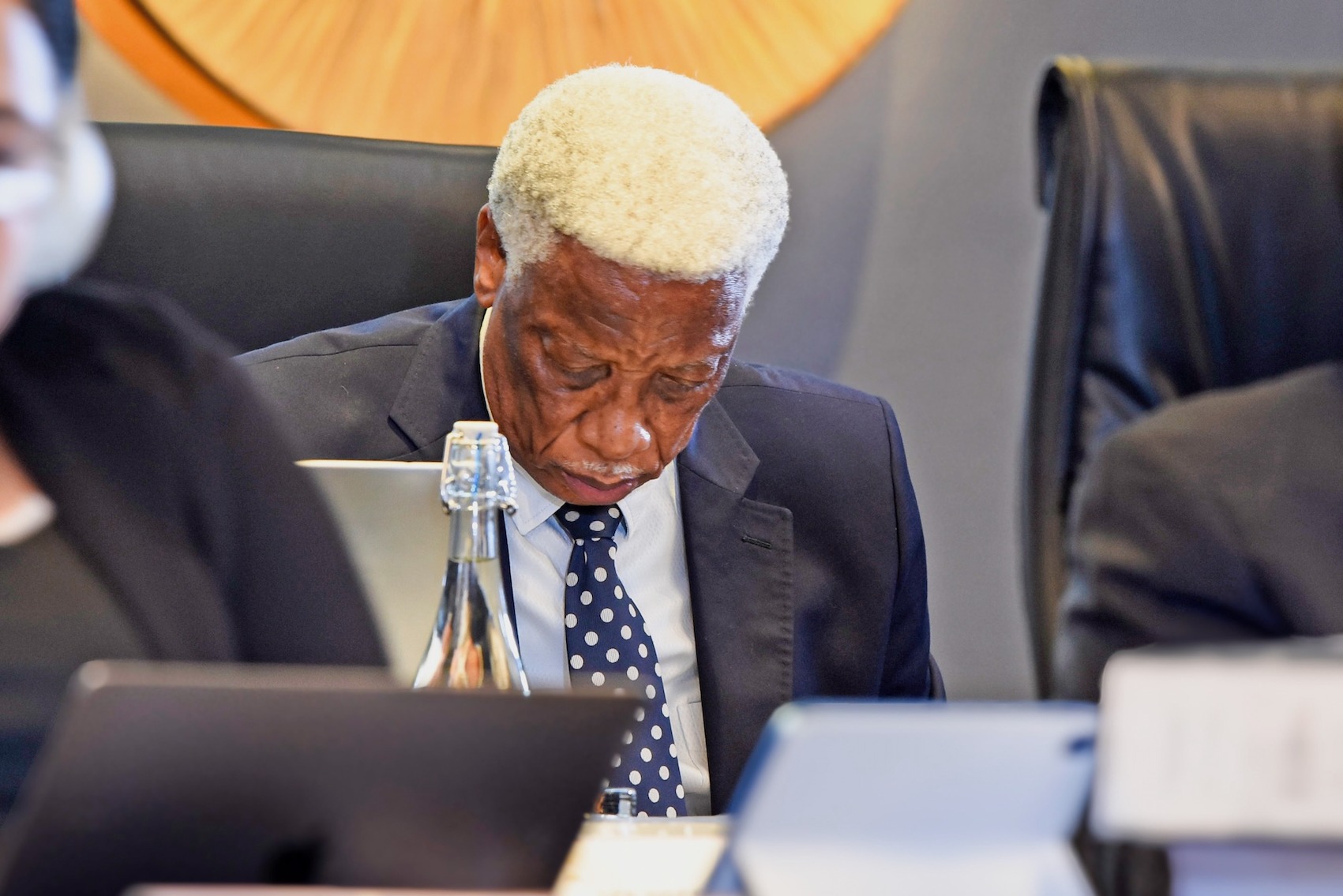
 Eastern Cape Judge President Selby Mbenenge at the Judicial Conduct Tribunal into a complaint of sexual harassment against him in 2025. (Archive photo: Office of the Chief Justice / N Mabusela)
Disgraced Eastern Cape Judge President Selby Mbenenge, who has been on “special leave” since 2023 after allegations that he sexually harassed a junior secretary at the court, is to be placed on formal suspension.
His “special leave” status, repeatedly confirmed by the Judicial Service Commission (JSC), differed from the usual rules, where judges facing gross misconduct charges are immediately suspended pending the ruling of a Judicial Conduct Tribunal.
The JSC did not immediately suspend Mbenenge because he was already on special leave. However, at its meeting in June, it resolved to recommend to President Cyril Ramaphosa that Mbenenge be suspended now that he had been found guilty of gross misconduct and impeachment proceedings had been initiated.
In January, after hearing evidence that included salacious messages and sexual emojis between Mbenenge and secretary Andiswa Mengo, the tribunal ruled that he was only guilty of a “degree of misconduct”.
But in April, the JSC refused to rubber-stamp the tribunal’s finding and recommended that he be impeached.
The JSC said the tribunal had not properly understood the power balance between the judge president and a secretary, and that sexual harassment was an “affront to the propriety of judicial office and the values underpinning the Constitution”.
In response, Mbenenge launched legal proceedings in the High Court in Pretoria to stop the impeachment process, pending a review of the JSC’s decision which he described as “unreasonable, unconstitutional and unlawful”.
With that application pending, the JSC has now said Mbenenge must be formally suspended.
In its report, the JSC stated both Mbenenge and Mengo had made written submissions on the issue.
Mengo said that Mbenenge should have been suspended after the tribunal hearings started. She said the gravity of the findings of gross misconduct, the significance of the position he holds, the public interest in the matter, public confidence in the judiciary and the impact on her personally, should hold sway.
Mbenenge opposed this, claiming that since he is on special leave with the consent of the Chief Justice, there was no risk of him doing judicial duties, and suspension was being used to “embarrass” him.
He said it was also inappropriate given his legal challenge to the JSC findings.
The JSC said the question was whether a formal suspension was necessary to protect the integrity, dignity and public standing of the judiciary while the constitutionally prescribed removal process ran its course.
It noted that Mbenenge had again been granted special leave by the Chief Justice in April, after he filed his review application.
However, the JSC said in its report: “Unless and until the JSC’s decision [finding him guilty of gross misconduct] is set aside by a competent court, it remains the operative decision.
“A recommendation of suspension would not undermine the review, nor would it pre-empt the role of the National Assembly [which decides impeachment]. It would regulate the interim position pending the finalisation of the constitutional process.”
The JSC had also taken into account the seriousness of the findings of gross misconduct, based on the facts admitted by Mbenenge, the public interest, the need to protect the integrity and reputation of the judiciary, and the need for consistency.
The suspension was not “punitive but precautionary in nature”. While it may have an adverse impact on Mbenenge, that impact had to be balanced against the need to protect the judiciary, it said.
The JSC also noted that Eastern Cape High Court Judge Belinda Hartle – who is facing charges that she made derogatory and racist remarks to a registry clerk – had been suspended despite “opting for special leave”. DM
First published by GroundUp.
Comments
Scroll down to load comments...