





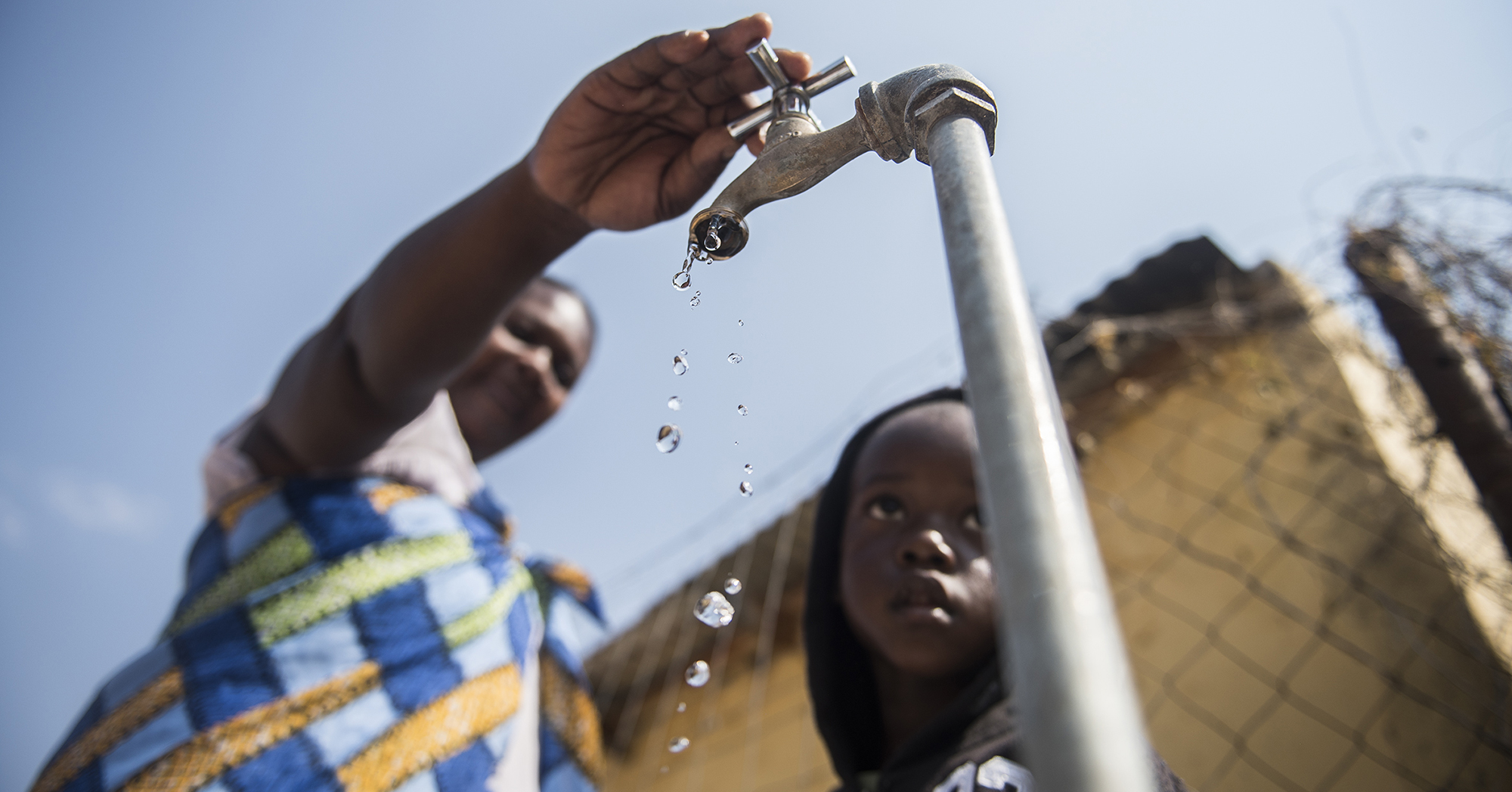
 A woman fills her bucket with water from a trickling tap in North West. (Photo: Shiraaz Mohamed)
 /file/dailymaverick/wp-content/uploads/2025/10/label-Op-Ed.jpg)
Water scarcity in cities is not simply a question of whether pipes, taps and reservoirs exist. It is also about who can access them, when water flows, who carries the burden of securing it and the social networks and improvisations that keep urban life going when formal infrastructure fails.
This was one of the central messages to emerge from the Food Indaba 2026 webinar Water Scarcity in Global South Cities, held on July 20, as part of this year’s programme themed around water and food systems.
Hosted by Gareth Haysom of the African Centre for Cities, the webinar brought together insights from Bengaluru (India), Mossel Bay, Tamale (Ghana) and Cape Town – four secondary cities in the Global South, where rapid urbanisation is pressurising already-strained infrastructure.
Water access is not the same as water security
In Bengaluru, Vrashali Khandelwal of the Indian Institute for Human Settlements presented research from a densely populated ward where around 80% of households have access to treated tap water, more than the city-wide average of 70%.
The reality on the ground is far more complex, however.
According to Khandelwal, residents rely on a patchwork of systems: the city water grid, boreholes, water ATMs, tankers and other off-grid arrangements. Water from the city network may arrive only a few times a week, while access to borehole water depends on pumps, repairs, storage capacity and the timing of supply.
“Multiplicity is not to be read as resilience, but it’s actually a coping strategy,” Khandelwal explained.
“The ability to cope is also shaped by income and housing conditions. Households with greater storage capacity can hold more water, while others must continually adapt to the timing of supply. In some cases, treated water arrives during the early hours of the morning, and women carry much of the responsibility for waking up, collecting and storing it,” she added.
The consequences extend directly into the food system. Water availability affects how households cook, clean, store food and manage their time. The hidden labour of making infrastructure work, Khandelwal argued, is also deeply gendered: women often carry the primary responsibility for securing and managing water for their households. This burden includes not only physical work, but also the cognitive and emotional labour of managing unreliable systems.
The everyday cost of waiting
In Mossel Bay, University of Cape Town researcher Mercy Brown-Luthango examined water access in three informal settlements undergoing a process of upgrading.
Her research shifted attention away from the long-term waiting for formal housing towards what she described as the “chronic everyday waiting” associated with accessing basic services.
In one settlement, a single tap served hundreds of households. During peak periods, residents faced low water pressure and long queues. People had to learn when water was likely to be available, plan their days around peak demand, collect and store water in advance and seek alternative sources from neighbours or other settlements.
Residents effectively became managers of an unreliable system.
This waiting has consequences far beyond inconvenience. Poor access to water affects food preparation, food storage and food choices. Residents described delayed meals, having to plan cooking around water and electricity availability and being unable to safely store fresh food.
Yet the research also showed that waiting is not passive. Residents pool resources, install pipes and taps, create informal connections and rely on networks of neighbours and family.
These relationships become a form of social infrastructure.
/file/dailymaverick/wp-content/uploads/2024/05/michelle-national-water1.jpg "Residents in Lenasia South, Johannesburg, still face water cuts despite the recent construction of a reservoir. Infrastructure systems must catch up with the pace of urbanisation, attendees at the Food Indaba 2026 heard. (Photo: Shiraaz Mohamed)")
Water access is negotiated
Issahaka Fuseini said that in Tamale, Ghana, water scarcity is a recurring crisis that intensifies when the rainy season ends.
“The city’s water infrastructure was designed for a much smaller population. Current demand significantly exceeds production, while only around 40% of households have in-house connections. Supply is rationed, and access varies significantly depending on where residents live,” Fuseini said.
As a result, residents rely on alternatives, including water tankers, tricycles, vendors, boreholes, dams and hand-dug wells.
But access is also shaped by relationships and negotiation. Communities seek support from politicians, NGOs and faith-based organisations. Boreholes may be provided through political commitments, while charities support the construction of wells and other water infrastructure.
In some cases, communities themselves resist development that threatens access to existing water sources.
Water access also shapes the geography and value of the city; properties located near reliable water supplies are more valuable, with water availability influencing patterns of urban growth.
Designing water into the food system
The final presentation brought the discussion back to Cape Town, as Tamsin Faragher talked about the redesign of the Smiley Market in Langa as part of the AfriFOODlinks programme.
Here, water was not simply an infrastructure service to be added to an existing market. It became a force shaping the architecture itself.
The requirements of water, sanitation and stormwater departments influenced the design of the market. The need to manage wastewater and prevent contamination meant that the market required a roof. Ablution facilities were necessary to create a dining area, while water was also needed to clean food preparation and waste areas.
The process revealed how closely water, food, energy, sanitation and the built environment are connected.
Faragher argued that markets could potentially become resilience hubs, incorporating infrastructure such as boreholes and solar power. Her talk highlighted that water scarcity cannot be separated from energy scarcity, and that the water-energy-food nexus becomes particularly visible when infrastructure systems fail.
Beyond infrastructure as hardware
/file/dailymaverick/wp-content/uploads/2021/09/long-wait-for-water1.jpg "A community member waits for her bucket to fill at a communal water tap in Nhlaneki village, Giyani. Poor access to water affects food preparation, food storage and food choices, attendees at the Food Indaba 2026 heard. (Photo: Lucas Ledwaba / Mukurukuru Media)")
The webinar revealed a common pattern: water scarcity results from the absence of infrastructure, compounded by uneven systems that people must navigate daily.
The presentations further showed that infrastructure is never just technical. It is social, political and deeply connected to food, health, gender, dignity and urban inequality.
As Haysom noted in closing, rapidly urbanising cities across the Global South face a growing challenge: infrastructure systems must catch up with the pace of urbanisation, even as the resources to build and maintain them become increasingly constrained.
The question, therefore, is not only how cities will secure more water; it is also how they will understand, design and govern the systems through which water reaches people, and how those systems shape the food, livelihoods and futures of urban communities. DM
Thandi Mancoba is a researcher at the African Centre for Cities and Communications Lead for Food Indaba and the South African Urban Food and Farming Trust. Her work focuses on urban food systems, food justice, research communication and the everyday realities shaping cities and communities.
This article is part of the Food Indaba 2026, themed: Food Systems and Water Systems – Rivers, Oceans, Aquifers and Rainfall (ROAR), taking place across Cape Town from 20 July to 2 August 2026.