




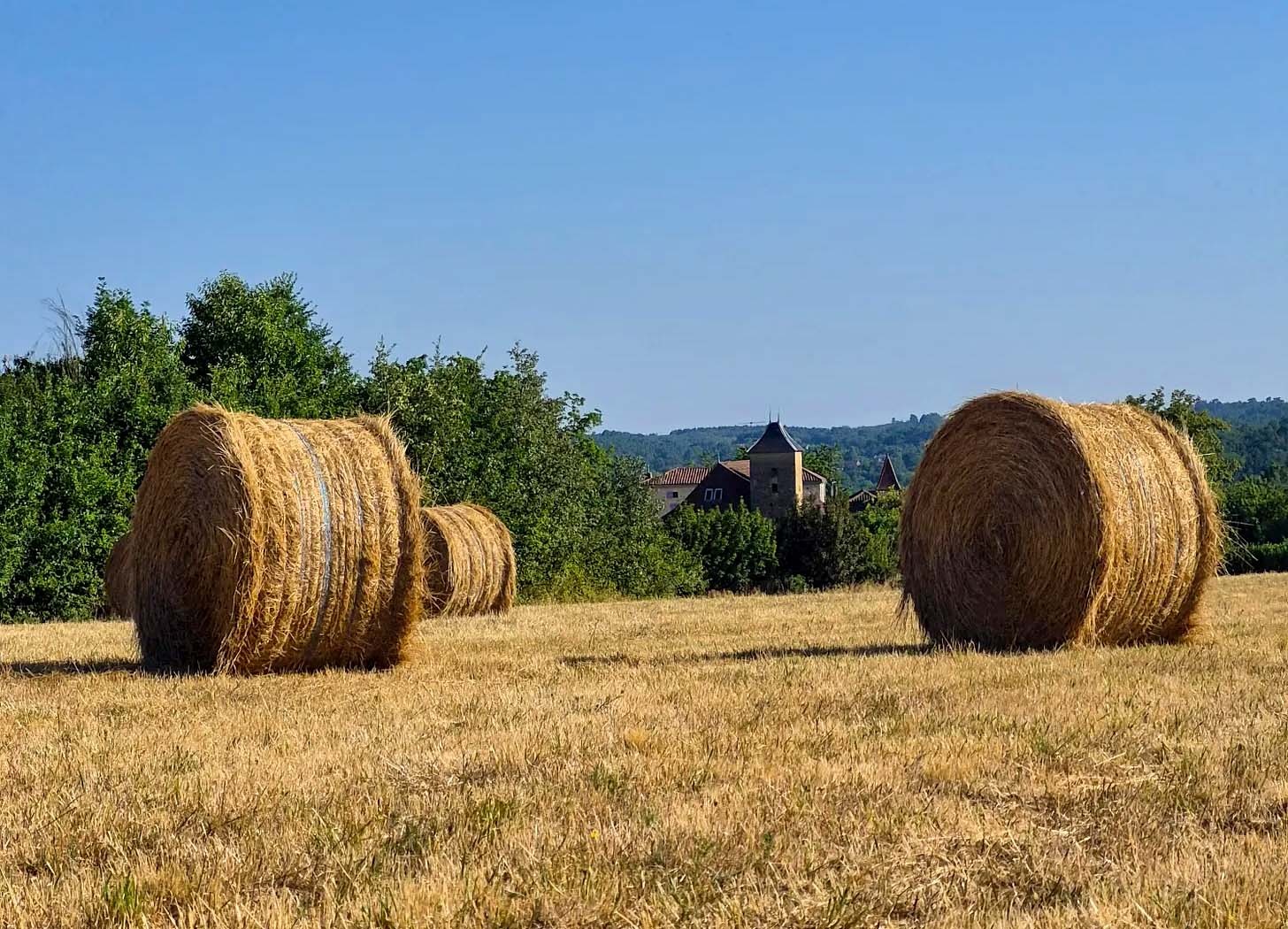
 When France is hot and dry, South Africans living there maak 'n plan... (Photo: Marita van der Vyver)
 Oops. This fortnight break is the longest I’ve been away since I started regularly posting on Substack last year. What can I say? It’s summer and the living is easy?
No, in fact the living has been quite hectic this summer. I don’t think we can even call it a succession of heat waves rolling over us any longer. It feels more like floundering in a continuous heat flood that is sweeping away some of our most popular seasonal pastimes and traditions.
My favourite French festival, the Fête de la Musique, celebrated annually on the longest day of the year, was cancelled in many regions due to extreme heat. On 21 June the streets are usually alive with people and music, from Paris to the smallest hamlets, but this year an eerie silence reigned in the deserted streets of our village. Numerous summer festivals of rock, jazz, blues, street theatre, you name it, suffered the same sad fate.
Even this week’s Fête Nationale (which the French never call “Bastille Day”) was a subdued affair. Stalls selling beer and wine on village squares around us were banned, with the flimsy excuse that emergency services had to be ready to deal with heat-stroke victims and possible fires, and therefore couldn’t be bothered with alcohol-related accidents. As if hordes of drunken revellers, driven mad by the heat, would re-enact the storming of the Bastille. Maybe behead a few mayors and drive the rich from their luxurious summer homes?
Summer in the French countryside has always been my most social time of the year, when I crawl out of my solitary winter cocoon and entertain visitors from far and wide. Inviting friends and neighbours over for al fresco dining, participating in village festivals, enjoying picnics and evening food markets. But this summer the extreme weather has been messing with everyone, draining our social energy, making it much more tempting to stay inside next to a fan than to attempt any kind of outing.
The irony is that our drawn-out restoration project is finally finished; we now have the desired courtyard where we can host lunches under a huge umbrella and dinners under the stars – but it’s so damn hot that we mostly eat inside. And since it’s torture spending too much time close to a stove, we survive on salads and cold soups.
We did, however, celebrate our new courtyard with a few friends. We couldn’t call it a roof wetting because there is no roof (we removed the roof of a ruin to construct the courtyard), but describing it as a roofless party might make us sound as if we’d lost our home. Housewarming was also not the right word because the whole point of the courtyard was to entertain outside the house. This left us with crémaillière, the French translation for housewarming, which literally means the rack from which a pot of food was hung over the kitchen fire. Trust the French to regard food as the most important part of any party. So we settled for the French word.
Most of our guests were South Africans. Don’t ask me how that happens, but it usually does, wherever I live in France. I don’t search out my compatriots on purpose; I believe the chances of not liking someone from my birthplace are more or less the same as the chances of not liking someone from any other country. But the outsider in me is always attracted to other outsiders, whether they’re from South Africa, Italy or Japan. And if they happen to be open-minded South Africans, there is an immediate connection of shared context to ease a potential friendship along.
Anyway, the guests all spontaneously offered to bring something to eat. Maybe it has nothing to do with being South African, this fear of arriving empty-handed, but it surely makes life easier for a lazy hostess who doesn’t want to over-plan the food.
Marietha, who lives in a neighbouring Périgord village, arrived with an enormous plate of assorted cheeses “with frills”, as she labelled it, including a South African touch. A creamy Camembert cut in half horizontally, stuffed with finely grated biltong, and covered with equally finely grated macadamia nuts. A surprising combination of French, South African and Australian flavours that hit all the right spots. She also included some quince paste recently bought in South Africa, which reminded me of the traditional pâte de coing produced as festive Christmas fare in Provence.
Jaco and Petrie, who own a wine farm close to Bergerac, insisted on bringing a home-baked bread pudding — another Proust’s madeleine from my South African youth — which we served with warm custard and/or vanilla ice cream. They also provided us with many bottles of wine from their Château Lestevenie range, made by (yes, you guessed it) their South African winemaker.
/file/attachments/2995/marita2_628245.jpg "A huge wooden totem sculpture brought by guests. (Photo: Marita van der Vyver)")
Other guests brought other gifts, quiches, honey, jam, even a huge wooden totem sculpture created by a sculptor in our street. It fits beautifully in a niche in one of the stone walls of our courtyard — although Eric had made it in 2023, before the courtyard existed, and named it Energy, as if he could foresee that energy was exactly what we would need in the crushing heat of 2026. But the biggest gift was simply everyone’s presence — and however corny that may sound, sometimes it is true.
I used to be nervous about language differences and communication difficulties whenever I hosted a party – until I realised that all my parties were inevitably multilingual and multinational, and possibly more enjoyable because of the eclectic mix. Our crémaillière was just another example of this allegaartjie, the memorable Afrikaans word for a mixed grill. Adrian and Basil, who had to drive quite far to reach us, warned us that their French was not yet fluent, but I assured them English and Afrikaans would be spoken too.
Even Spanish, as it happened, because two of our guests were from Uruguay and Venezuela. The Spanish-speakers didn’t know each other, nor did all the South Africans, but by the end of the evening I could see the beginning of a few beautiful friendships taking shape.
Even the weather played along and allowed us a brief respite, a suggestion of a breeze, although luckily not enough of a breeze to blow out the candles we could light outside.
But in between organising our roofless roof wetting and wilting in the relentless heat, I also had to get some urgent writing done. (Probably a more acceptable excuse for neglecting Substack.) I needed to write a promised essay for a decor magazine, and make some progress with a novel-in-progress, and check the final proofs of a YA novel to be published in September.
This last task was the most difficult. I used to turn into a nervous wreck each time I had to let go of a manuscript – and correcting the final proofs is really the last chance to change anything before the book is thrown to the wolves out there. But after 40 years as a published author I’ve learned that most things in life become, if not easier, then at least bearable if you do it often enough. I won’t say practice makes perfect, but practice does indeed help.
/file/attachments/2995/marita3book_448801.jpeg "Letting go of your manuscript can be the hardest thing.")
I still hate the process of letting go, but I don’t get skin rashes from stress as I used to, or frightening panic attacks that resemble heart attacks. I do yoga to relax and breathing exercises to calm down instead of drinking too much coffee and smoking too many cigarettes as I used to. And I console myself that the text of this youth novel, Twee halwes maak ’n hele, won a competition run by a major publisher, so it can’t be completely without merit – but still. Living ain’t easy if you have to let go of something you’ve worked on for almost two years.
I did it, though, I rolled this weight off my shoulders a few days ago. I would’ve felt much lighter if the heat weren’t still bearing down on me. I have the other unfinished manuscript waiting in the wings, but hopefully I’ll be able to deliver that one in winter. Summer will never be my favourite writing time, and the hotter the summer, the harder the writing. That I now know.
Picture of the week
/file/attachments/2995/marita4_569556.jpg "How the butcher wraps meat in our village butchery. (Photo: Marita van der Vyver)")
We are fortunate to have a butchery in our village. There used to be two, before people started buying cheaper meat in supermarkets, but at least we have one left.
I’m not a big meat eater – except for duck, which our butcher doesn’t sell – but I try to support his small traditional shop whenever I can. And each time I buy a piece of meat or charcuterie there, I’m thrilled to watch him wrap the food in white paper decorated with a drawing of our village square. The butchery is next to the old market place and the ancient stone church depicted on the wrapping paper. To me this feels like pure luxury, a parcel of food wrapped like a gift, instead of dumped in a plastic bag or handed over in a generic brown paper bag.
Taste of the week
The shiny slice of pâté de tête I bought at the butchery, eaten cold with a chunk of bread and a green salad, ideal for a light summer lunch. It is also called “head cheese” in English – although it has nothing to do with cheese, go figure. What it is, is a jellied terrine made with flesh from the head of a pig or a calf. Sounds a bit grillerig if described like that, so it was just as well I didn’t know what I was eating when I first tasted it in France many years ago. After tasting it, it was too late not to like it.
Quote of the week
First, I’ll tell about the robbery our parents committed. Then about the murders, which happened later.
This is how Richard Ford starts his magnificent novel Canada, which I recently picked up in a second-hand book store in a sleepy French village.
It is the kind of opening phrase that instantly draws the reader into the story. I would place it right up there with my favourite opening sentences in literature, like the irresistible beginning of Gabriel García Márquez’s first novel, One Hundred Years of Solitude:
Many years later, in front of the firing squad, colonel Aureliano Buendia would remember that distant afternoon his father took him to see ice.
Or Anthony Burgess’ outrageous statement in Earthly Powers:
It was the afternoon of my eighty-first birthday, and I was in bed with my catamite when Ali announced that the archbishop had come to see me.
How can you not want to know more when a book begins like this? According to Stephen King (whose advice I often quote to attendees of my creative writing workshops), a good opening line should say:
Listen. Come in here. You want to know about this.
Richard Ford’s first two lines pass this test with flying colours. Of course a brilliant opening paragraph is no guarantee that the rest of the book will be equally brilliant. On the contrary, sometimes it raises such high expectations that the reader can only be disappointed.
Therefore it is with immense relief that I can report that I read all 500 (and something) pages of Canada without ever feeling let down. We’re only halfway through the year, and I hope to read a lot more in the second half, but I can already tell that Canada is going to be one of my books of the year.
My only regret is that I didn’t read it when it was first published in 2012. Then again, I do believe the right book comes to the right reader at the right time, and perhaps I wouldn’t have been ready for the melancholic wisdom of this one 14 years ago? DM
Republished from Marita van der Vyver’s Substack. Read more of her Substack pieces here.