




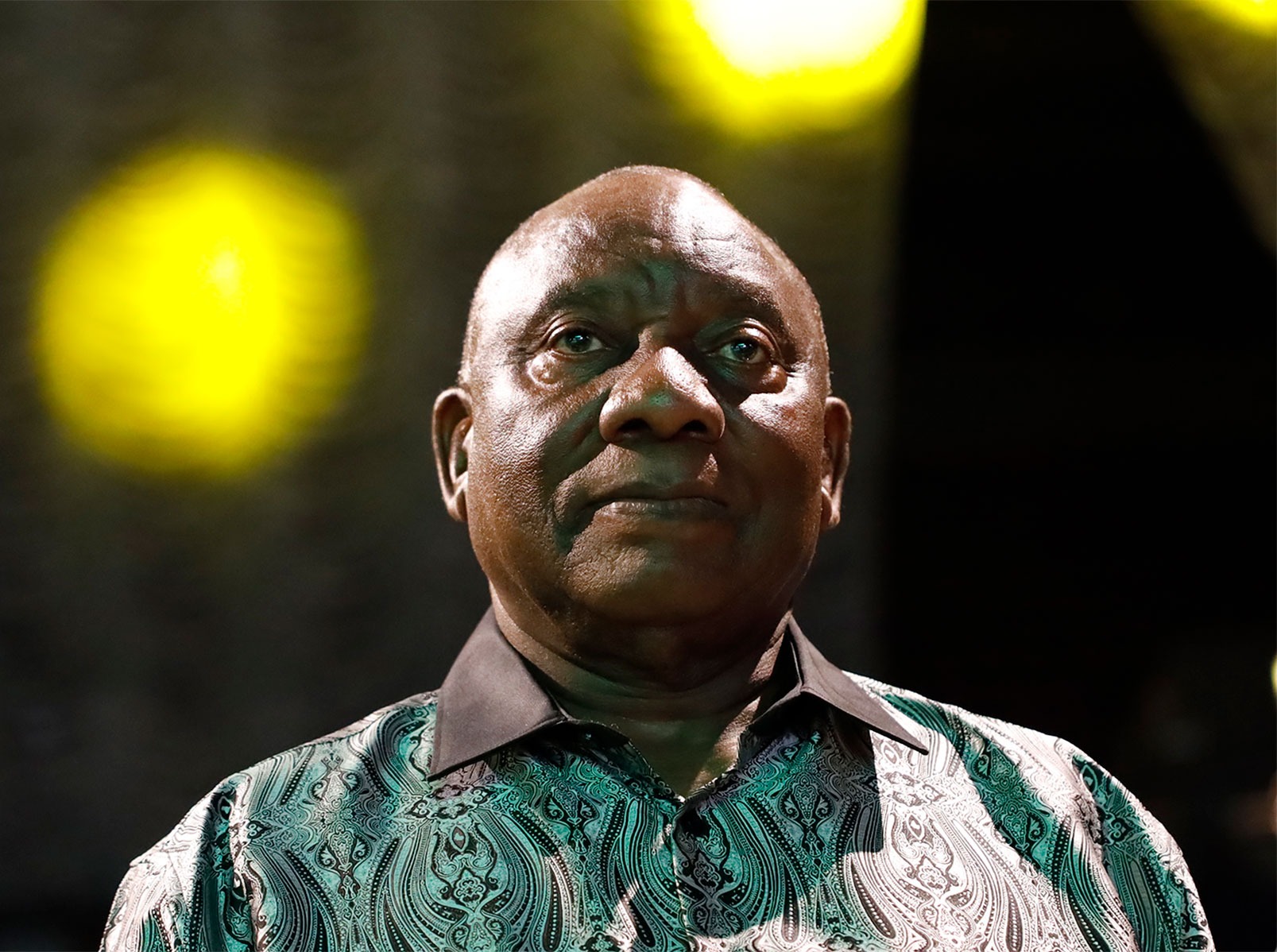
 The Phala Phala impeachment process is on hold after President Cyril Ramaphosa won a high court interdict. (Photo: Gallo Images / Sharon Seretlo)
 The Western Cape Division of the High Court has granted President Cyril Ramaphosa an interdict to stay Parliament’s Section 89 impeachment committee from proceeding with its public impeachment inquiry in the Phala Phala saga.
“This court has carefully considered the weighty arguments advanced by the parties in the limited time available, given the urgency of the matter,” Judge Andre le Grange said when reading the judgment on Friday morning, 24 July 2026.
“There are three judgments. The first judgment concludes, for reasons set out therein, that the president has not made out a case for an interim interdict. It proposes that the application be dismissed.
“The second judgment concludes that the president has made out a case for an interim interdict, for the reasons set out in that judgment. It proposes that an interdict of limited duration be granted.
“The third judgment concurs with the second judgment. The second judgment is the majority judgment.
“In the result, the following order is made… Pending the determination by this court of the applicant’s review… The first and second respondents [National Assembly Speaker Thoko Didiza and the Section 89 impeachment committee chair, Rise Mzansi MP Makashule Gana] are interdicted from proceeding with a public impeachment proceeding,” Le Grange continued.
Ramaphosa had sought to stay a public impeachment inquiry – which will probe his conduct in the Phala Phala affair – pending a legal review of the report of the Section 89 panel led by former Chief Justice Sandile Ngcobo.
That panel found that Ramaphosa had a case to answer over the theft of $580,000 in cash hidden in his sofa at his Phala Phala game farm.
In May, the Constitutional Court cleared the path for impeachment proceedings to begin when it ordered Parliament to refer the panel report to an impeachment committee. Ramaphosa subsequently launched a review of the report, which is set to be heard in early September.
The African Transformation Movement (ATM), Economic Freedom Fighters (EFF), uMkhonto Wesizwe (MK) and United African Transformation (UAT) parties opposed his application for an urgent interdict. Parliament’s impeachment committee, chaired by Gana, also opposed the interdict on legal grounds.
Judges Le Grange, Matthew Francis and Diane Davis presided over the matter.
In the majority judgment on Friday, judges Le Grange and Davis ordered Parliament’s impeachment inquiry may not proceed until Ramaphosa’s review application is decided. They disagreed with Judge Francis, who said in the first judgment that he would have refused the interdict.
‘Respect of judicial independence’
The matter was heard in the High Court over two days last week.
Advocate Wim Trengove, representing Ramaphosa, argued that subjecting the president to a public impeachment inquiry on the back of a flawed report would be a “humiliation” from which he could not easily recover. He said that if the Section 89 report was found invalid on review, its invalidity would cause Ramaphosa “significant” reputational harm if the hearing went ahead.
The ATM, EFF, MK and UAT, meanwhile, argued that the court would be “cutting into the lane of Parliament” if it were to grant the president an urgent interdict.
They further argued that Ramaphosa had failed to make a case for irreparable harm, and that harm would instead be inflicted on the public should an impeachment inquiry be stalled and accountability delayed.
Earlier this week, Parliament’s impeachment committee kicked for touch decisions on how it would run its proceedings, in particular its terms of reference, Daily Maverick’s Marianne Merten reported.
Responding to the ruling on Friday morning, Gana said he noted the Western Cape Division of the High Court’s decision to interdict the impeachment proceedings.
“We now await the full judgment which we will study and be able to give further updates in terms of the work that the committee still has to do, because what I heard, it’s only the public hearings that have been interdicted,” he added.
In a statement, the Presidency said Ramaphosa noted the ruling of the high court, adding that he “reaffirms his respect of judicial independence and separation of powers enshrined in our Constitution.
“The president will continue to cooperate with and abide by processes of accountability,” it said.
‘Allegations have been public for years’
In the first judgment, Francis determined that Ramaphosa will not suffer harm that is irreparable. He found four reasons why the President will not suffer significant harm through a public inquiry before the validity of the report has been tested.
“First, the [inquiry] process is protective at every stage. The Committee must act fairly. The President is entitled to be heard, to dispute and test the evidence, to put his own version, and to be assisted by a legal practitioner,” he said.
“Harm mediated through so many stages, and answerable at each of them, is not the immediate and irreversible harm that grounds an interdict.”
Second, Francis contended, the reputational material is not new, as the panel report has been public since November 2022.
“The allegations the President fears will be repeated have been in the public domain, unchallenged by any review, for close to four years,” he said.
Third, Judge Francis found that the grounds for Ramaphosa’s review are “weak,” and fourth, he disagreed with Trengove’s argument that a successful review would be hollow if the enquiry had run its course in the meantime.
‘Genie let out of the bottle’
However, judges Davis and Le Grande disagreed with Francis’ findings.
In her ruling, which Le Grande concurred, Davis found that the court does have the jurisdiction to grant the interdict sought, and that the panel report is indeed reviewable. She concluded that Ramaphosa had satisfied the requirements for an interim interdict.
“This application is not rendered moot by virtue of the fact that the impeachment committee has already begun its preparatory work, because, properly construed, the relief sought by the President is not to prevent the impeachment committee from continuing with its preparatory work, but rather to prevent the hearing of evidence, so that a successful review is not left hollow,” she said.
Davis differed from Francis’ ruling in that she found that Ramaphosa would incur irreparable harm should the report ultimately be set aside on review. She did not accept Francis’ argument that an inquiry would not cause reputational harm to the president since the damning allegations against him have been in the public domain since 2022.
“It is clear that if an interim interdict is not granted pending the review, the President faces the prospect of the ignominy of public hearings in which he faces accusations of criminal conduct and unfitness for the office he occupies. The impeachment process is punitive, and, by its very nature, entails a full frontal attack on the President’s dignity.
“Deep humiliation is inherent in the nature of the proceedings. In my judgment, if the impeachment hearings are allowed to continue pending the review, the President will suffer a lasting stain on his reputation which cannot be undone by the review court. The genie will have been let out of the bottle – the impeachment proceedings will have been recorded for posterity and widely publicised in the press and on social media,” she said.
Le Grange ultimately concurred.
“The reality of irreparable harm had been correctly recognised in the second judgment. In my view the reasoning in the first judgment that the harm is not ‘irreparable’ because the review court can set aside steps taken later misses the point.
“As observed by the second judgment, once the impeachment hearings occur, ‘the genie will have been let out of the bottle’. Public humiliation and reputational damage are the very substance of the harm, not merely incidental consequences. No subsequent declaration of invalidity can restore the President’s dignity or erase the public spectacle of an impeachment enquiry,” said Le Grange. DM
This story was updated on Friday, 24 July 2026, to include more details from the judgment.