



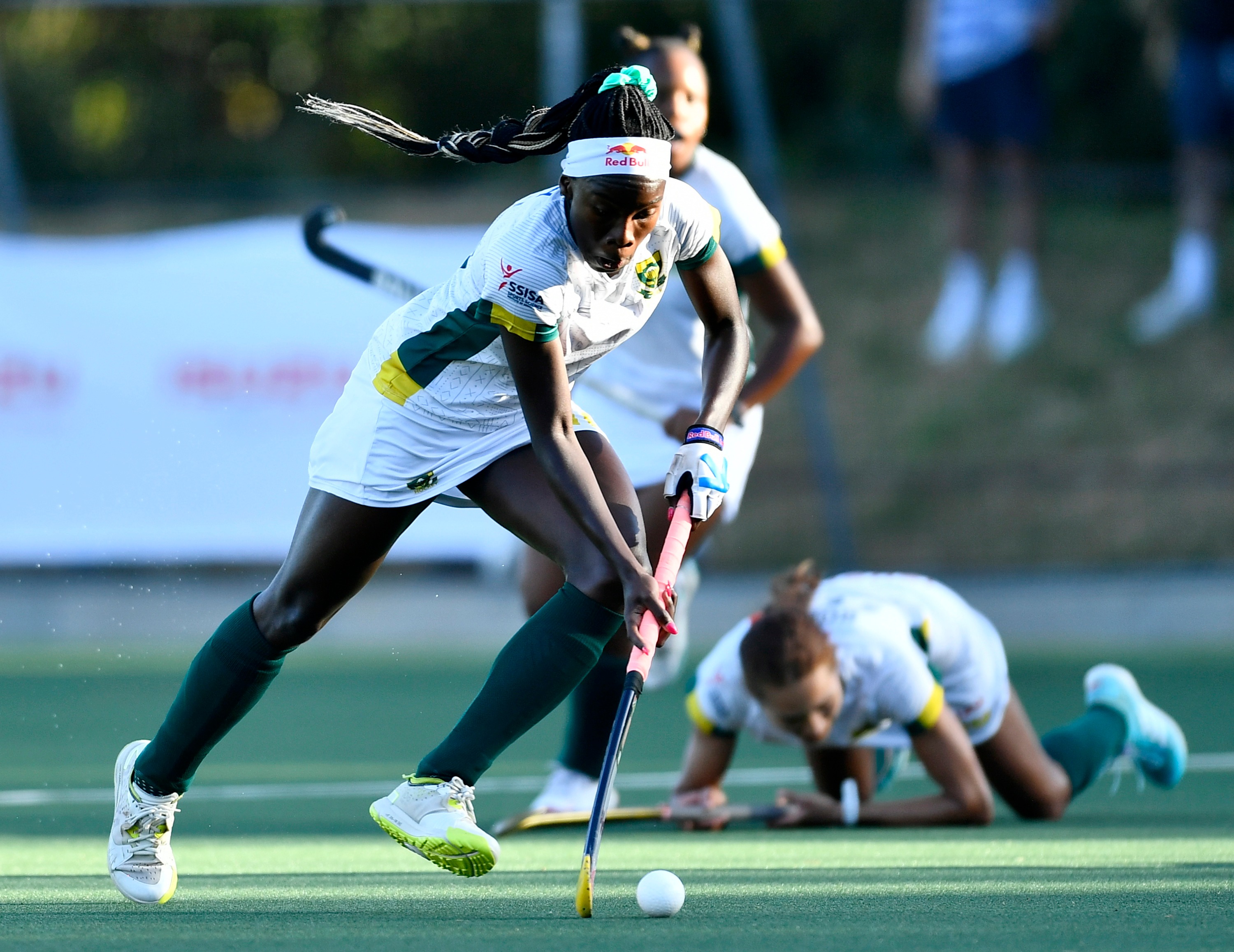
 Two-time Olympian Onthatile Zulu took to social media to speak up about the financial burden she and her teammates and many other South African athletes have to carry. (Photo: Ashley Vlotman / Gallo Images)
In a matter of weeks, South Africa’s men’s and women’s hockey teams will arrive in Belgium and the Netherlands for the 2026 Hockey World Cup.
/file/attachments/orphans/Image_01_587120.jpg "File photo: The South African men's team is through to the semifinals of the annual Nations Cup, a hockey competition for mid-ranked international sides just outside the world’s top 10, for the first time since 2024. (Photo: World Sport Pics)")
Apart from the Olympics, the World Cup, happening from 15-30 August, is the pinnacle of their sport.
The teams will do so fully funded after Minister of Sports, Arts and Culture Gayton McKenzie approved departmental financial assistance of R3-million on 23 July.
The announcement comes after two-time Olympian Onthatile Zulu took to social media on 17 July to speak up about the financial burden she and her teammates and many other South African athletes have to carry.
In order to participate in the World Cup and represent her country, Zulu said it cost her approximately R68,000 for flights, accommodation, meals, transport, medical treatment and training camps.
“I’ve been quiet for too long,” she said in the post. “But as we prepare for the World Cup, I feel I owe it to my team, my family and every young athlete in South Africa to speak up. For years, my family, friends and personal sponsors have financially carried my hockey career.
“This is a sport I love with every fibre of my being. It has given me the dream-come-true opportunity to represent my country. But behind every green-and-gold jersey is a heavy financial reality. I have had to personally pay for almost everything to represent SA: interprovincial tournaments, visas, flights, accommodation and transport.
“While I am deeply grateful when our federation is able to subsidise our costs, the remaining burden on us as players is overwhelming. It is exhausting and stressful to worry about how to pay for a tournament when we should only be focusing on performance.”
/file/attachments/orphans/ED_598893_815482.jpg "Minister Gayton McKenzie briefs the media on the Department of Sport, Arts and Culture (DSAC) portfolio at Freedom Park Heritage Site And Museum on March 04, 2026 in Pretoria. (Photo: Gallo Images / Frennie Shivambu)")
In the statement announcing the assistance, the minister emphasised that it was “strictly in the national interest to safeguard this tournament” and that it should not be deduced as an attempt by the government to “cover operational or financial shortfalls at national federations”.
“It cannot be right that athletes who have earned that place on the world stage through years of sacrifice are then asked to fund their own participation. Representing your country is a national honour and a national responsibility. It should never be a personal financial burden,” said McKenzie.
While the team may have received the funding, the circumstances that prompted it remain difficult to ignore. Why is it that it took a social media post and public outcry for the players to receive financial support?
Fifa nation-building programme
The other question that arises is whether the country’s already limited sporting funds are being spent where they are needed most.
Zulu’s post initially came amid public scrutiny over the department’s and McKenzie’s spending of close to R31-million on various activities around the 2026 Fifa World Cup.
/file/attachments/orphans/2267384805_669125.jpg "Minister of Sports, Arts and Culture Gayton McKenzie at the LIV Golf South Africa tournament on 22 March in Johannesburg. The government spent R85-million on licence fees for the tournament at Steyn City. (Photo: Johan Rynners / Getty Images)")
The department spent close to R8-million on a 14-member delegation, more than R3-million on suite tickets and almost R7-million for the Bafana Bafana 2010 legends’ exhibition match against Mexican legends on the eve of the tournament. This is according to a statement by the minister on 19 July providing a breakdown of the costs.
It also included buying match tickets worth more than R3-million for the delegation, stakeholders and programme participants, which included fans, influencers and artists.
/file/attachments/orphans/B25JNAG3733_672944.jpg "Gayton Mckenzie, Minister of Sports, Arts and Culture celebrates during the FIFA World Cup Qualifiers 2026 match between South Africa and Rwanda at Mbombela Stadium in Nelpsruit, South Africa on 14 October 2025. (Photo: Alche Greeff/BackpagePix)")
“What’s even more disheartening is seeing the massive amount of money spent on sports tourism while our national women’s team is struggling to cover expenses to represent our country at the upcoming World Cup,” said Zulu.
“It hurts... it really just comes down to care and investment and the necessary people actually paying attention to sports that need development.”
McKenzie defended the expenditure, arguing that promoting SA on the world’s biggest sporting stage fell within the department’s mandate.
“Spending a departmental budget on the department’s mandate is not, in itself, a wrongdoing,” said the minister in his statement. “The Fifa World Cup was the single largest global sport, arts and culture platform of the year, and it comes only every four years.
“No sporting event globally compares to the Fifa World Cup in terms of impact, not even an Olympic Games.”
While it is important to promote SA internationally, the question arises whether the expenditure represents value for money at a time when many communities lack basic sporting facilities and national teams such as hockey continue to face funding constraints.
/file/dailymaverick/wp-content/uploads/2025/09/TL_2452690.jpg "Gayton Mckenzie during the 2026 FIFA World Cup qualifier match between South Africa and Nigeria at Toyota Stadium on 9 September 2025 in Bloemfontein. (Photo: Daniel Hlongwane / Gallo Images)")
‘Diversion of resources’
As it stands, SA’s sporting system operates with limited resources, making strategic allocation imperative.
For the 2025/26 financial year, the Department of Sports, Arts and Culture had a budget of R6.3-billion, of which Programme 2 (Recreation Development and Sport Promotion) was allocated R1.281-billion – it is the department’s lowest-funded programme.
In his own address on the tabling of the 2025/26 Budget Vote, McKenzie said: “We must be honest, though, that what our home-grown talents are achieving is often despite the circumstances they are facing, and not because of the platforms we are giving them.
“Our amazing success on the field is too often balanced by the dysfunction we continue to face off the field. Ours is a system that too often still excludes the majority of people in our country.”
However, last year the department summarily slashed funding to sport federations, largely to funda VAR (Video Assistant Referee) initiative, before being blocked by the National Treasury.
/file/attachments/orphans/TL_2242030_125376.jpg "While South Africa's Onthatile Zulu acknowledges how lucky she is to be sponsored by Red Bull and Adidas, some athletes don’t have access to similar backing. ‘Over the years I’ve also seen some of my incredibly talented teammates forced to walk away from their dreams simply because they couldn’t afford to keep playing,’ she said in a social media post. (Photo: Roger Sedres / Gallo Images)")
On top of the R31-million, McKenzie also spent R85-million on licence fees for the LIV Golf tournament at Steyn City in March this year, a figure contained in the department’s annual budget vote.
The department was criticised by the portfolio committee for diverting resources away from pre-approved mandates and shifting funds to unplanned projects without sufficient justification.
“The ad hoc implementation of projects such as the provision of wheelchairs for the national basketball team, the LIV golf tournament, and the VAR initiative points to a departure from systematic and strategic planning,” said the sports, arts and culture portfolio committee in its report of the budget vote.
“Such unplanned interventions risk undermining fiscal discipline and has resulted in the diversion of resources away from core, pre-approved mandates and long-term strategic objectives.
“Furthermore, the committee notes with concern an emerging trend of circumventing parliamentary processes through the reprioritisation or shifting of funds to unplanned projects without sufficient justification.”
The funding ecosystem
The funding ecosystem is complex and differs for each sporting federation. Funding can consist of government grants, National Lottery funding, South African Sports Confederation and Olympic Committee (Sascoc) support and private/corporate sponsorship.
For the 2025/26 period the South African Hockey Association (Saha) received R4.4-million in government funding. Generated revenue for 2025 was almost R29-million. However, Saha, like many federations, must split costs across international and intercontinental tours, athlete preparation, coaching, management support, team apparel and more.
As a result, it’s a swinging pendulum between federation funding and self-funding. For example, according to Saha’s 2025 annual report, the women’s Nations Cup in Poland in June last year was fully funded, the men’s Junior Africa Cup in Namibia last April was self-funded while the men’s Junior Hockey World Cup in Chile in December last year was partially funded.
While Zulu, in her statement, acknowledges she is lucky to be sponsored by Red Bull and Adidas to offset some of the costs, many athletes do not have access to similar backing.
“We are constantly labelled the ‘underdogs’ due to minimal preparation and underfunding, yet our country is filled with world-class talent looking to be given the opportunity to be treated like elite athletes,” Zulu continued in her statement.
Swimming South Africa (SSA) presents a similar challenge. For the Junior Artistic Swimming Championships coming up in August, athletes were initially expected to pay R85,000 for the tournament, according to a team list released in May. When several players dropped out, that number jumped to R120,000 per athlete.
Over the past four years, athlete contributions toward SSA have risen.
According to SSA’s annual report, the federation spent R15.44-million in 2025 on high performance. Upon request, SSA provided Daily Maverick with a breakdown of the expenditure.
Of that amount, R5.91-million came from the federation and its funding partners including the government and private sponsors, while athletes contributed R9.53-million themselves.
Athlete contributions surged from R7.13-million from 2024, while overall high-performance expenditure declined from R19.36-million (an Olympic year) to R15.44-million over the same period in 2025.
/file/attachments/orphans/unnamed_972569.jpg "Over the years, athlete contribution in swimming has risen. While Swimming South Africa (SSA) and other sporting federations receive grants and sponsorship funding, it has to be stretched across various international and intercontinental tours as well as for coaching and management supports, athlete preparation and selected apparel. This is according to SSA. (Graphic: Annemieke Thomaidis / Source: Swimming South Africa)")
Misappropriation of funds: special tribunal
South African sport has also faced governance failures, stalled projects and allegations of financial misconduct. These issues do not define every federation or sporting body, but they have contributed to concerns about whether limited resources consistently reach the athletes and programmes they are intended to support.
In swimming, the stalled Franschhoek High-Performance Centre project, which received R35-million in National Lotteries Commission funding, has nothing to show for it but empty pools and dilapidated buildings.
/file/attachments/orphans/RIOEC86000LE1_498260.jpg "Wayde van Niekerk of South Africa carries his country’s flag during the Opening Ceremony of the 2016 Olympic Games at Maracana Stadium on 5 August 2016 in Rio de Janeiro, Brazil. (Photo: Reuters / Stoyan Nenov)")
In another story, Daily Maverick wrote about how a special tribunal on 27 May found that a R24.98-million National Lotteries Commission grant, approved in July 2016, nominally to fund nationwide Olympic awareness events nationwide, had been obtained through material misrepresentation and fraud.
While these millions were being siphoned off to a four-month-old foundation, SA’s Olympic athletes were being told to book their own flights to Rio for the Olympic Games.
The South African Sports Confederation and Olympic Committee (Sascoc), whose mandate is to support Team SA athletes, has been accused by a respected judge of being complicit in siphoning funds intended to support those same athletes.
Because it facilitated the application, Sascoc’s direct liability was a R150,000 “administrative fee”, which Sascoc says it has since repaid.
Ultimately, SA’s hockey teams will get to travel to the 2026 Hockey World Cup fully funded after the government approved a R3-million intervention.
But the episode has once again raised questions about why public pressure and viral social media posts are often needed before support reaches athletes, and whether the country’s sporting resources are being spent where they are needed most. DM
Comments
Scroll down to load comments...