



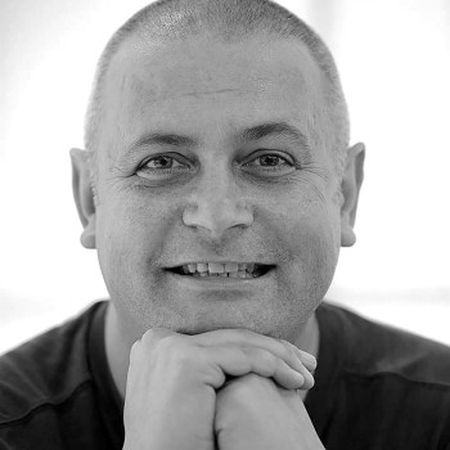
 Rod Suskin in his consulting room. (Photo: About Rod Suskin)
 Rod Ronnen Suskin, born 1 January 1963, died 18 July 2026.
Rod Suskin spent four decades elevating astrology beyond banal newspaper horoscope columns, earning a reputation as one of South Africa’s leading astrologers and most thoughtful spiritual teachers. He brought intellectual rigour and gravitas to a discipline too often dismissed as entertainment.
He did it with birth charts and planetary transits, with tarot cards rather than the divining bones of the tradition that had trained him, and with a patience that clients and colleagues remembered long after their hour with him had ended.
Suskin died in Cape Town on 18 July, after a long illness, at the age of 63. He was born Rod Ronnen Suskin in Johannesburg on 1 January 1963, one of three sons of Edward and Mina Suskin.
All three boys grew up in the city, and his brothers, Joseph and Danni, remember a household that prized intellect and self-sufficiency above noise. Rod was, in their words, “quiet, studious, super-intellectual, independent”, a boy who kept his own counsel and, at an age when most children were still mastering their bicycles, decided to grow his own vegetables.
From early childhood he had a fascination with the unseen world. By the age of six, his family recalls, he was already drawn to questions of spirit and fate that most children never think to ask, and that hunger never left him. There was no single childhood memory his brothers point to as the moment it began; it seems, instead, to have been there from the start, with the vegetable patch and the books, waiting for the right training to give it a shape and a use.
He was educated at Highlands North High School before attending the University of the Witwatersrand to study psychology, with an eye on clinical practice. A module on alternative therapies, taken in his second year, changed the direction of his life entirely.
Suskin was sent to Swaziland, now Eswatini, to observe traditional healing at close quarters, and there he met sangomas who did something no lecture theatre could replicate: they looked at a 19-year-old psychology student from Johannesburg and recognised a fellow diviner. Reflecting on the episode, Suskin described the recognition as immediate and unambiguous, the moment his path chose him rather than the other way round.
That set him on two rails that ran, for the rest of his working life, side by side. Trained further as a sangoma, he was instructed by his teachers to use the divination tools of his own ancestry rather than adopt those of the culture into which he was being initiated. Where a Swazi diviner might throw bones, Suskin was told to read tarot cards and birth charts, tools that belonged to his own European lineage.
Yet, he remained firmly anchored in African traditions and the earth. By the time he was 26 he had left psychology behind and was working full-time as an astrologer.
Suskin’s own explanation for how the two disciplines fitted together was more philosophical than technical. He believed, in a conviction rooted in the sangoma tradition itself, that people, trees and planets all shared a single source, and that African spirituality’s conviction that spirit inhabits all things sat naturally alongside astrology’s premise that the movement of the heavens reflects truths on Earth.
He liked to point out that rural shamans who had never encountered a birth chart in their lives grasped his method the moment he described it to them, recognising his reading of the stars as a variant of their own ritualised foretellings rather than a foreign or competing practice. Singing, dancing and star-reading were, to his mind, simply different tools for reaching the same spirits, an idea he returned to often in his teaching.
/file/attachments/orphans/images25_180604.jpg "Rod Suskin enrolled for an MA in cultural astronomy and astrology in 2009 and graduated in 2015. (Photo: Sophia Project / Wikipedia)")
His academic curiosity outlasted his student years. Decades into his career he completed a master’s degree in cultural astronomy and astrology at the University of Wales, choosing for his dissertation a subject that drew the two halves of his working life together: the cosmology of the sangoma tradition.
The degree gave scholarly shape to knowledge he had absorbed non-verbally during his own training, and it equipped him to lecture, as he later did at the University of Cape Town and Stellenbosch University medical schools, on the history of medicine and its relationship with cultural belief.
Suskin came to see astrology, traditional healing and Western medicine as different instruments answering different needs rather than as rivals for the same ground, an idea he carried directly into his teaching of integrated courses for medical students.
His interest in medical astrology grew, over time, into a serious study of the history of medicine itself and its long, often uneasy relationship with cultural belief. Students who might otherwise never have sat across from a sangoma found themselves, thanks to Suskin, doing exactly that in a lecture theatre, learning to ask better questions of patients who moved between two worlds of treatment rather than choosing one over the other.
/file/attachments/orphans/468942736_10162937086255229_7995962357660817548_n_455015.jpg "Suskin sharing a joyful interaction with a child in Pondoland, Eastern Cape. Known for his gentle spirit and genuine affection for young people, he embraced every opportunity to connect across generations. (Photo: Facebook)")
The distinction mattered to him. Between the horoscope column, with its 12 broad categories and its stock predictions for the week ahead, and Suskin’s own method there was, in practice, very little in common. He worked from the precise position of the planets at a client’s date, time and place of birth, constructing an individual chart rather than reaching for something generic, an approach sharpened by decades of study and, eventually, by the discipline of formal academic research.
Popular television and radio shows exposed his knowledge to a much wider audience than any consulting room could reach alone. He presented an astrology segment on national television for nine years, beginning as a young man with long curly hair on a programme called Free Spirit, footage that colleagues still circulate among themselves, and a broadcast on CapeTalk radio for 17 years, fielding live calls from listeners who wanted rather more than a stock forecast.
In later years he hosted his own show, Rod TV, watched by more than 30,000 people a week, proof that an appetite for his slower, more considered approach to astrology had outlasted horoscope columns by a wide margin. He wrote regularly for South African publications such as Femina under Jane Raphaely and was once commissioned to chart the astrological profile of the nation itself for the official parliamentary newspaper, an assignment that sat rather charmingly alongside his more private one-to-one consultations.
Alongside all of it he founded and ran the Rod Suskin School of Astrology, teaching a three-year diploma course online to students well beyond South Africa’s borders, and wrote four books: Cycles of Life and Synastry, published in the US by Llewellyn, and Soul Talks and Soul Life, published locally by Double Storey Books. A meditation CD and a range of astrology software followed, too, evidence of a restless streak that kept finding new forms for the same underlying material.
Of everything he made, teaching mattered to him most, his family says, with his books close behind. The astrology teacher Karen James, who studied under him, remembers a story he told of arriving at Wits as a young student and being drawn into a gathering of sangomas on campus who recognised him then, just as their counterparts in Swaziland would later, as one of their own. “Rod Suskin, who taught me and many others how to be a practising astrologer, has fittingly passed on Madiba’s birthday,” she says.
He grew close over the years to the Zulu sangoma and author Credo Mutwa, whose books, among them, Indaba, My Children, drew deeply on African mythology and folklore, and became, in James’s description, a presenter of real charisma with a voice that carried both warmth and authority.
She points, too, to the pattern in the sky at the moment of his death: a rare four-degree activation involving Jupiter, Pluto, Uranus and Neptune, of the kind once studied by the French astrologer André Barbault, who died earlier this year himself. “A fitting sky to mark the start of his spirit journey,” she says.
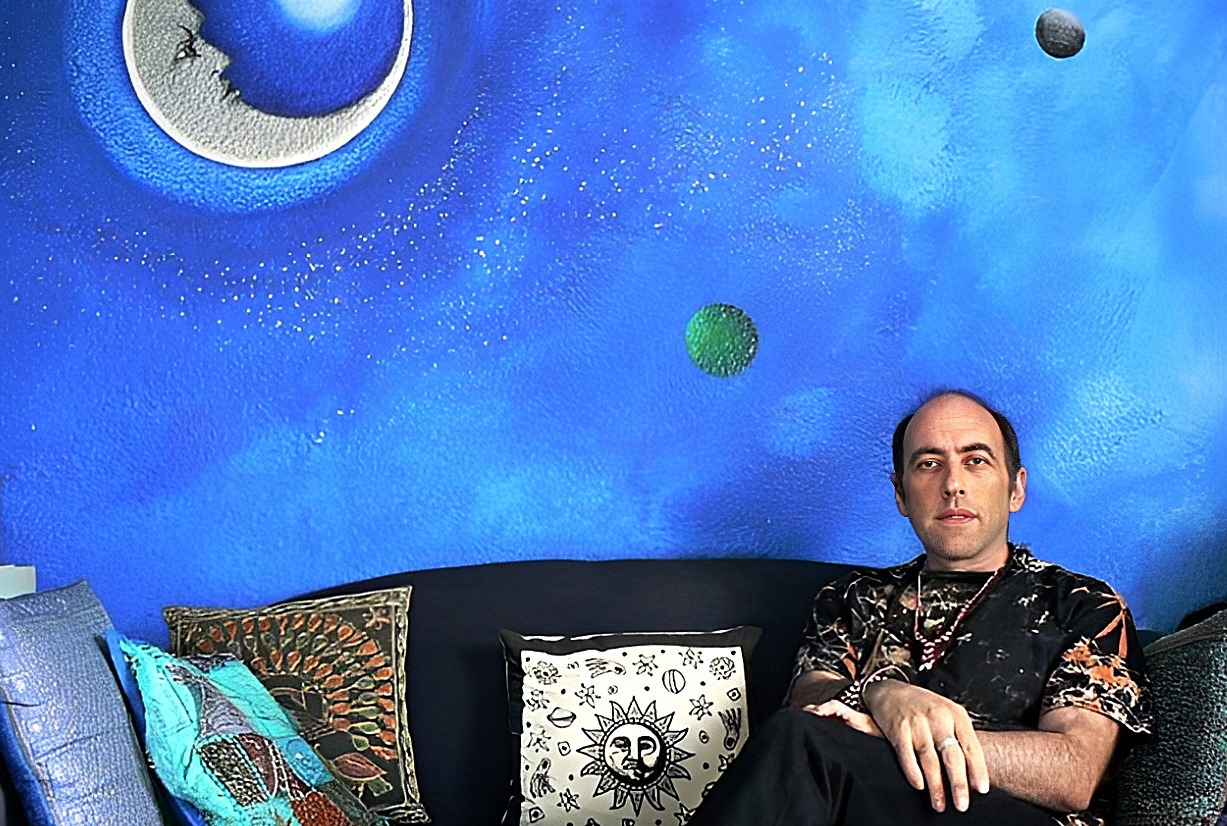
He consulted clients from his Vredehoek consulting room, its walls painted deep blue, his modus operandi closer to therapy than fortune telling. Jane Rosenthal, writing up her own session with him for the Mail & Guardian, recalled an hour that moved between the light and the serious without strain, guided by a man who knew his subject in real depth yet never let that knowledge turn into performance.
/file/attachments/orphans/rodsuskin0001_476856.jpg "The rich blue walls, evoking the night sky and the cosmos, created a serene, contemplative space for his astrological consultations and spiritual work.(Photo: About Rod Suskin)")
He worked from what a client’s chart appeared to show rather than from cold reading or flattery, she noted, which stripped away the usual awkwardness of sitting opposite someone claiming authority over one’s life; instead the session became a kind of shared enquiry, something a sceptical journalist could sit through for a full hour and leave unsettled, and interested, in equal measure.
Cynics asked whether such moments said more about the chart or about Suskin’s reading of the person in front of him. He seemed untroubled by the question, working instead from millennia of accumulated observation about how the planets had, over centuries, come to acquire their particular meanings, an inheritance he treated as a discipline to be studied rather than a mystery to be sold.
Colleagues and friends describe a personality built on empathy rather than showmanship. “Gentle, kind, curious, intellectual, thoughtful,” is how his family sums him up, and those who worked alongside him tend to reach for the same handful of words.
The actress and author Megan Choritz first met him in 1995, when a birthday reading told her she was emerging from her Saturn return and that writing was the strongest thing in her chart. She did not believe him at the time. Years later Suskin became one of the greatest champions of her novel Lost Property, telling everyone he knew about it and helping her through a difficult period on what she describes as a deeply spiritual level.
“I loved how passionate he was about 3D printing. I loved how silly he was. I loved how beautifully he supported and encouraged people,” she says. The two shared a commitment to veganism, and Choritz remembers him describing a recipe for vegan hot chocolate more than once, a recipe she confesses she never managed to retain.
The singer Jennifer Ferguson knew him over many years of friendship and speaks of his gift for translating complex, otherworldly ideas into language anyone could use in an ordinary life.
She describes a man capable of quiet, steady leadership, someone who could take command gently when a moment called for it, and thinks now of his husband, Chris Ntombemhlophe Reid, whose sudden death in 2021 left Suskin, in her telling, in enormous grief. “Now they are dancing in the invisible spheres of oneness,” she says. “Forever reunited.”
/file/attachments/orphans/751_433516.jpg "Suskin’s husband, Chris Ntombemhlophe Reid, passed away in 2021. They were both big animal lovers.
<br>(Photo: Facebook)")
(Photo: Facebook)
His cousin, Renee Usdin, remembers him as “completely non-judgemental. Wise, supportive.”
Away from consulting rooms and cameras, Suskin read widely and people often spotted him and Reid in full sangoma attire at the opening nights of an opera or play at Artscape, or at a movie festival at the Labia Theatre. They certainly stood out in a spectacular way and ushered in colourful decolonised sartorial attire amid a sea of generic Western outfits.
Apart from making gourmet vegan meals, his family says he was also a devoted connoisseur of root beer. In 2018, he stepped in front of another type of camera, appearing in the short film Sea Point 280SL alongside Grethe Fox and Grant Swanby. The film follows a group of Sea Point characters trying to stay relevant in a changing city while grappling with a shifting sense of identity, themes that echoed the questions he had spent his career helping others navigate.
/file/attachments/orphans/469039903_10162987273890229_8911233094229393746_n_158071.jpg "Rod Suskin with the actor Grethe Fox, who appeared with him in the short film Sea Point 280SL. (Photo: Facebook)<br>")
/file/attachments/orphans/487397169_9351868491557315_1633008806687400582_n_924480.jpg "(Photo: Facebook)")
Suskin’s legacy, his family believes, was never really the books or the broadcasts, useful as those were in carrying his work to a wider audience. It was something plainer: an example of how to sit with someone in confusion and help them find a shape they could work with, without judgement and without hurry.
Suskin’s interests extended far beyond astrology. He followed South African and world politics closely. Reflecting on the conflict in West Asia (Middle East), he once wrote: “The wrongs of history cannot be undone by putting things back to what they once were; the better option is to look for solutions that recognise everyone who lives on the land, not just some imagined ‘original’ occupant.”
/file/attachments/orphans/841_186020.jpg "Suskin and his beloved root beer.
<br>(Photo: Facebook)")
(Photo: Facebook)
Suskin’s compassion is best illustrated by a note he sent this obituarist after reading something published about a mutual friend who had died by suicide: “What prompted me to write is to thank you for making me think of Grant. I remember how he would come to my flat in Vredehoek and cry on my balcony, and I felt so helpless because I couldn’t understand why.
“I happened to be in Joburg at the time of his death and went to his funeral at the Braamfontein Crematorium in 1997. I haven’t thought of him for years, but I am so pleased you have immortalised him by putting his name in a book. Kind regards, Rod.”
Rod Ronnen Suskin spent his life helping others make sense of themselves, and he never stopped caring about those he could not help. That a man with deep trauma could sit weeping freely on his balcony, a place where he could feel safe to cry, says much about the type of person Suskin was.
Indeed, the stars kept him spellbound, but people mattered more.
He is survived by his mother, Mina; his brothers, Joseph, in Toronto, and Danni, in Atlanta; his daughter, Nokukhanya; and his sons, Vuyalithongo and Malivuye. He was predeceased by his father, Edward, in 2006, and by his husband, Chris Ntombemhlophe Reid, in 2021. DM