



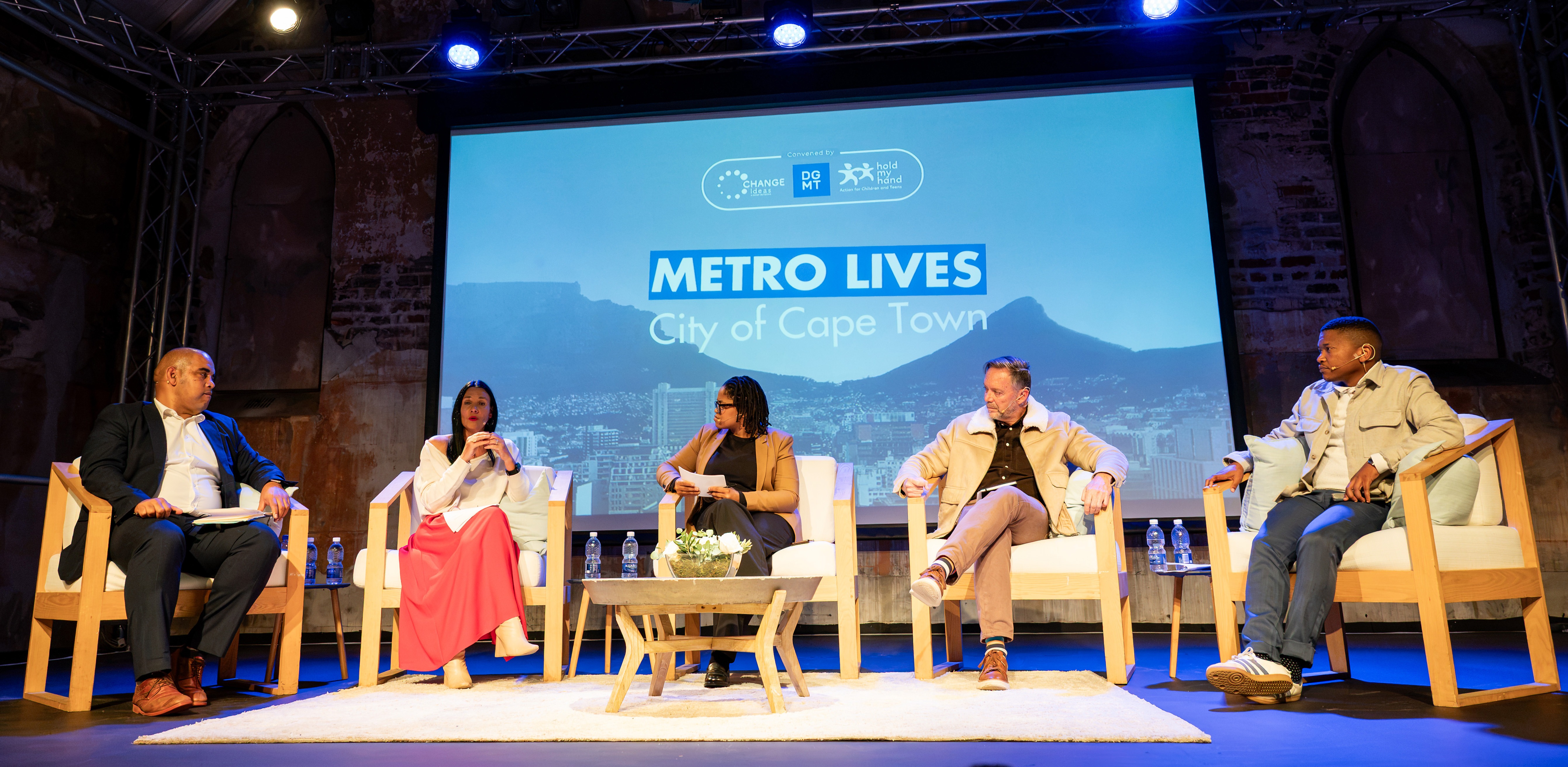
 A panel of local government leaders and advocates at the Metro Lives Cape Town event hosted by the DG Murray Trust on Tuesday, 21 July 2026, discuss improving the lives of Cape Town’s children. From left: Deputy Mayor of Cape Town Eddie Andrews, Western Cape children’s commissioner Sarah Roberts, deputy CEO of the DG Murray Trust Kentse Radebe, secretary-general of the Good party Brett Herron and project director at the DG Murray Trust Kwanda Ndoda. (Photo: Joanne Markland Photography)
What can municipalities do to create an environment in which children and families can thrive? Brett Herron, secretary-general of the Good party, argues that all levels of government need to prioritise first investment, services and infrastructure in communities that have the greatest need.
In the City of Cape Town, the area in which a child grows up continues to have a large impact on their quality of life, including access to decent education, play spaces and opportunities – a legacy of apartheid spatial planning that continues to go largely unaddressed more than 30 years after the advent of democracy, he said.
“We need to be more angry about the way in which people live, and the way in which people live affects the way children live. And no child will have a pathway to success, to development, to realise their potential, to realise their opportunities, without us addressing this systemic problem that we have not addressed: the apartheid spatial plan that relegates some children to broken communities in the built environment space,” said Herron.
Herron was speaking at a Metro Lives dialogue hosted by the DG Murray Trust at the Homecoming Centre in District Six, Cape Town, on Tuesday, 21 July. He was joined by City of Cape Town Deputy Mayor Eddie Andrews, Western Cape commissioner for children Sarah Roberts, DG Murray Trust project director Kwanda Ndoda and DG Murray Trust deputy CEO Kentse Radebe.
/file/attachments/orphans/BrettHerron_953623.jpg "Secretary-general of the Good party Brett Herron says the failure to adequately address apartheid spatial planning 30 years into democracy continues to affect the quality of many children’s lives. (Photo: Joanne Markland Photography)")
The discussion explored how municipal decisions shaped every aspect of children’s daily lives, even though these young people did not get to vote in local government elections.
Andrews reflected on his experience of growing up in the Cape Flats, where he saw first-hand the injustices that came with spatial inequalities. He said that the City of Cape Town was looking at ways to “crowd invest” into skills and infrastructure development across areas in need, and putting a significant portion of its budget towards improving services in these communities.
“[We need to] compel the departments to crowd investment, to understand the context, and to ensure that they sustain traction in those ventures. Because if you don’t do that, you’ll be complicit in sustaining what currently is happening,” he said.
Both Herron and Andrews spoke on the importance of addressing the “silos” between departments to ensure better collaboration in developing communities and addressing children’s needs.
/file/attachments/orphans/EddieAndrews_354268.jpg "Deputy Mayor of Cape Town Eddie Andrews argues that early childhood development programmes are among the most important focus areas for improving outcomes for children. (Photo: Joanne Markland Photography)")
Early childhood development
Andrews said early childhood development (ECD) was “the most important programme” the City needed to focus on to improve outcomes for children. Over the past three years, he has been part of the city’s ECD task team, working with the Centre for Early Childhood Development and other partners to tackle municipal barriers that prevent early learning centres from achieving registration and accessing critical subsidies.
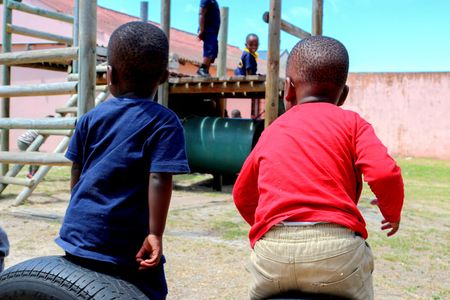
The task team has worked to exempt centres in vulnerable areas from administrative penalties for operating without the necessary land use approval, and improve access to exemptions from development charges, which are once-off payments made to the City to cover the cost of municipal engineering services.
“What we’ve seen with the [ECD] operators in the City of Cape Town [is that of] the 2,620 educares in the city, approximately 63% to 65% of them are not compliant [with regulations]. So what do we do? We engage. We ask them, why are you not compliant? What barriers are you facing?” asked Andrews.
“The outcome in five years’ time [is] that we have more compliant ECD from a child’s perspective, and that is important, not just in terms of [education], but even important in reducing the trauma that the child is exposed to.”
Safety of families and children continued to be “compromised” in many areas with high crime and gang violence, said Andrews, driving the City’s call for the devolution of certain functions related to community security.
“That’s one of the primary reasons we’ve, over the past four and a half years, employed approximately 1,600 law enforcement officers, and on the other side, SAPS’s [South African Police Service’s] staff complement has reduced over the same period,” he said.
/file/attachments/orphans/SarahRoberts_871587.jpg "Western Cape commissioner for children Sarah Roberts emphasises that children’s voices need to be heard and considered when tackling systemic problems. (Photo: Joanne Markland Photography)")
Giving children a voice
Reflecting on her work as the children’s commissioner, Roberts emphasised the importance of “hearing the voice of the child”. Her team holds workshops with children in various areas to ask about their experiences, observations and challenges.
“We are adults who want to make decisions and must make decisions. I always say a child cannot make a decision, but their voice must be heard. They sometimes have very good ideas, and at times we miss what really is going on in communities, or what they see as safe spaces,” she said.
Roberts noted that while many government institutions and NGOs worked to help people in communities, local residents did not always know about these services or where to find them. She suggested a “mapping” of relevant support sites for children and caregivers in communities would streamline access to appropriate interventions.
/file/attachments/orphans/KwandaNdoda_445573.jpg "Project director at the DG Murray Trust Kwanda Ndoda says municipalities and homes need to prioritise children’s interests. (Photo: Joanne Markland Photography)")
Ndoda said all institutions within the country, especially municipalities, and even households, needed to “put children’s rights at the centre”.
“Having proper institutions ... helps develop a country,” he said, adding that a country did not need to be “rich” to build good institutions.
He also emphasised the importance of providing an “ecosystem of support” for children, including safe spaces for play and relaxation outside the home.
“Children need to feel safe because they need to be able to explore. They need to learn. They need to have their caregivers close to them, to be watching them ... These are the environments that you must create for children,” he said. DM
/file/attachments/orphans/ChildrensReporterV2_187851.jpg)
Comments
Scroll down to load comments...