



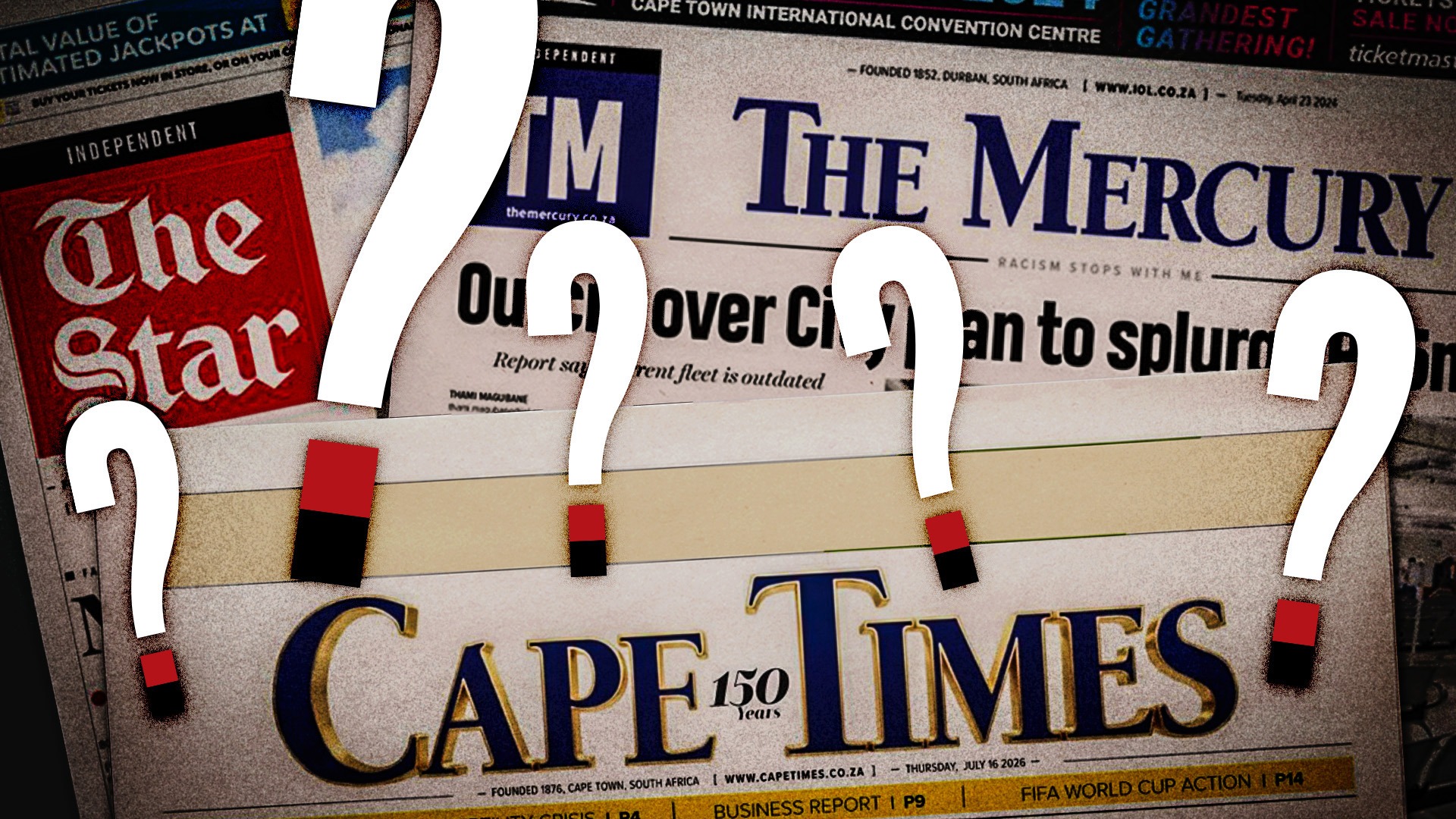
 Newspapers in the Independent Media stable face an uncertain future after Sekunjalo announced it would no longer fund the loss-making group. (Photos: X)
 In a statement on Tuesday, Sekunjalo said it had invested more than R5.2-billion in Independent Media and related businesses over the past decade and continued funding of the loss-making newspaper company was no longer commercially sustainable.
Independent Media has also apparently been told that its licence to use mastheads including The Cape Times, The Star and The Mercury will end on 31 July.
Sekunjalo said it was considering retaining the titles, licensing them to a third party or placing them in another commercial arrangement.
However, the numbers provided in the statement are difficult to reconcile with Sekunjalo’s previous accounts of the transaction and its financial support for Independent Media.
Sekunjalo said Independent Media was acquired for R2.1-billion in 2013, with R1.2-billion invested by the Sekunjalo Consortium and R880-million provided by the Public Investment Corporation (PIC).
It said the group subsequently invested R1.8-billion directly in Independent Media’s operations and R2.2-billion across media-related businesses, technology platforms and infrastructure.
These three amounts (R1.2-billion,R1.8-billion and R2.2-billion) add up to Sekunjalo’s claimed R5.2-billion investment. However, the R2.2-billion was described as spending across broader media-related operations rather than as a direct investment in Independent Media.
Sekunjalo previously said the acquisition vehicle represented a consortium comprising approximately 12 empowerment groupings and Sekunjalo. Its latest statement does not explain how much of the R1.2-billion consortium contribution came from Sekunjalo itself or provide a supporting breakdown of the figures.
A complicated trail
The similar names of the companies involved make following the money particularly difficult.
➡️ Sekunjalo Investment Holdings is the broader investment group.
➡️ Sekunjalo Independent Media, later renamed the Independent Media Consortium, was a special-purpose vehicle created to acquire shares in Independent Media.
➡️ Independent Media is the operating newspaper business.
➡️ Independent Online, or IOL, is described by Sekunjalo as another separate company that has had a commercial relationship with Independent Media since 2014.
The distinctions have been central to Sekunjalo’s response to a long-running dispute with the Southern African Clothing and Textile Workers’ Union (Sactwu) and its investment arm, Sactwu Investments Group.
The Sactwu dispute
In 2013, Sactwu Investments Group advanced a R150-million loan to Sekunjalo Independent Media to help finance the acquisition.
Sekunjalo has repeatedly stressed that the R150-million was paid to the PIC through law firm ENS and did not flow into Sekunjalo’s bank account.
However, where the money was ultimately paid does not settle who owes the debt. Sekunjalo Independent Media entered into the loan agreement and allegedly instructed that the money be used as part of the acquisition transaction.
The Supreme Court of Appeal found in March that a later agreement subordinating the loan was invalid because Sactwu general secretary André Kriel had not been properly authorised to sign it.
The original judgment reflected a repayment amount of approximately R458.6-million, plus interest and legal costs.
In June, Sekunjalo announced that the court had rectified what it described as an error and applied the in duplum rule, which prevents unpaid interest from exceeding the original capital amount. Sekunjalo said this reduced the amount to R300-million.
The rectification letter or amended order was not included with Sekunjalo’s statement.
Sekunjalo has also brought a separate claim against Sactwu over an alleged promise to fund the World of Work newspaper.
In April, Sekunjalo placed the value of this claim at R628-million, comprising an alleged R250-million commitment plus interest and damages. By June, it described the total as approximately R620-million.
Sactwu denies that an enforceable agreement to provide the money existed. The claim remains unresolved and does not automatically offset the amount owed under the separate loan dispute.
Which company owns the mastheads?
The latest announcement introduces another corporate distinction.
Sekunjalo says the mastheads used by Independent Media belong to the group and were merely licensed to the newspaper company. Specific titles mentioned were The Star, the Cape Times, The Mercury “and others”. The licence expired at the end of June and was extended for one month.
/file/dailymaverick/wp-content/uploads/ufrieda-TRCdatabase-option-2.jpg "The Cape Times is one of the titles in the Independent stable. (Photo: Oryx Media Archive / Gallo Images)")
“The licensing agreement allowing Independent Media Publications to use our mastheads expired at the end of June. We granted a one-month extension until the end of July, after which the licence will terminate,” said Sekunjalo Group CEO Lucien Jacobs.
The statement does not identify the precise company that legally owns the mastheads, when it acquired them or what Independent Media paid for their use.
It also does not explain whether the mastheads were included in the assets bought for R2.1-billion in 2013, or whether they were subsequently transferred to another company.
These questions have consequences for Independent Media’s minority shareholders. If the operating company funded or developed the titles while another Sekunjalo-controlled entity owned the intellectual property, licensing the mastheads elsewhere could move their remaining commercial value beyond the reach of those shareholders.
Sekunjalo said it would continue engaging with the PIC, Sactwu and Interacom — a minority shareholder backed by Chinese investors — to find a sustainable arrangement. Yet its statement also made clear that it no longer wanted to fund an operation in which other shareholders benefited.
“We will now invest on our account and not to benefit other shareholders,” Sekunjalo said, adding that future spending would focus on media operations it owns outright.
The sequence suggests that Sekunjalo plans to separate the assets it considers valuable from the loss-making newspaper operation. It has not disclosed where the mastheads will be housed or whether Independent Media will continue publishing after July.
Jacobs said the executive team had concluded that continued funding of a loss-making business was no longer commercially sustainable.
“The executive team and I have adopted a fundamentally different approach from previous management. While previous leadership continued funding Independent Media despite sustained losses in order to preserve jobs, support journalism and promote media freedom, our responsibility is to ensure that the business operates on sound commercial principles.”
The group may be entitled to reorganise its investments, but its statements do not provide a consistent account of how much was invested, which legal entities provided the funding or which companies now own the assets.
For Independent Media’s employees, shareholders and PIC beneficiaries, the immediate question is more practical: what exactly will be left inside the newspaper company when the funding and masthead licences end? DM