




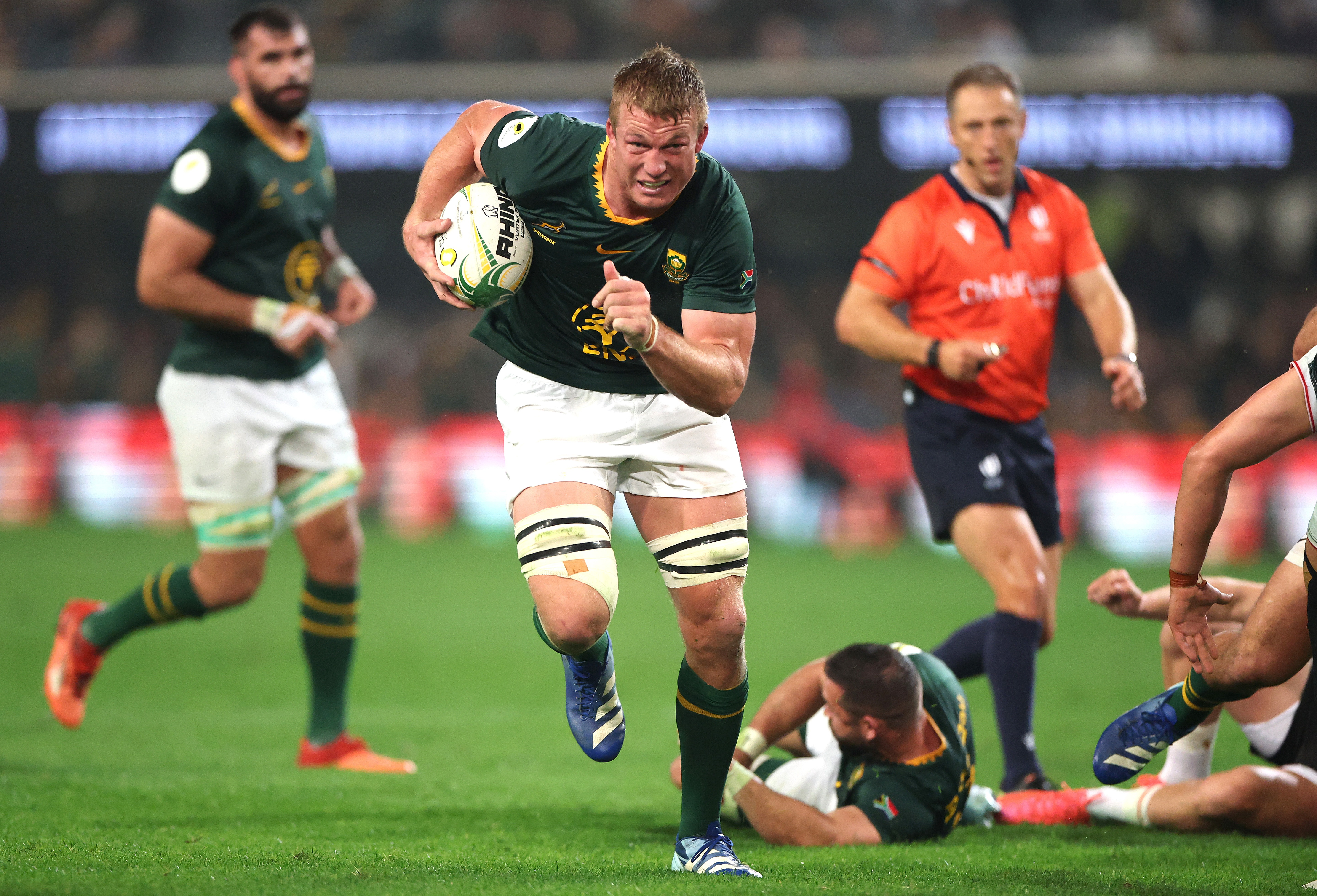
 Stand-in captain Pieter-Steph du Toit was one of a handful of Bok players who featured in each of the three Nations Championship Tests in July.(Photo: David Rogers / Getty Images)
 /file/dailymaverick/wp-content/uploads/2025/10/label-analysis-2.jpg)
Springbok coach Rassie Erasmus has played his cards close to his chest in recent weeks, at least as far as the team’s tactics are concerned.
The Boks failed to get out of third gear across the Nations Championship Tests, yet still managed to average 43 points and seven tries a match.
While they did enough to finish at the top of the southern conference – and perhaps more significantly, at the top of a combined 12-team log – they weren’t at their best, and one cannot help but wonder whether the coaches are saving something in reserve for the all-important series against the All Blacks next month.
With regard to squad management, Erasmus showed his hand in the June and July period, using 67 players across matches against the Barbarians, Zimbabwe, England, Scotland and Wales.
/file/attachments/orphans/TL_2588802_829264.jpg "Bok utility back Damian Willemse on the attack during the Nations Championship match against Wales at Kings Park on 18 July. (Photo: Steve Haag Sports / Gallo Images)")
The Bok coach spoke about experimenting with younger players and new combinations with an eye to the series against the All Blacks as well as Rugby World Cup 2027.
What’s more, Erasmus reiterated that 40 players would be needed to perform across four-consecutive Tests against the All Blacks – and in preparation for that gruelling schedule, he fielded 44 players across three Nations Championship Tests.
Boks still ahead of the curve
Now that the first phase of the global league is done and dusted, it’s interesting to note how many of the Test coaches have followed Erasmus’ lead.
The Boks won the 2019 and 2023 World Cups thanks to their quality in depth. It’s fair to say that depth will be all important at the next global tournament in 2027, and that squad rotation will be essential across a new four-week playoff structure.
/file/attachments/orphans/TL_2586228_767796.jpg "Bok flank Paul de Villiers featured in all three Tests in the Nations Championship. (Photo: Sydney Seshibedi / Gallo Images)<br>")
The teams will travel to the World Cup next year with 33-man squads, and it’s vital that every member of that group accumulates as much experience and game time as possible before the global showpiece.
This past July, eight of the 12 head coaches involved in the Nations Championship picked 33 players or more across the three Tests.
France have cast the net wide over the past two years, and it shouldn’t come as a surprise to hear that they used 36 players in recent matches.
The Celtic nations, however, will have raised some eyebrows. Scotland (36) and Ireland (35) managed to win two of their three games while rotating regularly.
Meanwhile, the All Blacks used fewer than 33 players in this block, and their starting XV remained largely unchanged.
New coach Dave Rennie can be forgiven for backing the same players in the first three games of his tenure – and the All Blacks certainly impressed in those performances, at least on attack.
/file/attachments/2995/PlayersusedinNationsChampionship_103655.png "Comparison of players used by the 12 teams in the Nations Championship. (Graphic: Jon Cardinelli)")
That said, one wonders whether he will favour the same team across three Tests in varying South African conditions, and in the fourth staged in Baltimore, US.
England have come in for criticism in recent months, after recording their worst Six Nations campaign in history and losing 45-21 to the Boks in Johannesburg.
While they bounced back in subsequent games against Fiji and Argentina, they only used 28 players across the three games – the fewest in the Nations Championship.
Again, coach Steve Borthwick might be forgiven for focusing on the task at hand and ending his side’s losing streak, but England’s relative lack of depth may cost them further down the line.
/file/attachments/orphans/2286881016_557221.jpg "Rassie Erasmus has made squad rotation an art as well as a science. (Photo: David Rogers / Getty Images)")
Building a squad for all situations
The Boks used eight more players than the next best teams on the list (France and Scotland).
French fans might argue that Antoine Dupont, Thomas Ramos and other superstars didn’t tour this July, and that France – which boast the world’s strongest domestic tournament in the Top 14 – has the depth to match that of South Africa.
The rebuttal is that the Boks were without captain Siya Kolisi, star flyhalf Sacha Feinberg-Mngomezulu, their most capped player in Eben Etzebeth and more than a dozen others this July.
And while France’s development project is starting to bear fruit, it’s the Boks who have struck the best balance between rotation and performance in recent times – as illustrated by their showings in the Nations Championship and the fact that they’ve won 11 consecutive Tests.
The tour of Europe in November 2025 showcased a Bok side at its peak – as Erasmus rotated the team regularly over five consecutive matches without compromising the side’s drive for results.
Playing the All Blacks on four consecutive weekends, of course, will demand another step up.
Erasmus will have to take the varying conditions in Johannesburg and Cape Town into account, and may have to save a few bullets for a potential decider in Baltimore. Jet lag may be a factor before the latter, and with that in mind, rotation between the third and fourth Tests may be essential.
/file/attachments/orphans/2286648489_112338.jpg "Centre Jesse Kriel was another who played against England, Scotland and Wales in July. (Photo: David Rogers / Getty Images)")
Of course, Erasmus’ recent selections suggest they are preparing for the challenge. As many as 33 different players were used in the Bok starting XV this July – which is one more than the All Blacks used across their match 23 in three successive Tests.
The game minutes also make for interesting reading, and show how Erasmus is striving for the perfect balance between workload management and match fitness.
Of the 44 players used, only Pieter-Steph du Toit, Paul de Villiers, Jesse Kriel, Damian Willemse and Ben-Jason Dixon featured in all three Tests – and only three of those in a starting capacity every week.
By contrast, the All Blacks stuck with nine starting players throughout the Nations Championship. Where Erasmus picked three completely different halfback combinations in Grant Williams-Manie Libbok, Embrose Papier-Handré Pollard and Cobus Reinach-Vusi Moyo, Rennie retained Cam Roigard and Ruben Love throughout.
Looking at the mid-year block as a whole – and accounting for preceding matches against the Barbarians and Zimbabwe – only 21 of the 67 Boks used played more than 100 minutes (out of a possible 320).
Again, Erasmus got the balance right, when you consider that rookie Paul de Villiers – who looks set to feature alongside a host of World Cup-winners in the big matches against the All Blacks – was on the field for more than 200 minutes, and ultimately given a fair opportunity to prove his worth.
Most of the squad will be fresh and ready for what will be a unique challenge against the All Blacks – with the first Test scheduled for 22 August in Johannesburg.
Prior to that, Erasmus will face a different sort of balancing act, as he attempts to bring returning players such as Kolisi, Feinberg-Mngomezulu, Etzebeth and others up to speed, possibly by playing them in the one-off against Argentina in Buenos Aires on 8 August. DM