




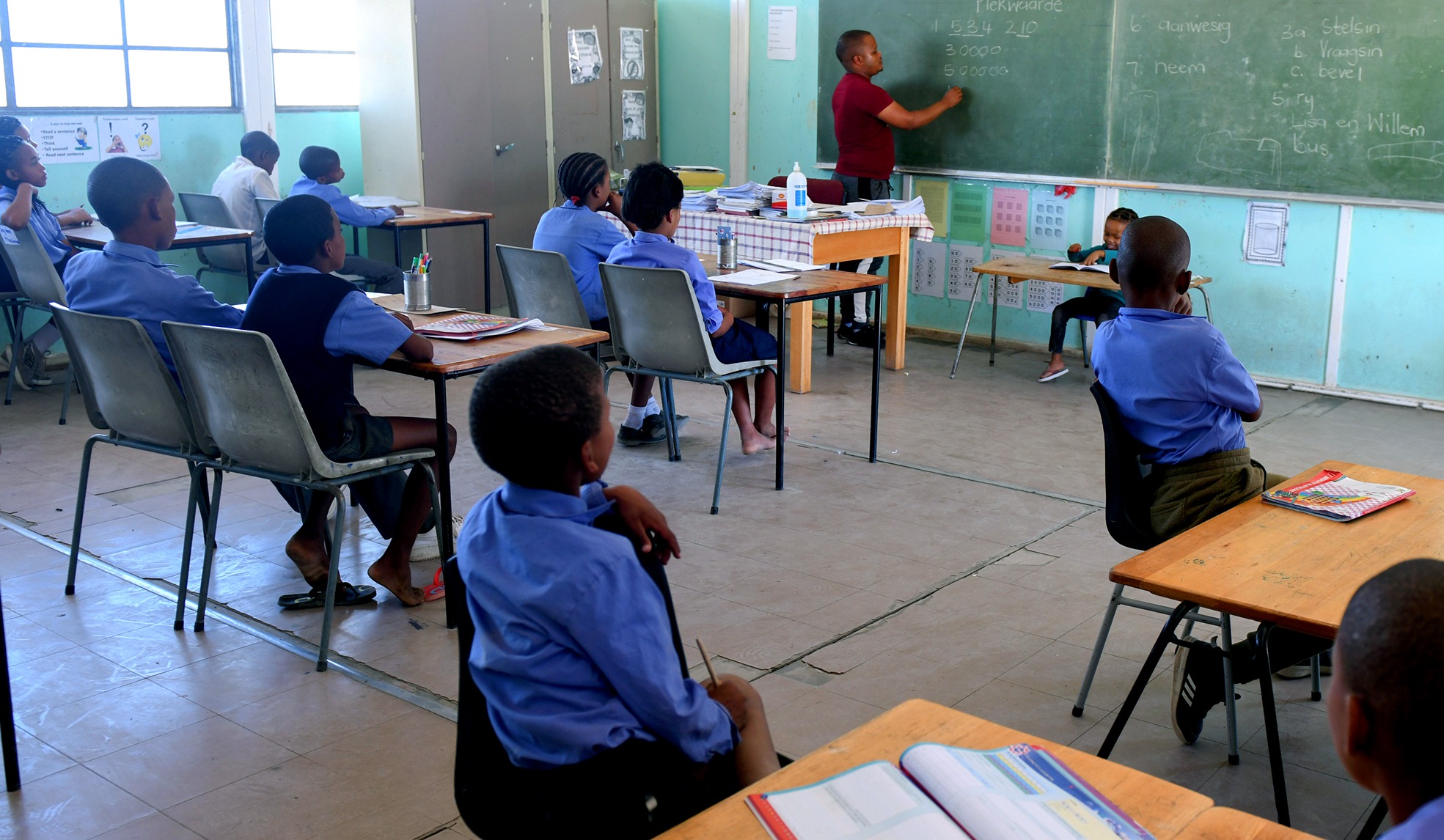
 Teaching assistant Cassidy Williams volunteers at Seekoegat VGK Primary School in Prince Albert. (Photo: Gallo Images / Rapport / Edrea du Toit)
 South Africa’s public schools are heading into a teacher replacement crunch, with almost half of publicly employed educators already 50 or older and thousands of posts still vacant. With a retirement age of 60, this means our basic education system is heading towards a massive retirement wave that will see an almost 50% vacancy in teaching posts.
According to a parliamentary reply from Basic Education Minister Siviwe Gwarube, there were 17,450 vacancies across 389,286 allocated posts, based on Persal data for the end of January 2026. The department said that translated into a national vacancy rate of 4%. The Western Cape recorded the highest vacancy rate at 11%, followed by the Northern Cape at 10% and Limpopo at 8%.
/file/dailymaverick/wp-content/uploads/2025/05/Christi-bonita-khayelitsha-UCT-4.jpg "The constitutional right to basic education has been eroded by years of budget cuts. (Photo: Christi Nortier)")
Gwarube said the figures did not tell the full story. Vacancies arose through resignations, retirements, promotions and temporary absences, while schools and provinces used temporary, substitute, acting and permanent appointments to keep teaching and learning going.
“Accordingly, headline vacancy figures do not always equate to the strict position of there being no educator in front of the class,” the reply read.
The staffing pressures
Gwarube said educator posts allocated through approved provincial establishments were intended to be funded posts, but the Post Provisioning Norms did not provide for the allocation of “unfunded” posts as part of the approved establishment, or for the formal freezing of posts once allocated.
At the same time, she said the pace at which funded vacancies were filled could be slowed by “provincial administrative processes, affordability pressures and post-filling arrangements,” which fell under provincial employer functions.
“To the extent that the vacancies referred to relate to funded posts on approved provincial educator establishments, those posts are ordinarily intended to be filled from within provincial compensation budgets,” the reply read.
Furthermore, educator appointments are a provincial employer function, and Provincial Education Departments determine and fill their funded educator posts within the affordability of provincial budgets and in accordance with applicable post provisioning processes.
“The national Department of Basic Education (DBE) is therefore not in a position to provide a single additional national funding amount required to fill such vacancies over and above provincial budget processes,” read the reply.
What the pipeline lacks
In theory, that should make teaching a strong recruitment opening. However, Zayd Waghid, an associate professor in the Faculty of Education at the Cape Peninsula University of Technology, said the system was failing to prepare and retain enough young teachers.
Daily Maverick spoke to Waghid, whose book with Yohana William, Preparedness to Teach, draws on research into pre-service teachers’ beliefs, motivations and professional identities.
Waghid said one of the biggest problems was the gap between what student teachers learnt at university and what they faced in schools. Teacher education curricula generally covered what to teach, how to teach, teaching practice and the conditions of schools. But many students still left university feeling underprepared for the realities of crowded classrooms, learner discipline, weak parental support and the wider social pressures that shaped schooling.
/file/attachments/orphans/6I1A1918_153939.jpg "One of the biggest problems is the gap between what student teachers learn at university and what they face in schools. (Photo: Felix Dlangamandla)")
“The reality is that even though they are oriented to teaching practice, many of them are still confronted with other sorts of issues in the school context—issues around gangsterism, all sorts of socioeconomic issues, and learner ill-discipline is also quite a significant issue. The lack of parental support in schools also compounds the issues that these pre-service teachers encounter,” said Waghid.
By the fourth year, most student teachers in the study saw teaching as stressful: 76% at one university and 85% at the other agreed or strongly agreed.
The problem is not only pedagogical, as Waghid highlighted language as another pressure point. South Africa’s Language in Education Policy promotes multilingualism and recognises learners’ rights to access education through the country’s official languages, but teacher education programmes have often been criticised for not preparing student teachers well enough to build literacy in home languages.
The spirit sustaining early-career teachers
Yet, despite staggering anxiety levels and systemic hurdles, the research also revealed a resilience among the cohort, with many final-year students remaining deeply committed to the vocation. When unpacking what keeps these young educators in the pipeline, Waghid points to an underlying culture of altruism that defies the harsh conditions.
One student teacher Daily Maverick spoke to expressed a mix of optimism about the profession’s social value and deep concern about systemic barriers that undermined their preparation for entering classrooms.
“I feel that the training should be more focused on real classroom conditions, not just theory. We also want better preparation for overcrowded classrooms, discipline challenges and uneven school resources, which shape day-to-day teaching in South Africa. I know there are challenges, but I still want to be a teacher and to help children learn and grow. I feel that this is my calling,” said the student, who asked not to be named.
Creating a sustainable model for the classroom
To address these issues, Waghid said the fix began with teacher education that was more practical and better connected to the realities of South African classrooms. He said that training had to prepare teachers for multilingual classrooms, while universities, schools and communities worked together more closely so that student teachers had stronger mentorship, better support and a clearer sense of belonging.
Making the profession more attractive also meant restoring dignity to teaching through better pay, lighter workloads and better-resourced schools, Waghid said. Just as importantly, institutions needed to pay closer attention to student teachers’ well-being, because confidence and emotional support were part of what kept them in the pipeline.
The DBE said it did not envisage a single national date by which all funded teaching posts would be filled, because vacancies continuously arose through natural attrition. Gwarube said its role was to support provinces to keep vacancy rates within a reasonable range through improved monitoring and the timely filling of funded posts.
She said the department was reviewing the Post Provisioning Norms “as a matter of urgency” and continuing to support the teacher pipeline through the Funza Lushaka Bursary Scheme. It was also engaging provinces and the National Treasury on the impact of fiscal pressures on funded posts and schooling capacity. DM