




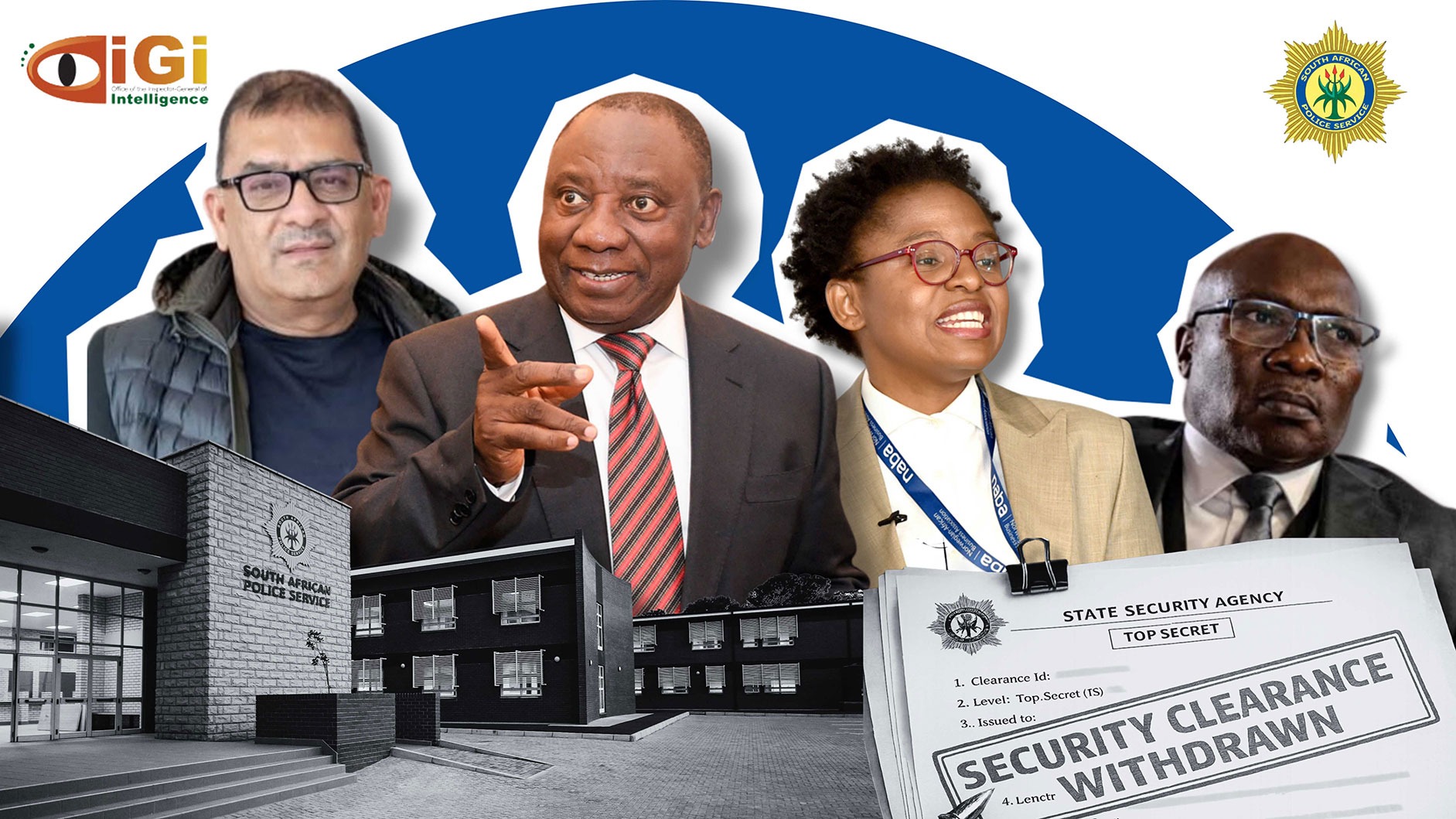
 Suspended Inspector General of Intelligence Imtiaz Fazel says flimsy claims were used to sideline him after he was drawn into the fight over Crime Intelligence boss Dumisani Khumalo. From left: Imtiaz Fazel, President Cyril Ramaphosa, Minister in the Presidency Khumbudzo Ntshavheni and Dumisani Khumalo. (X / LinkedIn / Flickr / Canva)
An explosive high court application by suspended Inspector General of Intelligence (IGI) Imtiaz Fazel confirms how central former police minister Senzo Mchunu’s office was to the series of investigations and leaks that led both to the Madlanga Commission and to the unprocedural and likely unconstitutional suspension of the IGI.
Fazel is challenging the withdrawal of his security clearance and his subsequent suspension by President Cyril Ramaphosa. See Fazel’s full affidavit here, including a highly revealing letter to Ramaphosa dated 1 October 2025, just two weeks before the IGI was suspended. The President and the other respondents are still to file their answer.
Fazel’s evidence strongly suggests that the State Security Agency (SSA), Minister in the Presidency Khumbudzo Ntshavheni and Ramaphosa himself relied on a desperately flimsy case in order to sideline the IGI.
The crucial question is, why?
While Fazel reveals that the IGI faced systematic resistance from all three intelligence services — the State Security Agency (SSA), Defence Intelligence and police Crime Intelligence — to the disclosure and oversight mandated by law, his evidence and the sequence of events suggest that his real troubles began when, in early January 2025, Minister Mchunu directed him to investigate a set of allegations against the faction in Crime Intelligence clustered around CI boss General Dumisani Khumalo.
As we’ll see, these were precisely the same set of allegations that Mchunu’s office referred to Idac in the same month, including the allegations concerning the appointment of Brigadier Dineo Mokwele, whose investigation by Idac came under heavy criticism at the Madlanga commission this past week.
In his bombshell letter to President Ramaphosa, Fazel wrote, “In January 2025, the Honourable Minister of Police, Mr Mchunu, designated certain functions to me in accordance with section 7(7)(c) of the Oversight Act, in terms of which I was requested to investigate certain matters relating to the Crime Intelligence Division of the South African Police Service.
/file/dailymaverick/wp-content/uploads/2022/09/Dienrx9XUAAXvzk.jpeg "Inspector General of Intelligence Imtiaz Ahmed Fazel. (Photo: Twitter / @SAgovnews)")
“These matters related to allegations of irregular procurement of the Veroz Boutique Hotel in Pretoria North; utilising funds from the Secret Services Account; irregular appointment of a Brigadier, without meeting the minimum requirements of the post of Section Head: Technical Support Services; and whether or not the Component Head: Intelligence Analysis at Crime Intelligence was in possession of a valid security clearance.
“Subsequently, we received more complaints from members of the public, including members of Parliament, regarding the procurement irregularities involving other covert buildings purchased by Crime Intelligence… During the course of our investigation, we experienced unprecedented interference, especially in respect of the investigation [into the] procurement of the Veroz Boutique Hotel in Pretoria.”
A hotel, ‘GCI-Ops’ and a mobilisation
The sensitivity around the Veroz hotel is no coincidence and links Fazel’s investigation to what appears to have been an extraordinary mobilisation against Khumalo in response to the Gauteng Counter-Intelligence Operations (GCI-Ops) initiative, initially formed following the murder of whistleblower Armand Swart.
What was not previously known, but now emerges through Fazel’s affidavit, is that the allegedly unprocedural purchase of the Pretoria hotel appears to have been motivated to quickly establish a covert base for GCI-Ops and the Gauteng deployees of the PKTT, the largely KwaZulu-Natal-based Provincial Killings Task Team.
It was Mchunu’s 31 December 2024 order to disband the PKTT that set in motion his collision with KZN provisional commissioner General Nhlanhla Mkhwanazi — but also ultimately to the suspension of the Inspector General.
/file/attachments/orphans/WhatsApp-Image-2025-10-21-at-100853_358842.jpeg "Senzo Mchunu. (Photo: Phando Jikelo / RSA Parliament)")
The timeline is instructive:
17 April 2024: Armand Swart, an engineer, is assassinated over a multimillion-rand Transnet tender where the cost of components was massively inflated. It was a case of mistaken identity; the hitmen meant to kill another colleague who had reported the fraud.
30 June 2024: Senzo Mchunu appointed police minister with effect from 3 July 2024.
6 August 2024: Khumalo set in motion the GCI-Ops project after a risk assessment found that the investigators in the Swart murder faced threats from syndicates that had also infiltrated the South African Police Service (SAPS).
10 August 2024: Katiso Molefe identified as a person of interest in Swart’s murder.
30 August 2024: Khumalo requests assistance from PKTT in assisting GCI-Ops.
10 October 2024: 10 PKTT members arrive in Gauteng.
October 2024: Crime Intelligence uses covert funds to buy the Veroz hotel to accommodate GPI-Ops and PKTT.
We don’t know the detail of what happened next, but the swift arrest of Swart’s killers and the identification of KT Molefe as a suspect – later named as an alleged member of the Big Five cartel – would have sent shockwaves up the chain of a syndicate that we now know has tentacles reaching high into police and intelligence circles.
Molefe’s associates named at the Madlanga Commission include Brigadier Abraham Nkhwashu, the suspended Sedibeng District Commissioner; Sergeant Fannie Nkosi, implicated as a corrupt associate of alleged Big Five leaders and an intermediary with senior police officials including General Shadrack Sibiya, the Deputy National Commissioner for Crime Detection who played a key role in trying to carry out Mchunu’s December 2024 instruction to shut down the PKTT.
Whoever was involved, it appears the GCI-Ops investigations set off an incredible mobilisation to neutralise crime intelligence boss Khumalo and his teams, which included the PKTT.
As we’ll see, that mobilisation clearly also made use of powerful actors, some of whom, such as Fazel, may even have been unaware that they were being used in a wider battle.
Enter Brown Mogotsi and Fadiel Adams
/file/attachments/orphans/ED_609337_185253.jpg "Businessman Brown Mogotsi. (Photo: Gallo Images / Sharon Seretlo)")
30 September 2024: Controversial businessman and fixer Brown Mogotsi sends an introductory message to KZN police commissioner Mkhwanazi, seemingly to try to get him onside.
October 2024: MP Fadiel Adams allegedly has files slipped under his door. He seems primed for action, opening cases against Khumalo and his allies at the Cape Town Central police station on 29 October, then parallel cases on 31 October at police stations in Gauteng.
/file/attachments/orphans/ED_609084_195144.jpg "MP and National Coloured Congress Leader Fadiel Adams. (Photo: Gallo Images / Darren Stewart)")
1 November 2024: Adams wrote to Mchunu claiming there was interference with investigations and asked the minister to intervene. Mchunu’s chief of staff Cedrick Nkabinde escalated the matter to the office of the national commissioner.
11 November 2024: The minister’s chief of staff Nkabinde formally refers Adams’ complaint to Idac under Section 27. The Madlanga Commission has heard how flimsy Adams’ evidence was at this stage, yet an inquiry was launched.
6 December 2024: GCI-Ops, assisted by the PKTT, conducted two operations: the arrest of Katiso Molefe and the execution of a search and seizure warrant at the property of Vusimuzi “Cat” Matlala. During operations, potential interference was noted from members of the Johannesburg Metro Police Department and the Directorate of Priority Crime Investigation (the Hawks).
31 December 2024: Police Minister Senzo Mchunu instructs National Police Commissioner Fanie Masemola to disband the PKTT. Crucially, he also ordered a halt to the filling of vacant posts at Crime Intelligence.
Strategic leaks
Things moved fast in January 2025.
Adams submitted an affidavit to Idac, and the matter was handed to investigator Brian Padayachee, who later arrested Khumalo, Brigadier Mokwele, head of Intelligence Analysis and Co-ordination Nosipho Madondo, Major General Philani Lushaba and Gauteng Crime Intelligence boss Josia Lekalakala for the employment of Mokwele.
Notwithstanding his hapless recent performance at Madlanga, Padayachee was at the time clearly sold a powerful narrative about Khumalo, laced with some real facts.
So was the public.
On 6 January 2025, private investigator Paul O’Sullivan, clearly drawing on leaked source material, went on BizNews, alleging that unlawful, unqualified appointments were compromising South Africa’s Crime Intelligence division, specifically targeting “a 29-year-old Brigadier” lacking police experience or security clearance – the exact claims about Mokwele placed in front of Idac.
On 13 January 2025, News24 published an extensive exposé about the purchase of the Veroz hotel, which also took in the claims about Brigadier Mokwele.
And in January, as we’ve seen, IGI Fazel began his investigation of these same claims based on the instructions from Mchunu in terms of section 7(7)(c) of the Intelligence Oversight Act.
We know from the same article that “an official in Mchunu’s office” – probably Nkabinde – “had confirmed to O’Sullivan that the minister had requested the Inspector General of Intelligence to investigate the [Mokwele] appointment”.
We know from O’Sullivan’s later affidavit for the Parliamentary hearings on the Mkhwanazi allegations that he made contact with the IGI and forwarded material on the purchase of the hotel on 16 February 2025.
/file/attachments/orphans/ED_595169_617662.jpg "Paul O'Sullivan. (Photo: Gallo Images / Brenton Geach)")
It is easy to see how, from the perspective of Khumalo, this looked like a coordinated attack. What Fazel’s affidavit now shows is Khumalo concerns were shared in the Presidency.
Counter-mobilisation that caught Fazel in the middle
What is clear is that there was high-level concern that the IGI’s investigation of the Crime Intelligence purchase of the Veroz hotel would compromise the GCI-Ops project.
Fazel reveals in his letter to Ramaphosa: “The Minister in The Presidency, Khumbudzo Ntshavheni (MP), in correspondence dated 11 February 2025, communicated to me the need to extend [delay] the duration of my investigation, to allow the work of the Gauteng Counter Intelligence Operations (GCI-Ops) that necessitated the purchase of the said Hotel to be concluded, before my Office was given access to the GCI-Ops project file.”
Ntshavheni is the minister in the presidency responsible for the SSA, but has no jurisdiction over Crime Intelligence – and Fazel found the intervention problematic.
He notes, “This communication was unprecedented and appeared to be peculiar for a Minister responsible for a different Service to interfere with an investigation initiated by another Minister (Minister of Police).”
Fazel opted not to comply with Ntshavheni’s request, noting, “She had no authority over me and no power to direct my work, especially if it concerns an investigation into a different national intelligence structure.”
Instead, he informed her that he would engage National Police Commissioner Fannie Masemola about any operational sensitivities.
He told Ramaphosa, “Subsequently, on 18 February 2025, a meeting was held between ourselves and General Masemola, wherein we explained the purpose of our investigation and assured him that we were not interfering with the GCI-Ops, but mainly focused on the procurement of the Hotel. Despite this meeting, no access was granted to the GCI-Ops project file. We, however, concluded our investigation and submitted the investigation report to the Minister of Police on 2 May 2025.”
On 6 May 2025, Fazel briefed the Joint Standing Committee on Intelligence (JSCI) about his report’s findings on the procurement of properties by Crime Intelligence.
Contrary to what was later reported, it does not appear that the IGI recommended criminal charges against Khumalo and Masemola, but it seems the seeds of suspicion about him being responsible for the leaks had already been sown – and Fazel was soon himself to be placed under “investigation”.
Neutralising the IGI
On 25 June 2025, Khumalo, the head of Crime Intelligence and coordinator of the PKTT, was arrested by Idac (along with six other senior Crime Intelligence members) on fraud and corruption charges relating to the appointment of Mokwele.
In response, General Mkhwanazi launched his now famous press conference on 6 July 2025, publicly alleging that Mchunu and Sibiya interfered in investigations to protect a criminal syndicate.
During his testimony before the Madlanga Commission, Mkhwanazi alluded to a conspiracy between Crime Intelligence deputy head Major General Feroz Khan and Fazel in allegedly co-ordinating the leakage of confidential information to MP Adams.
So far there is no evidence implicating the IGI, notwithstanding a family connection between Fazel and Khan’s sidekick, tobacco mogul Mo Sayed, which we’ll get to later.
But the suspicions swirled, and eventually they provided the pretext for Ramaphosa to suspend the IGI. In his application, Fazel discloses that on 22 July 2025, he received a letter from the JSCI disclosing that Parliament’s oversight entity had initiated an investigation into him.
/file/attachments/2991/138164242_956039_417441.jpg "President Cyril Ramaphosa. (Photo: EPA / Andre Borges)<br>")
After his suspension by Ramaphosa in October 2025, Fazel again wrote to the committee, stating, “By letter on 26 August 2025 I asked you to confirm what allegations were being investigated against me by the JSCI. I have not received a response to my letter.”
It appears that today, almost exactly a year after he was informed of the “investigation”, he is still none the wiser about the precise allegations against him.
Then, in September 2025, matters came to a head. By now both the Madlanga Commission and Parliamentary hearings had been set in motion, and it appears that Fazel’s detractors were worried about what he might disclose.
The security clearance gambit
In a letter dated 23 September 2025, acting director-general of the SSA Tony “Gab” Msimanga informed Fazel of the withdrawal of his security clearance, accusing him of the “unauthorised disclosure of classified information”.
Msimanga said Fazel’s matter was being investigated by JSCI.
“It should be noted that the reported leaks and alleged political interference related to the Office of the Inspector General is concerning. This points to potential weaknesses in internal information security protocols and raises serious questions about the integrity and confidentiality of sensitive oversight processes. Given the nature of the disclosures, there is a credible basis to consider that a breach of security protocols may have occurred.”
Fazel requested clarity on the nature of the investigation – which cited leaks to the media – and how he was involved, but failed to get any answers from Msimanga, who directed him to appeal against the decision with Ntshavheni, who Fazel says simply ignored his request for an appeal.
The correspondence shows that the pretext was paper thin. No evidence was advanced, then or now, to show it was Fazel who leaked information rather than, say, someone in Mchunu’s office.
Fazel points out that this is not the first time such a stratagem has been used. He notes in his affidavit, “Significantly, the security clearance of my predecessor, Dr [Setlhomamaru] Dintwe, was withdrawn under similar circumstances, after he had commissioned an investigation into the conduct of the DG at the time.”
The DG at the time was Arthur Fraser, who Ramaphosa himself decided to move sideways and give presidential support to the IGI. This time was different.
Notwithstanding Fazel’s detailed letters outlining procedural flaws, flimsy reasons and the absence of evidence behind the withdrawal of his security clearance and the purported JSCI investigation, this time Ramaphosa rubber-stamped the suspension in a move that was arguably uncharacteristically both swift and irrational.
On 14 October 2025, the President wrote to Fazel citing the provision of the Intelligence Services Act that provides that “if the Inspector General is the subject of an investigation by the Committee [the JSCI]… he or she may be suspended by the President pending a decision in such investigation”.
When Fazel queried the facts establishing this investigation, Ramaphosa’s legal adviser, advocate Nokukhanya Jele, wrote back, essentially telling Fazel he was lucky Ramaphosa didn’t simply fire him because of the withdrawal of his security clearance, which the Act permits the President to do.
Part of Fazel’s court application rightly includes a constitutional challenge to the legislative scheme which can so easily manufacture the removal of the IGI, simply through the arbitrary withdrawal of a security clearance, such as in the manner that occurred in this case.
But Fazel also reveals that the resistance to real oversight is worryingly pervasive.
Stripped of resources and facing obstruction
Fazel is scathing in his assessment of Ntshavheni, who holds the power to appoint the staff in the office of the IGI, which he claims undermines their independence.
“Since my appointment on 1 November 2022, the vacancy rate has increased exponentially from 12% to 56%. Currently, the OIGI is operating at 44% capacity. I have on numerous occasions tried to fill these vacancies. During the first half of 2024, I recommended the appointment of four senior management posts. In June 2025, I recommended the appointment of six senior management positions, including a legal adviser. Minister Ntshavheni approved the appointment of only one senior management post. She has not acted on the remaining recommendations.”
Fazel raised further concerns about the resistance to oversight from SSA and Defence Intelligence.
In his letter to Ramaphosa, he noted, “Defence Intelligence, in the course of oversight on the 2022/23 Financial Year, displayed a fundamental resistance to Intelligence Oversight.
“Oversight activities were delayed during 2023/24 given the Divisional Command Council’s resistance to, and misinterpretation of the oversight mandate of the IGI in terms of the Oversight Act.
“Following extensive deliberation between ourselves and CDI (chief of defence intelligence), some common ground was established and oversight of the Division could continue.
“However, even though the 2022/23 Certificate and Management Report on Defence Intelligence were endorsed by both the Minister of Defence and Military Veterans as well as the Joint Standing Committee on Intelligence, DI eventually resorted to the courts (without any merit in our view) to have the 2022/23 Dl Certificate and Oversight Report withdrawn…
“In November 2024, in keeping with the recommendations of the Mojapelo Panel for, amongst others, the IGl to investigate the role of the Intelligence Services in the circumstances around the docking, handling of cargo and departure of Lady R from Simon’s Town in December 2022, you [Ramaphosa] had requested me, to investigate the role of the SSA in the matter. In the course of this designated function I faced particular resistance from members, under instruction from the Chief of the SA National Defence Force, who declined to be interviewed, until the intervention of the National Security Adviser, Prof [Sydney] Mufamadi.”
“In the SSA, oversight has essentially been suspended since 4 September 2025 as the Agency increasingly focused on the risk of oversight, raising spurious security concerns to delay and throttle oversight field work… even though, in terms of the Oversight Act, access to information and premises may not be denied to the IGI on any grounds…”
The controversial relation
As the deadline approaches for the President to respond to Fazel’s legal challenge, another issue was floated, seemingly to undermine his credibility. AmaBhungane can reveal his family ties to controversial tobacco baron Mohammadh Sayed.
Fazel is related to Sayed’s mother, Shamshad, a veteran broadcast journalist, Islamic scholar, humanitarian and businesswoman.
Information initially supplied to amaBhungane suggested Fazel and Shamshad were siblings, which would make Mohammadh his uncle. But both Fazel and Mohammadh downplayed this close relationship, claiming they were distant relatives.
Shamshad read our questions, but did not respond.
Mohammadh Sayed said: “I confirm that Mr Fazel and I are related through our extended family. We are, however, of different generations and do not socialise with one another. Beyond that family connection, I have no business, professional or social relationship with Mr Fazel whatsoever.”
Sayed and Adriano Mazzotti, the co-founders of tobacco company Carnilinx, are key financial benefactors of EFF leader Julius Malema.
Confirmation of Fazel and Sayed as relations follows damning evidence recently presented at the Madlanga Commission of Inquiry exposing a plot between Major General Khan, Sayed and Malema, in orchestrating the removal of the former IGI Dr Dintwe.
AmaBhungane understands members of the commission are aware of their relationship.
WhatsApp messages retrieved from Khan’s cellphones, seized during a raid at his Houghton property in May, revealed how in June 2021, Khan used Sayed as an intermediary to plant questions in Parliament through Malema, in an attempt to trap Dintwe into lying regarding his relationship with convicted drug dealer and former Crime Intelligence informer Timmy Marimuthu.
According to News24, former EFF MP Mbuyiseni Ndlozi posed the questions to Dintwe during a closed session of the JSCI.
Dintwe admitted to meeting Marimuthu, which centred on complaints Marimuthu had over crime intelligence allegedly harassing his family. He dismissed Ndlozi’s suggestion of a criminal relationship with Marimuthu as “baseless”, citing his duties as a public official for meeting requests with anyone.
But what is ironic is that Dintwe told News24 that Khan was also in attendance during this meeting with Marimuthu.
Khan’s plot against Dintwe did not succeed, with Dintwe concluding his five-year term as IGI in March 2022.
Fazel was appointed IGI by Ramaphosa seven months later.
Twenty-five applications were received for the post, and following a rigorous selection process, 10 candidates were shortlisted for interviews which were conducted over two days in February 2022. You can listen to Fazel’s interview here.
Fazel’s connection to Sayed is noteworthy, but as of yet there seems to be no evidence to suggest any improper conduct between the pair.
But, it’s both in Fazel’s and the public’s interest that his case goes ahead to squarely address the flaws in the structure and independence of IGI – and any doubts about its incumbent. DM
This report was produced by the amaBhungane Centre for Investigative Journalism. Sign up for their newsletter.
Comments
Scroll down to load comments...