




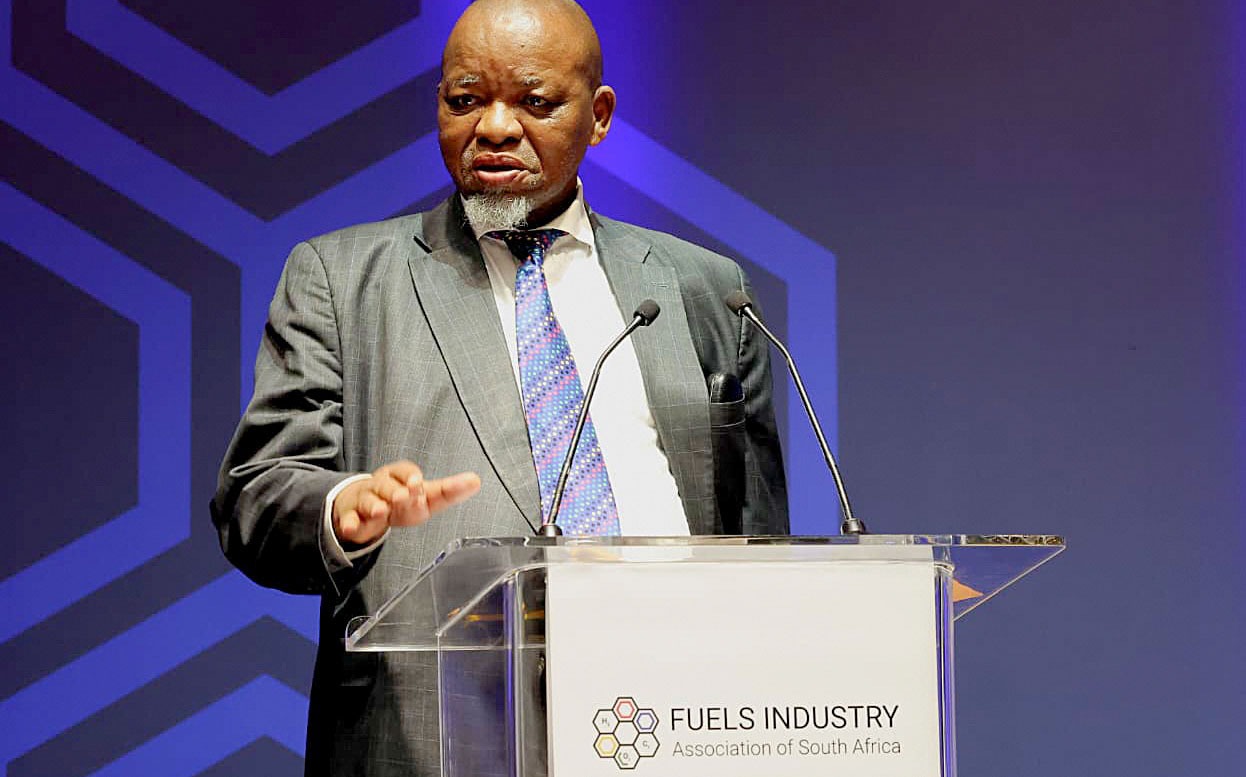
 Minister of Mineral and Petroleum Resources Gwede Mantashe. (Photo: Siyabulela Duda / GCIS)
 When you get to Section 7.1 of the recently gazetted Draft Strategic Petroleum Stocks Policy of 2026 (SPSP) – the part that tallies the economic cost of fuel supply disruption in South Africa – you’ll find a severe clerical error. Someone substituted “million” for “billion”.
Adjust for that, and you’ll find that the underlying economic model is sound and the resulting 0.7% GDP impact is highly realistic.
The draft policy is actually an about-turn from a passive, voluntary stockholding model to a highly regulated, mandatory dual-obligation regime designed to insulate the economy from extreme global supply shocks and severe fuel supply disruptions.
We now know that the ceasefire between the US and Iran didn’t hold, but even if it did, there was another shock for the globe’s fuel supply: Ukrainian drone strikes have knocked out up to 60% of Russian refining capacity, leading Russia – the world’s second-largest exporter of industry’s favourite fuel – to ban key refined product exports.
So this plan lands at the exact moment when the physical cushions in the global energy system are eroding at a record pace.
A crisis accelerant
“The geopolitical disruptions we continue to witness have exposed the risks associated with excessive dependence on imported refined petroleum products,” said Minister of Minerals and Petroleum Resources Gwede Mantashe of the policy formation.
The timing is low-key immaculate. Global oil stocks plummeted by 143 million barrels in May alone, and OECD government inventories have fallen to their lowest level since December 1990 as emergency stock releases were accelerated.
Even the US Strategic Petroleum Reserve (SPR) has fallen to its lowest level since 1983 (316.5 million barrels) as the US Department of Energy continues its 172-million-barrel emergency release to counter the Iranian conflict.
From a South African perspective, we consume about 27 billion litres of petroleum products a year, with the transport sector sitting at 90% dependency on liquid fuels.
“If we are serious about improving our energy security, reducing our vulnerability to external shocks and strengthening our economic sovereignty, then we must accelerate exploration and development of our own oil and gas resources.”
In this context alone, the SPSP 2026 is totally justified. Now add the total downstream refining collapse.
The country lost more than 260,000bpd of refining capacity when the Engen Durban refinery (135,000bpd) was permanently closed following an explosion in 2020 and Sapref Durban (180,000 bpd) was shut down by BP and Shell in 2022 before suffering severe damage in the KwaZulu-Natal floods.
PetroSA’s gas-to-liquid refinery in Mossel Bay (45,000 bpd) remains mothballed due to the total exhaustion of offshore gas reserves.
As it stands, domestic refining (primarily Astron Energy and Natref) meets only about 30% to 40% of our daily domestic demand. This forces us to rely on seaborne imports of finished fuels with lead times of 21 to 42 days.
To bypass the Strait of Hormuz, the industry scrambled to source refined fuels from the US Gulf Coast, Brazil, Mexico and West Africa. Rerouting tankers around the Cape of Good Hope to avoid the Red Sea adds up to 14 days to voyage times, severely escalating landed costs.
Wait, what does the SPSP actually say?
First, everything will be managed by the newly consolidated South African National Petroleum Company (SANPC) – remember, that’s the merger of the Strategic Fuel Fund, PetroSA and iGas.
These stocks will be held in a mix of 70% crude oil and 30% key refined products (read: diesel, petrol, jet fuel) and stored at state-owned terminals in Saldanha Bay and Milnerton. The long-term target is to phase this state cover up to 90 days.
Then, licensed wholesalers, manufacturers and importers must maintain a 21-day safety buffer. These private stocks must also follow a 70% crude and 30% finished product split to ensure immediate downstream market liquidity.
To bypass the bottleneck of non-operational domestic refineries, the SPSP mandates a permanent shift in the strategic stocks mix to include at least 30% finished products.
But the part that will cause the most drama is where it mandates that all strategic reserves be transported via pipelines entirely within South African sovereign territory (such as Transnet’s Multi-Product Pipeline) to guarantee full state control.
Painting over structural cracks
While strategic stockholding is necessary, the state’s accompanying infrastructure plans and the financial burden placed on the private sector raise severe viability concerns.
The government acquired the flood-damaged Sapref facility in 2024, rebranding it as the SANPC Refinery with plans to revive and expand its capacity from 180,000 bpd to a massive 400,000-600,000bpd as a cornerstone of its BRICS-aligned energy strategy (read: sourcing crude from Russia and Brazil).
And although Transnet’s Multi-Product Pipeline (MPP) has the built-in strategic reserve capacity to move fuel from Durban to Johannesburg, Transnet remains a critical structural bottleneck on port capacity and volume movement.
Port pricing and rail constraints could severely delay emergency stock replenishment, which the policy optimistically mandates must happen within 60 days for strategic stocks and 45 days for commercial stocks.
The SPSP 2026, like many of South Africa’s greatest policy hits, is an ambitious, essential, but high-risk intervention.
Our complete loss of refining capacity means we can no longer afford a just-in-time commercial delivery model, so building a 36-million-barrel physical reserve under a dual-obligation model is a highly justified strategic move to buy the country time during a crisis.
But since the maths is already broken in the draft … as always, it is the execution that matters. We’re off to a bad start. DM