



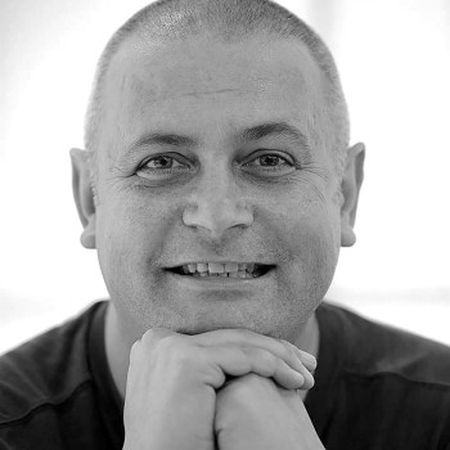
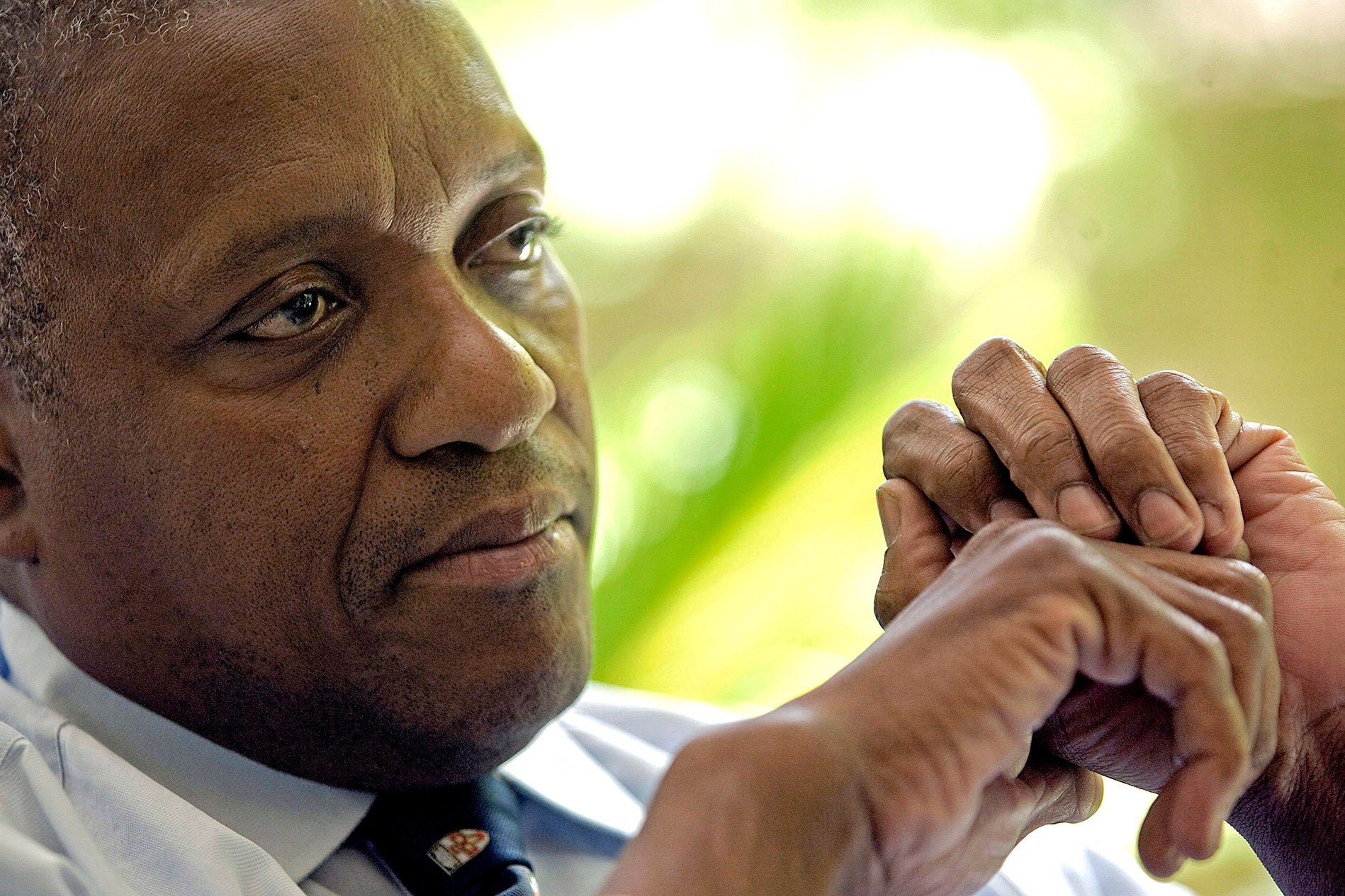
 Trevor Tutu, the son of legendary anti-apartheid activist Archbishop Emeritus Desmond Tutu. (Photo: Gallo Images / Foto24 / Brendan Croft)
Trevor Thamsanqa Armstrong Tutu, born on 14 April 1956 in Klerksdorp, died at an undisclosed venue in Johannesburg. The cause of his death is also unknown.
Trevor Tutu was named after Father Trevor Huddleston, a prominent English Anglican priest and anti-apartheid activist. Huddleston was a mentor to Archbishop Desmond Tutu and significantly influenced Tutu’s decision to enter the priesthood.
/file/attachments/orphans/AFP_20111228_ARP3029335_v2_HighRes_SouthAfricaTutuTrevorJustice_727634.jpg "Trevor Tutu, son of Anglican Archbishop Desmond Tutu, is led from court in Soweto on 26 August 1985, after being arrested under South Africa’s state-of-emergency regulations. He had disrupted a court hearing for dozens of black schoolchildren detained by police for boycotting classes. (Photo: Wendy Sure Lamm / AFP)")
He grew up in a house that never stayed still. Trevor spent his earliest years moving between Johannesburg and London as his father’s calling as a priest pulled the family through one uprooting after another. By the time the Tutus settled briefly in Golders Green in the early 1960s, young Trevor spoke only Xhosa. He picked up English within months, the first of many quick adjustments a childhood spent in his father’s slipstream would demand of him.
“I have very fond memories indeed of my time with my dad in England,” he told the Daily Mirror in 2022, recalling a father who, in those years, was simply “plain Joe Soap”, not yet the figure who would win a Nobel Peace Prize and lend his voice to a nation in mourning and hope.
It was in England that father and son discovered a shared devotion to football. Desmond Tutu had fallen for West Ham United, largely on the strength of Bobby Moore, Martin Peters and Geoff Hurst, and Trevor inherited the obsession whole.
/file/attachments/orphans/0000126706_388013.jpg "15 July 2009: Trevor Tutu, the son of legendary anti-apartheid activist Archbishop Emeritus Desmond Tutu, at the Solidarity and the Institute for Constitutional and Labour Law Studies International Conference on Affirmative Action at Centurion Lake Hotel. (Photo: Gallo Images / Foto24 / Cornel van Heerden)")
He remembered being taken, aged eight or nine, to Wembley for the 1966 World Cup semifinal between England and Portugal, riding on the back of his father’s scooter. “We were at the end where Gordon Banks made that famous save from Eusebio,” he said.
His father’s fame did nothing to dampen his taste for a motorbike, even after security made such outings rarer. “But I do remember when he once picked up the South African ambassador to Ireland on his bike and raced off,” Trevor said. “She couldn’t believe it.”
***
Back in South Africa, his parents sent him to Waterford Kamhlaba School in the then Swaziland (Kingdom of Eswatini), the boarding school that became, for a generation of children whose parents were harassed, banned or imprisoned by the apartheid state, something closer to a sanctuary than an ordinary classroom.
It was there, in 1969, that Trevor met Ghaleb Cachalia, the businessman, columnist and former Member of Parliament whose family had also sent a son to Waterford to escape what Cachalia later called “the daily brutalities and absurdities of apartheid”.
The two boys became dormitory mates and, in Cachalia’s words at his memorial address, built a friendship out of nothing grander than “shared jokes, adolescent conspiracies, whispered conversations long after lights out”.
/file/attachments/orphans/0000126675_946276.jpg "9 January 2009: Trevor Tutu, the son of legendary anti-apartheid activist, Archbishop Emeritus Desmond Tutu. (Photo: Gallo Images / Foto24 / Brendan Croft)")
The friendship followed both young men to London in the 1970s, Trevor to Imperial College, Cachalia to SOAS (School of Oriental and African Studies). Whatever their families had intended, they treated their studies as a formality set around a more urgent curriculum of tennis.
An elderly member of the English Lawn Tennis Association, charmed by the pair’s efforts on Clapham Common, gave them tickets to watch Stan Smith beat Ilie Nastase in the Wimbledon final. On another occasion they talked their way into the Members’ Enclosure at Lord’s using club ties bought purely for the purpose, a scheme built entirely, Cachalia said, on the confidence of “young men who believed rules were for other people”.
It did not always go their way. After one football match the pair found themselves chased by skinheads, a reminder, Cachalia noted, that prejudice was “not an exclusively South African export”.
***
Underneath the mischief ran a seriousness that would shape the rest of Trevor’s life. He and Cachalia marched together in protests and later travelled to Soweto to meet Senator Ted Kennedy during his landmark 1985 visit to South Africa.
/file/attachments/orphans/peterfab-europe-oneyear-Tutu_919400.jpg "23 February 2023: Trevor Tutu speaks at a discussion in Cape Town about Russia’s war in Ukraine. (Photo: Hannah Zhukovina / UKZA)")
That same year, Trevor was arrested and photographed being led from a Soweto courtroom after disrupting a hearing for black schoolchildren facing charges over a class boycott, one image among many that captured the personal risk carried by the children of the country’s most prominent anti-apartheid voices.
Some years later, however, he found himself at the centre of a different kind of headline. He caused a bomb scare at (the then) East London Airport that delayed a Johannesburg-bound South African Airways flight for more than three hours.
He rarely discussed this incident in public, and those who knew him say he treated them as closed chapters rather than defining ones. Trevor’s story, nonetheless, belongs to a wider history.
South Africa’s liberation struggle did not end at the prison gates or on the political stage; it also entered the homes of those who fought it. In Country of My Skull, Antjie Krog reflects on the enduring emotional legacy of apartheid and the way public violence seeped into private lives.
/file/attachments/orphans/ED_184758_830522.jpg "Trevor Tutu at the 9th Annual Desmond Tutu International Peace Lecture at the Cape Town City Hall on 7 October 2019 in Cape Town, South Africa. The lecture, delivered by influential Zimbabwean-born businessman and philanthropist Strive Masiyiwa, focused on one of the critical struggles: overcoming corruption and restoring citizen trust, locally and globally. (Photo: Gallo Images / Brenton Geach)")
Psychologist Pumla Gobodo-Madikizela, in A Human Being Died That Night, and in her subsequent work on memory and intergenerational trauma, has explored how the wounds of political conflict can echo across generations, shaping families long after the struggle itself has ended.
Children of activists often grew up in households marked by uncertainty, frequent absences, exile, surveillance or fear. It is not difficult to imagine that being the son of a man revered by millions yet vilified by others could hardly have been a simple inheritance.
***
If 1990 belonged to his father and to Nelson Mandela, it also gave Trevor one of the stories he liked to tell. When Mandela walked free after 27 years and was taken to Archbishop Tutu’s residence in Cape Town, it was Trevor’s small flat beside the main house that was handed over for the night.
“At the time I had a small apartment alongside the main house and Madiba actually slept in my bed,” he told the Daily Mirror. “I was consigned to a small room in the big house itself.” The next morning Mandela greeted him by name, having evidently studied the Tutu family tree during his years on Robben Island.
***
Trevor’s professional life never settled into a single shape. He worked for IBM, created a marketing company and was engaged in a variety of nonprofit activities. In his later years he found something closer to a vocation as a historical tour guide in Soweto, walking visitors down Vilakazi Street and through the district’s layered history of activism and survival, a role that let him talk, at length and with evident relish, about a struggle he had lived rather than merely studied.
/file/attachments/orphans/AFP_20120101_ARP3030942_v3_HighRes_JusticeSouthAfricaTrevorTutu_728806.jpg "Trevor Tutu, who threatened to explode a bomb aboard an aeroplane at East London Airport, is arrested on 3 January 3, 1989 after his appearance in the Kempton Park Magistrates’ Court on a charge of contravening civil aviation laws. (Photo: AFP)")
In 2023, Daily Maverick wrote that at a Cape Town event marking the first anniversary of Russia’s invasion of Ukraine, he challenged his audience with characteristic bluntness. He said he was amazed that South Africans seemed to be indifferent to the fact that Ukrainians were shedding their blood to preserve democracy.
“I have a real issue that democracy lives or survives at the borders of Ukraine. And we’re treating it as a Sunday-afternoon picnic,” he said to applause. He appeared to be addressing not only the controversial “non-aligned” position of the South African government towards the war, but also his perception that ordinary South Africans seemed to be indifferent to what the Ukrainians were doing in resisting Russia’s invasion.
***
Trevor married Ntombizanele Tshabalala, and the couple raised a daughter, Palesa, and a son, Lizo. Cachalia remembered evenings around the Tutu dinner table and tennis on the court at his own home in Observatory, where the two men’s daughters, close in age, grew into a friendship of their own.
Palesa, speaking at his memorial, described a father who filled a room with a large and unpredictable personality: “unpredictable, impossible, funny and generous”, a man with his own voice who “lived boldly”.
She recalled Saturday mornings spent buying flowers for the house and for her mother, and often given over to his own cooking, mussels in a white sauce, eaten together as a family in the unhurried ritual he seemed to value above almost anything else. His kindness could be impulsive rather than considered; he once brought a homeless stranger home and offered him a bed for the night, with no apparent thought for what the gesture might cost or complicate.
/file/dailymaverick/wp-content/uploads/2022/01/Ach-Mrs-Tutu-University-of-Free-State-002.jpg "Archbishop Desmond and Leah Tutu at the University of the Free State on 17 October 2013. (Photo: Supplied)")
When this obituarist asked further questions, beyond what was already in the public domain and about what she remembered of her late father, Palesa Tutu replied: “I’m not interested in that kind of thing unfortunately. Sorry about that. The best I can do is review your article for any inaccuracies.”
In an online tribute she wrote: “If you’ve ever wondered whether a small contribution to a grieving family makes a difference, I can promise you it does. Even R200 can ease a burden. Never think your gift is too small.”
***
Trevor’s father’s death in December 2021 left its own mark. He was at his bedside on Christmas Day, the day before the Archbishop died, and described the scene afterwards with something between grief and wonder. “The current Archbishop of Cape Town, a close personal friend of my dad, was saying a prayer,” he told the Daily Mirror.
“You could actually see my father’s lips moving according to the words of the prayer. At the right moment, my father actually lifted his hand to give the sign of the cross.” He smiled as he said it. “He couldn’t have done it better.”
In Cachalia’s eulogy, he spoke about their last lunch, in Rosebank. “We laughed and reminisced,” Cachalia said, “and I left assuming, as we always do with old friends, that there would be another lunch.
Trevor was, in every sense, gloriously himself,” he told mourners. “A little errant, irreverent. But never dull, always loyal and entirely unforgettable. I say farewell today not simply to an old friend. But to a brother of my youth. My rabble-rousing companion. My fellow conspirator from those days when we both still wore short pants and believed the world lay entirely before us.”
***
When asked where in Johannesburg her brother had died, in which suburb, house or hospital, Rev Canon Mpho Tutu van Furth declined to elaborate. “That’s as much as I can tell [you about where and how he passed],” she said. “Blessings.”
/file/dailymaverick/wp-content/uploads/dm-epa-11-04-2019_12-05-56.jpg "Nobel laureate Archbishop Emeritus Desmond Tutu is helped by his daughter, Reverend Mpho Tutu van Furth, as he leaves after a televised address to the nation on the late South African president Nelson Mandela, in Cape Town on 6 December 2013. (Photo: EPA/Nic Bothma)")
Asked for a childhood memory of his father, his son Lizo declined. “I cannot write at the moment,” he said. “You should be asking who killed him and why.”
He is survived by his wife, Ntombizanele, daughter Palesa, son Lizo, his mother, Nomalizo Leah, and his siblings, Thandeka Tutu Gxashe, Nontombi Tutu and Mpho Tutu van Furth. DM
Trevor Thamsanqa Armstrong Tutu’s memorial service, as supplied by his sister, Rev Canon Mpho Tutu van Furth.
Comments
Scroll down to load comments...