




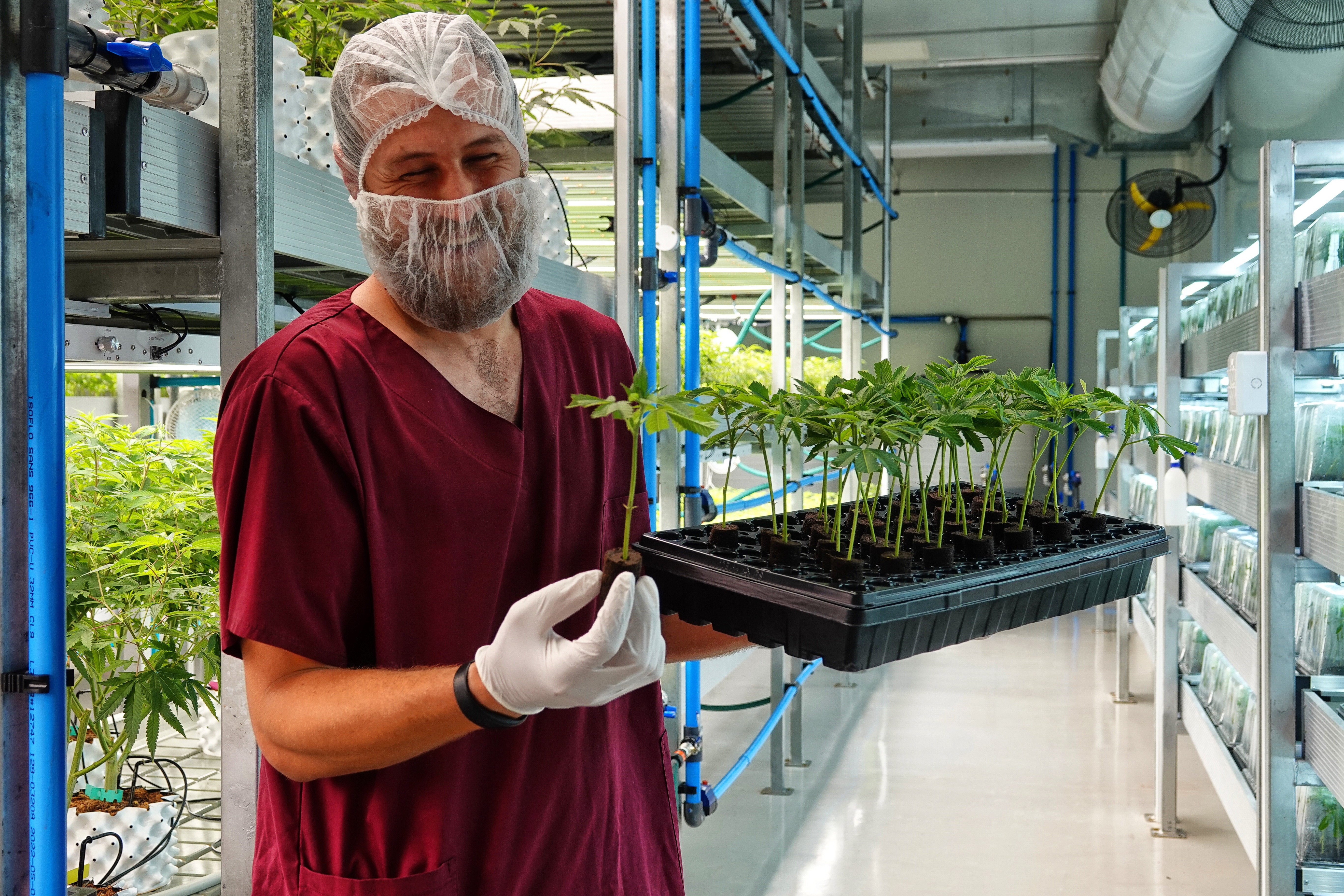
 Karoo Bioscience cultivation manager Anton Huysamer with a tray of young cannabis plants. (Photo: Chris Marais)
While rambling around Van Wyksdorp in the Klein Karoo, we kept hearing about the Dagga Fabriek, a local cannabis factory in a nearby valley. Every second person we spoke to seemed to work there, or knew someone who did.
Early the next morning, we found ourselves driving into the Opzoek Valley, admiring the flush of green life. As we round a curve in the road, we see a giant white building surrounded by solar panels and a succulent garden. It looks as if it was teleported here from an interesting time in the future. This is Karoo Bioscience, also known as the “Dagga Fabriek”.
Anton Huysamer, the cultivation manager, awaits us at reception. He wears latex gloves, a hairnet and even a beardnet. No time to laugh. We are soon dressed in silly protective gear ourselves.
/file/attachments/orphans/KarooBioscienceissituatedintheOpzoekvalleynearVanWyksdorp_ChrisMarais_461211.jpg "Karoo Bioscience is in the Opzoek Valley near Van Wyksdorp. (Photo: Chris Marais)")
/file/attachments/orphans/ThisDaggaFabriekestablishedin2022isnowoneoflargestemployersintheregion_ChrisMarais_345099.jpg "Karoo Bioscience, established in 2022, is now one of largest employers in the region. (Photo: Chris Marais)")
History of the holy herb in South Africa
Jan van Riebeeck, Dutch commander of the Cape of Good Hope, recorded the use of cannabis in his journal way back in 1658. Eva, a young Khoikhoi woman, had told him about a certain inland tribe that “made a living by keeping cattle and planting the valuable herb dacha, which drugs their brains”.
Van Riebeeck’s employer, the Dutch East India Company, later had a stab at creating a monopoly on it, but there was absolutely no way to limit or control access to the weed.
Many Khoikhoi tribes such as the Hessequa and the Hancumqua grew cannabis, all along the Klein Karoo to Mossel Bay and beyond. Up along the Orange River in the north, Swedish-Finnish mercenary Hendrik Jacob Wikar (the first European to see the Augrabies Falls) found plenty of dagga growing on the various islands in the Orange River in the late 1770s.
By the 18th century when the trekboers arrived with their wagons and livestock, liquor and tobacco for trade, the Bushmen (San) they met were already smoking a rather heady mix of kanna (Sceletium tortuosum) and cannabis for “enhanced perceptual acuity, flashbacks and visions”, according to a 2004 paper produced by Peter Mitchell and Andrew Hudson of Oxford University’s School of Archaeology.
Dagga in the rafters
In 1823, British explorer and trader George Thompson records finding a large amount of dagga drying from the rafters in a farmhouse north of Graaff-Reinet.
About 50km south of Nxuba (formerly Cradock) there’s an area called Daggaboers Nek, and a padstal bearing the same name.
Some locals will tell you it’s short for “Dag, ou boer”, the morning greeting in Afrikaans. Others say that the pioneer owners of the farm called Daggaboer were actually licensed to grow cannabis in the mid-1800s.
Cannabis became a reliable ingredient in “boererate” or Afrikaner home remedies, used in dozens of treatments for high blood pressure, asthma, poisonous bites, bleeding and more.
But in the 1920s, attitudes changed.
Dagga use began to be frowned upon. It started as a way to clamp down on criminality along the Orange River. By 1928 cannabis was criminalised and seen as equal to more serious drugs like opium.
/file/attachments/orphans/AperfectcannabisflowerinaKarooBiosciencegrow-roommeredaysawayfromharvesting_ChrisMarais_955329.jpg "A perfect cannabis flower in a Karoo Bioscience grow room, mere days away from harvesting. (Photo: Chris Marais)")
/file/attachments/orphans/OneofthenurseriesatKarooBioscience_ChrisMarais_756894.jpg "One of the nurseries at Karoo Bioscience. (Photo: Chris Marais)")
Different crops
Trade thrived under the radar, dagga was a high-value cash crop. For decades, entire generations of children were raised on the illicit income generated by hundreds of thousands of growers (mainly women) in KwaZulu-Natal and the Eastern Cape.
After many decades of legal persecution – possession of a tiny amount would land you in prison – smoking a joint (in private) was decriminalised in 2018 and legalised in 2024.

South Africa’s long history with cannabis means that it has its own landraces, plants that have developed certain characteristics over decades or even centuries.
Durban Poison is one, known around the world.
Cannabis connoisseurs describe its high as clear-headed and energising, perfect for daytime use, which is why it’s also called the “espresso of cannabis”. It has scents of sweet pine, citrus and anise.
Other dagga landraces from southern Africa include AmaMpondo, KwaZulu, Malawi Gold, Swazi and Rooibaard.
Huysamer explains: “People look for these strains around the world, then bring their unique traits into a commercial setting by breeding these characteristics into commercially viable cultivars.”
Endless summer for mothers
It is now legal in many countries, including South Africa, under tight medical and regulatory oversight, to order up cannabis from your doctor (typically for insomnia, chronic pain, as a palliative for cancer patients, or simply for relaxation), and it will be despatched to your local pharmacy.
This is Karoo Bioscience’s business, licensed by the South African Health Products Regulatory Authority. They grow, trim, dry and package medicinal cannabis for export to Australia, the UK and Europe.
Before heading into the hi-tech growing area behind reception, we glimpse a large room full of busy people.
“About 99% of what we do here is paperwork,” Huysamer explains. “When my wife Nella and I left the city and started here in 2020, it took two years just to get that side of things sorted for the licensing of the facility. After that came all the paperwork for the production itself, and that will always be changing and improving.”
Parallel to this effort was the far more exciting pheno-hunt (a short for phenotype hunting), which means sifting through large populations of seeds to find the plants expressing the most desirable commercial traits, such as yield or flower quality.
Huysamer explains: “So that’s where you plant however many seeds, and through very rigorous judgement, you exclude the ones that aren’t exceptional, and eventually end up with one or more that are absolutely amazing.”
Karoo Bioscience currently has eight special cultivars with specific properties, each with a “mother” that yields thousands of clones.
“We keep them in a non-flowering state by providing them with excessive hours of light. So they live the perfect life. For them, it’s endless summer.
“Propagation is basically making thousands of plants that are genetically identical to one another. And that is essential because we need consistency and we need reliability.”
/file/attachments/orphans/AntonHuysamerexplainingthegrowthprocesstotheauthor_ChrisMarais_619510.jpg "Anton Huysamer explaining the growth process to the author. (Photo: Chris Marais)")
/file/attachments/orphans/KarooBiosciencestaffinspectingthebuds_ChrisMarais_371595.jpg "Karoo Bioscience staff inspecting the buds. (Photo: Chris Marais)")
Lemon Zorilla
Like racehorses, the elite individuals that are eventually chosen are given descriptive names that reference lineage and breeder.
Read through the products on the Karoo Bioscience website and you could almost be looking at wine reviews: Sour OG Cheese (which offers long-lasting euphoria), has “unparalleled aromas of spices, garlic, parmesan and softer notes of sweet incense and diesel”.
Lemon Zorilla has scents of “preserved lemon, sherbet and lemongrass. Upliftment, creativity boosts and profound euphoria are experiences one might expect from this beauty.”
Black Cherry Punch creates “a deep mellowness in the body with a hint of elation”. Its flavour experience “is exploding with sour cherry, cranberry and subtle sage aromas”.
Names are a special part of cannabis lore. They can denote lineage, effect, flavours, aromas and overall user experience. Inevitably, some less-serious names slip through, like Bananas in Pyjamas or Banana Ooze.
“The naming process for one of those is still under way,” Anton says. “We’ve been debating furiously for months.”
Why here?
Karoo Bioscience is one of the country’s bigger cannabis export operations, and is 90% owned by South African shareholders.
Software used to cultivate tulips in Holland has been adapted to control light, water and air for the cannabis plants as they are moved from grow room to grow room. There are cameras everywhere.
Why is this sophisticated medicinal cannabis plant here, in this rather obscure valley near a tiny Karoo town? Surely it could have been built anywhere?
The reasons include the plentiful sunlight streaming through the greenhouse roof and onto the solar panels outside, the low humidity and the security of a nearby mountain aquifer. Up in the hills behind the white building is what CEO Doron Isaacs calls “a grandaddy borehole, powerful and consistent”.
Another reason is that cultivating cannabis is highly labour-intensive, so finding reliable staff is crucial. The vast majority of the 100-strong workforce is from tiny Van Wyksdorp.
“And they are really lovely people,” Huysamer says. DM
This is an excerpt from Klein Karoo Magic (390 pages, full colour) by Chris Marais and Julienne du Toit. To order your author-signed copy (R400 including SA courier service), email Julie at julie@karoospace.co.za
/file/attachments/2988/HeaderKLEINKAROO_510874.jpg)
Comments
Scroll down to load comments...