




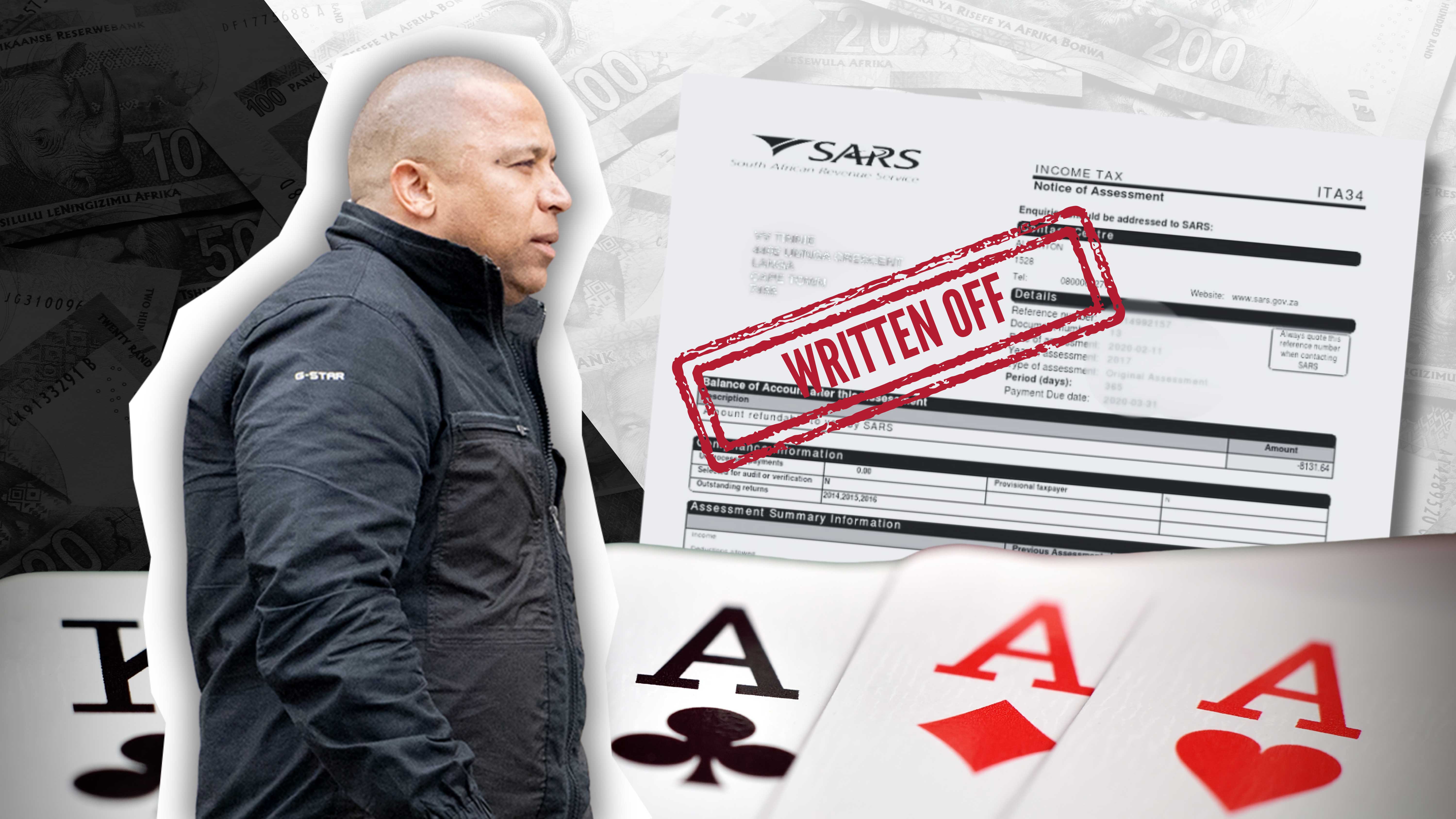
 Ralph Stanfield’s (pictured) SARS debt ballooned to R31.65-million, but the taxman ultimately recovered just R102,000. (Photo: Gallo / Canva)
In early 2019 Ralph Stanfield, the putative head of South Africa’s notorious 28s organised crime gang, was facing a seemingly slam-dunk criminal complaint from the South African Revenue Service (SARS) after the taxman uncovered what it believed to be a scheme to use fraudulent tax refunds to conveniently settle his debts.
But a combination of official inaction and some well-timed legal footwork allowed the alleged crime boss to avoid charges of tax fraud – and quash his formidable multimillion-rand tax bill.
The conflict with SARS started with Stanfield’s 2018 claims for refunds that somewhat suspiciously came to precisely his outstanding tax debt – R15.8-million.
In other words, a clean slate based on what a SARS investigator soon found to be rooted in fraudulent claims of employment income tax paid.
/file/attachments/orphans/1-The-R31-million-disappearing-act_658066.jpg "The R31-million disappearing act. (Photo: Canva)")
At the time, Stanfield was already facing charges relating to a massive gun-licence racket (later withdrawn). With SARS on his case, both his alleged burgeoning criminal enterprise and business empire were at risk of taking a massive financial knock.
Perhaps more importantly, SARS’ evidence could potentially have led to an Al Capone-style takedown (given that in South Africa tax fraud has attracted jail sentences of as much as 15 years).
The infamous 1920s American crime boss was convicted on strategic tax evasion charges instead of the slew of violent crimes he was otherwise accused of.
This was not to be the case with Stanfield – a lost opportunity which, with hindsight, could potentially have prevented a laundry list of subsequent violent crimes within the Cape Town underworld Stanfield is accused of orchestrating from 2019 onwards. As things stand, he and his criminally co-accused wife, Nicole Johnson, are due to go on trial in the Western Cape Division of the High Court in October alongside 12 of their alleged associates. The group, which is in prison awaiting trial, has been charged under the Prevention of Organised Crime Act for, among other alleged crimes, murder and attempted murder.
They are accused of trying to kill Joel Booysen, the son of alleged Sexy Boys gang leader, Jerome “Donkie” Booysen; and of the murders of Hard Livings gang boss Rashied Staggie, 27s gang leader William “Red” Stevens, off-duty police officer Sergeant Faizel Adams, gangster Ismail Abrahams, and City of Cape Town housing official Wendy Kloppers.
These murders occurred well after the opportunity for possible tax charges against Stanfield arose.
This missed opportunity to try and “Al Capone” Stanfield flows from the case for criminal prosecution SARS had already constructed in 2019, unaccountably languishing for two years until 2021 when the death of Stanfield’s accountant Jacques Francois de Villiers torpedoed any prospect of a successful conviction.
/file/attachments/orphans/2-The-four-act-escape_885963.jpg "The four-act escape. (Graphic: Canva)")
While speculative, sources with knowledge of current criminal investigations into Stanfield believe that, had SARS acted swiftly against him when it had the opportunity, there was a very real chance that Stanfield could have been imprisoned years ago, with the murder and mayhem that he allegedly unleashed across Cape Town potentially averted.
The affair seems to underline the possible consequences of the revenue service’s consistent preference for chasing tax debts over using its formidable investigative powers to criminally prosecute fraud.
As we will see, SARS did aggressively challenge Stanfield’s refund claims and launched an investigation, rapidly discovering the alleged tax evasion and fraud. It denied his refunds but then seemingly shelved the matter, happy to have saved some money. Meanwhile, Stanfield’s unpaid tax debt ballooned to R31.65-million due to the revenue service imposing a 100% penalty.
But this brings us to a second apparent failure on SARS’ part.
As it turns out, even after failing to secure his refunds, Stanfield had little reason to be concerned about his tax debt. A series of sequestration applications against him and two family trusts effectively extinguished this staggering enlarged debt not long afterwards.
There are red flags around these possibly “friendly” sequestration applications, not least that they were brought by his own accountant while the apparent sale of assets to friends and family muddied the waters, which we will get into. This circumstantial evidence suggests the sequestrations may have been orchestrated specifically to get around the tax debt.
And SARS seemingly missed the boat yet another time by not exercising its rights as a major creditor to pry open Stanfield’s financial affairs, as it was entitled to, by failing to demand an insolvency enquiry.
Stanfield and the trustees of his two trusts – Johnson, her mother Barbara Johnson, and Kevin Kiewitz – failed to respond to amaBhungane’s questions that were sent via email and WhatsApp.
The hapless accountant
Stanfield’s now-deceased accountant De Villiers is central to both parts of this story – the alleged fraud and the fortuitous sequestrations.
An affidavit deposed on 29 January 2019 by an investigator within the SARS Tax and Customs Enforcement Division shows that on 13 March 2018, De Villiers filed the first of two dodgy income tax refund claims.
A mere two weeks later, a SARS auditor, however, issued Stanfield with an audit notice demanding “proof of the payments made by him [Stanfield] to validate the PAYE credit of R5.27-million”.
Instead of proof, the accountant contacted SARS by phone and claimed that the suspicious tax return was “loaded in error”.
However, a week or so later De Villiers wrote to the revenue service to claim instead that the return was actually “not created, prepared or submitted” by his bookkeeping company, according to the SARS affidavit.
The SARS auditor nonetheless proceeded to interrogate the tax return and found that it was seemingly based entirely on a blatant lie.
The “return” included a PAYE refund claim related to Stanfield’s supposed employment. The tax reference number for the supposed employer however, belonged to a closed corporation called Kufa Trading Engineering – a Limpopo company that had ceased trading in 2015 – a full three years before Stanfield had allegedly worked at the business.
“The auditor contacted Mr Hawman of Kufa Trading who indicated in writing that he does not know the taxpayer,” states the SARS affidavit.
“At this point the auditor informed the taxpayer that SARS was disallowing the… R5.27-million claimed.”
De Villiers was however sticking to his guns about it all being some kind of problem with the e-filing system.
According to the affidavit, De Villiers agreed with the auditor’s findings, but maintained that no penalties should be imposed as Stanfield had “no control over the SARS e-filing system… and that [a] mistake on the e-filing system allowed for the submission”.
Two months later, on 24 July 2018, Stanfield (or rather, it seems, De Villiers) submitted yet another allegedly fraudulent income tax refund claim, this time for a R10.55-million refund for the 2019 tax year.
This submission was premature, and Stanfield did not actually qualify for early submission – perhaps indicating an urgent need for cash.
Nonetheless, the SARS affidavit shows that the same SARS auditor received Stanfield’s claim and once again demanded Stanfield provide proof to justify his refund request. As before, the PAYE being claimed was from a job Stanfield in fact never had.
Now De Villiers’ excuses expanded to include the possibility that his e-filing profile had been “hacked” because, as before, it supposedly wasn’t him who filed the tax return.
The SARS auditor met with both the accountant and Stanfield himself but, according to SARS’ affidavit, Stanfield refused to answer questions and instead pleaded poverty, saying that “he had lost all his businesses and that SARS should lock him up”.
/file/attachments/orphans/3-The-enquiry-that-never-was_437893.jpg "The enquiry that never was. (Photo: Canva)")
SARS alleged that its auditor had established that De Villiers, despite denials, had in fact uploaded both of Stanfield’s income refund claims.
“Considering the PAYE credits claimed for the 2018 and 2019 tax years had the effect that the entire tax debt of the taxpayer for the relevant tax years was eliminated tends to indicate that this was a deliberate act by the taxpayer and not a random systems error,” the SARS investigator wrote.
He concluded that Stanfield and De Villiers had breached the Tax Administration Act by committing tax evasion and fraud. Yet, despite these seemingly well-founded accusations, seemingly nothing more was done other than to deny the refunds Stanfield requested via De Villiers.
And parallel events seem to show that the mounting tax bill could in any case be evaded through other means.
Sequestrations
In between the dodgy tax refund claims, three sequestration applications were launched. One against Stanfield himself as well as another against the Ralph Israel Stanfield Family Trust and yet another against the similarly named Stanfield Family Trust.
Of these, the sequestration of Stanfield’s personal estate was by far the most consequential, although the way the trusts were dealt with also raises questions.
The sequestration of an individual or trust has the same effect as the liquidation of a company. Creditors’ claims get frozen, and a process ensues to sell off assets to try to recover whatever is possible to cover at least some part of the outstanding debts – including tax debts.
/file/attachments/orphans/4-Trusts_350567.jpg "The Stanfield trust structure. (Trusts: Canva / Gallo)")
There is always a risk that assets are hidden or dissipated so that creditors end up receiving “dividends” of only a portion of their actual claims on the estate.
And SARS’ claim could reach not only Stanfield himself but also his trusts, which can legally be treated as either an “extension” of a taxpayer or as a veil over assets that can be used to settle tax debts.
A proviso before we continue: we cannot prove conclusively that the sequestrations were orchestrated by Stanfield, who would have had to rally small friendly creditors and possibly even the court-appointed insolvency trustees tasked with ascertaining the value and distribution of assets.
That said, the stars did conspicuously align for him while related parties seem to have driven much of the process.
And ultimately it resulted in SARS managing to claw back far less than 1% of the massive punitive R31-million tax charge against Stanfield.
As with the ill-fated attempts to score tax refunds, the key Stanfield adjutant was De Villiers.
The accountant was involved in all three sequestration applications.
In each case it was his own invoices for accounting services that pushed the trusts and Stanfield over the line into insolvency or at least gave him standing to bring the applications.
De Villiers’ attorney, Ruben Healley, who acted in all three sequestration applications against Stanfield and the two trusts, denied that the sequestrations were a sham.
He also said there was nothing untoward in the fact that he later represented Stanfield in his successful rehabilitation application to exit sequestration.“I received instructions from and consulted with De Villiers, who was the bookkeeper at the time, and who simply indicated to me that his client and trusts needed to be sequestrated due to apparent insolvency.
“Applications were thereafter drafted in accordance with the instructions and information received from De Villiers. Subsequent sequestration orders were granted and obtained as requested.”
Healley described his relationship with De Villiers on his Facebook page after the accountant’s untimely death during the Covid-19 pandemic in 2021: “Jacques, my friend and mentor. I loved you like a brother.”
He told amaBhungane, “I was not aware, and was not made aware, of any of the allegations in regards to tax fraud prior, during or subsequent to the conclusion of my mandate by De Villiers, or anyone for that matter.
“I was acting bona fides upon instructions and information received from Mr De Villiers to attend to the sequestration applications. What transpired after that, I not only have no knowledge of but also had no duty to investigate and/or instructions to query, as that falls within the responsibilities of the appointed Trustees.”
Take one
The first sequestration application in July 2018 targeted the Ralph Israel Stanfield Family Trust.
It was brought in the midst of Stanfield’s attempt to get refunds out of SARS and revolved around the relatively paltry sum of R20,000 the law firm Lucas Dysel Crouse Inc (LDC) was apparently owed for legal fees – ironically said to have been incurred for consultations on recovering bad debts.
In an affidavit filed in support of the application, Healley – the sole director of LDC – claimed that the trust had as its only asset precisely R20,000 in cash. The only other creditor mentioned was De Villiers’ accounting firm, Sapphire Consult, which was seemingly owed R50,000, rendering the trust insolvent.
/file/attachments/orphans/5-Timeline_418837.jpg "The making of a tax vanishing act. (Timeline: Canva)")
In his affidavit on behalf of LDC (his own firm) Healley disclosed he had known and acted on behalf of the trust for about six months. His invoice, which provided none of the usual detailed time sheets, came to a round R20,000 exactly.
Healley told the following sad story about his client: “The Respondent’s source of business and income was predominantly the lending of monies… Therefore the Respondent’s primary source of income was generated via the interest charged on the respective loans…
“The unfortunate reality of unstable economic circumstances then had the prejudicial result in the [borrowers] being unable to repay the respective loans…
“This resulted in legal action against the third parties that defaulted in payments… The aforementioned legal action did not produce any positive results…”
While there is no evidence that Healley was personally aware of the SARS claim, he does state in the application that “legal proceedings, which certain creditors are planning to institute against the estate… will be stayed in the interest of the General Body of Creditors”.
An email from Healley’s legal associate to the three representatives of the family trust (which included Nicole Johnson) made it clear that they were in the loop, noting: “I am aware that you are cognizant of the application however, I wish to notify you personally.”
Take two
The more important sequestration of Stanfield’s personal estate kicked off in November 2018, again in the midst of SARS’ interrogation of his affairs.
This time, a R160,000 bill from De Villiers himself was the basis for his application to sequestrate Stanfield.
This seemingly followed straight after SARS rejected Stanfield’s second refund request, and it is reasonable to infer De Villiers was doing his client’s bidding rather than trying to squeeze unpaid bills out of the alleged gang boss.
In any case, De Villiers was certainly aware that the outstanding tax debt of R31.65-million, which takes precedence over other debts, made the likelihood of recovering anything of his R160,000 practically zero, so he appeared to be acting against his own interest in seeking Stanfield’s sequestration.
But, conveniently, SARS could also expect to get a tiny fraction of its claim against Stanfield – and the debt would effectively then be extinguished.
The three trustees appointed to administer Stanfield’s estate found that he essentially only had a R230,000 property in Mitchells Plain as a fixed asset.
According to an affidavit Stanfield would later depose to in 2023 when he sought to be rehabilitated, the dire financial position resulted from “a drastic decrease in my income and the fact that I had signed surety for a lot of debt, which in return caused my financial stability to spiral out of control to a point where I was unable to meet my financial obligations and pay my debts when they became due and payable”.
When all was said and done, the final distribution to the taxman was a mere R102,000 (wiping out a debt of R31.65-million) while De Villiers got nothing.
And the property in Mitchells Plain? It turns out that it was sold to a Prosper Trust, one of whose trustees is Denver Booysen, one of Stanfield’s co-accused in his upcoming trial in October.
Take three
A third sequestration targeting the Stanfield Family Trust (not to be confused with the already-sequestrated Ralph Israel Stanfield Family Trust) arrived later on, in June 2019.
The applicant was once again De Villiers, who was ostensibly chasing a R100,000 debt, and it was not opposed by Nicole Johnson, Stanfield’s wife and a trustee of the trust.
The application was mostly verbatim to the one previously used to sequestrate the other trust.
This time it was De Villiers who reproduced the sad story about “unstable economic circumstances” which had negatively affected Stanfield’s loan business – with the same wording seemingly cut and pasted from Healley’s affidavit in the earlier application.
All the trust had left was one property in Kenilworth worth R3-million. According to De Villiers this was more than offset by debts of R3.34-million.
Most of this debt was however owed to Stanfield’s wife (Nicole) and mother-in-law (Barbara Johnson) as well as ABSA in relation to a bond over the property.
In his affidavit, De Villiers claimed that “it would also appear that its trustees are unwilling or unable to donate any more funds to [the] respondent”.
But that wasn’t entirely true.
The property was sold to the company NJ Trump Investments, whose sole director is the aforementioned mother-in-law Barbara Johnson.
The Stanfield clan managed to find the money to keep the property in the family – and theoretically keep it beyond SARS’ reach.
De Villiers requested the matter be heard on an urgent basis, noting that provisional sequestration would stay “legal proceedings, which certain creditors are planning to institute against the estate”.
The final word should go to Healley, who bridled at amaBhungane’s questions about the propriety of the applications.
He told us: “As a respected officer of the High Court of South Africa for more than a decade, I take extreme exception against, and deny unequivocally your unfounded… assumption that I intentionally and knowingly acted mala fides... I will not allow my integrity to be questioned by you stating that orders granted by the said Honourable Court were so-called shams.”
Another lost opportunity
Creditors and trustees in sequestrations have one extremely powerful tool at hand if they have any suspicions that money might have been ferreted away and may yet be recoverable through criminal charges or civil proceedings – calling for an enquiry where witnesses can be called and information subpoenaed.
A sequestration enquiry, which would have seen both Stanfield and Johnson compelled to testify and produce any financial records, including any loan books and surety records, presented another “Al Capone” opportunity.
This opportunity to comprehensively access Stanfield’s financial records however, passed by and the police would eventually only in September 2024 – five years later – unearth anything comparable.
SARS could have called for enquiries into not only Stanfield’s estate but also the two trusts, but for some unknown reason opted not to.
We asked the tax authority why it did not do this, but this was one of many questions SARS did not answer in its boilerplate response to amaBhungane.
Its spokesperson told us: “SARS took a civil judgement against the taxpayer and subsequently the taxpayer was placed under sequestration… SARS has participated in the creditors meetings and at that time the value of the assets as confirmed by the liquidator was R230k... SARS was awarded final dividend from [the] Liquidation and Distribution account of R102k. Based on this… the [outstanding] tax becomes irrecoverable at law.”
Thin reports
The liquidators appointed to administer Stanfield’s personal estate were the Cape Town-based Gary Wallace and the Pretoria-based Michelle Schutter and Daniel Ndlovu.
In response to amaBhungane questions, the Pretoria team referred us to the more senior Wallace, who did not bother to respond.
In relation to Stanfield’s personal estate a barebones “Report of Trustees” was presented at a second creditors meeting held on 11 July 2019 at the Mitchells Plain Magistrate’s Court in Cape Town.
Crucially, in the report Schutter states that there was a “danger of contribution”, which means that if a debtor does not have enough funds to cover the legal and administration costs of winding up their estate, which includes the costs of an enquiry, any proven creditor can be legally compelled to cover any shortfall.
Given that Stanfield supposedly had nothing to his name but a property that realised a paltry R230,000, it seems this may have been just the thing to ward off SARS from pushing for an enquiry to test the legitimacy of his insolvency claims.
SARS records amaBhungane has obtained show that the Receiver ultimately wrote off Stanfield’s debt in August 2020 without calling for an enquiry into either of the three sequestrations.
Several more months passed until SARS, in March 2021, finally took its tax fraud case against Stanfield to the cops.
But, as we’ll see, it was too little too late – and SARS has again declined to explain its tardiness.
Dead accountant, dead case
De Villiers, the accountant who had been intimately involved in Stanfield’s tax affairs, died just two months before SARS finally laid criminal charges against the alleged gangster.
Court records show that De Villiers’ demise was the reason the National Prosecuting Authority (NPA) withdrew the charges of tax evasion and fraud by June that year.
Without De Villiers available to defend himself, Stanfield could simply blame everything on a rogue bookkeeper.
Court records show that the prosecutor stated that she was withdrawing the charges because there were “no prospects of a successful prosecution”.
The NPA’s Western Cape spokesperson Eric Ntabazlila said that Stanfield and De Villiers were charged with two counts of fraud after SARS discovered the employee tax certificates were fraudulent and the claims were rejected.
“The information that the accused owed SARS the exact amount he fraudulently claimed was indeed brought to the attention of the State, but that information could not assist the State in proving the charges against Stanfield in the absence of De Villiers.
“With the death of De Villiers, the State has no prima facie case against Stanfield alone… The blameworthiness of De Villiers cannot be attributed to Stanfield whilst he is not before Court.”
He said that while De Villiers had submitted the income tax returns on behalf of Stanfield, and uploaded the fraudulent employee tax certificates, “there was no evidence in the docket that he acted on the instructions of Stanfield to make fraudulent declarations”.
Qualms
De Villiers was potentially a massive liability for Stanfield.
As we saw, his death was conversely very fortuitous for the alleged gangster.
As it turns out, the accountant was trying to extricate himself from Stanfield’s business right before he died and shortly before the ill-fated fraud charges were finally laid.
According to a confidant of De Villiers, who asked not to be named because of security concerns, the accountant died exactly one month after meeting Stanfield in Kleinmond in December 2020 and telling his infamous client he wanted out.
The confidant told amaBhungane that De Villiers was worried about what Stanfield was involved in… I don’t know, but [I know] he wanted nothing more to do with him,” said his confidant.
“What the exact reasons were [of Jacques]… [his] family [being] in danger or [the] unlawful activity… I don’t know, but he wanted out. Ralph said they would talk about it in the new year.”
That conversation, however, never happened as De Villiers died in January.
Officially, he died from natural causes, which amaBhungane understands to have been Covid-19. DM
This story was produced by the amaBhungane Centre for Investigative Journalism. Sign up for their newsletter.
Comments
Scroll down to load comments...