



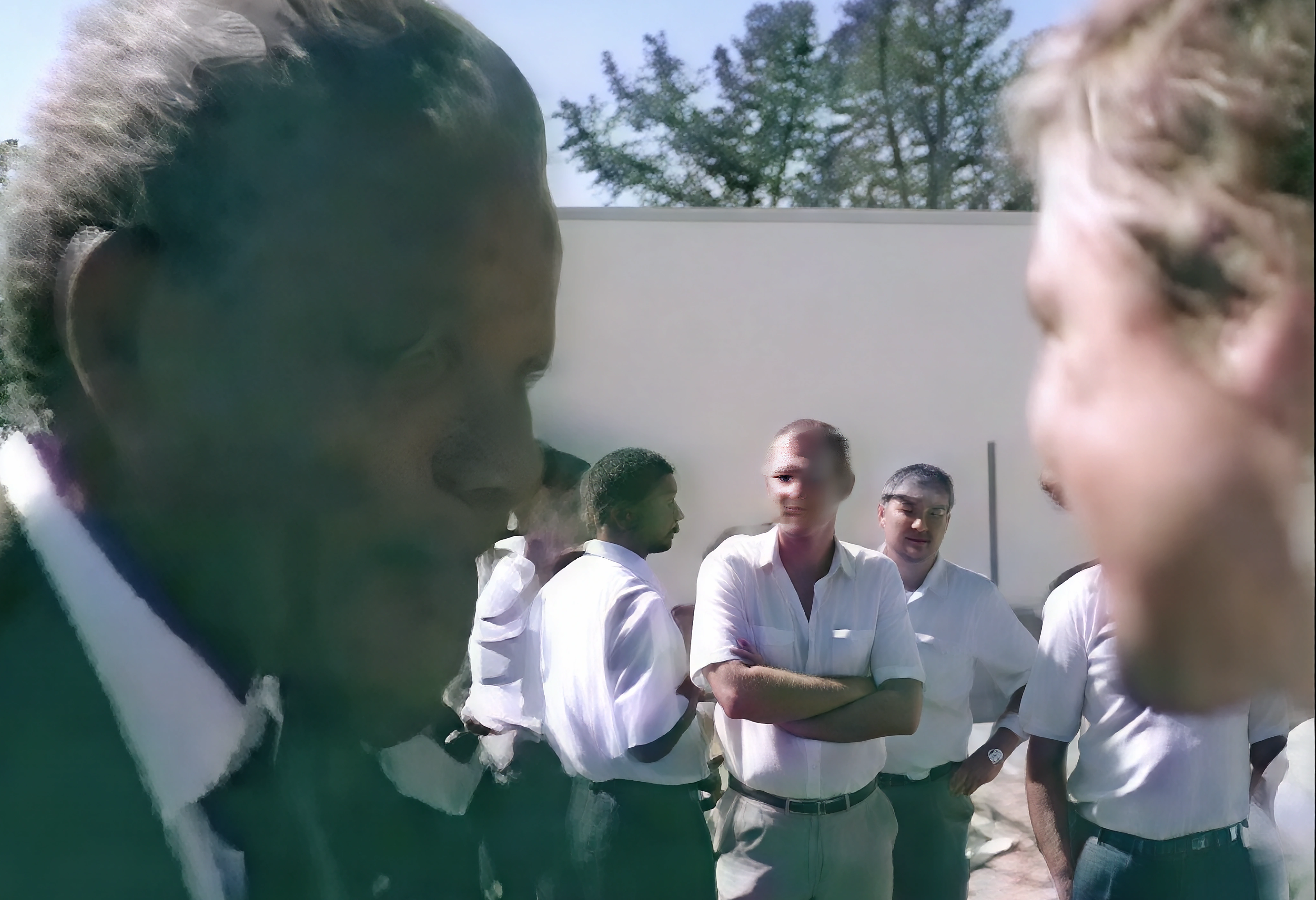
 The moment John Battersby became the first to shake Nelson Mandela’s hand after his release from prison. (Photo: Screenshot)
 It was with a dose of serendipity that I became the first person to shake Nelson Mandela’s hand as he walked free after 27 years in captivity.
I had arrived at the gate of the prison warder’s house at 2.55pm on a windless summer’s day with the shimmering heat and a clear blue sky.
Mandela’s release was due at 3pm. A large crowd of domestic and international media were gathered at the gate. Some had been there since 6am.
My head was so full of expectation and an overwhelming sense of history-in-the-making that I wandered through the gates and found what I thought was an inconspicuous position next to a tap.
I will never know why I was not challenged, and consequences were the last thing on my mind at that time.
Coincidentally I was wearing a slate-blue cotton suit that resembled the colour of the regular police uniform. That is the only factor I could come up with to explain my free passage into the prison grounds.
Freedom delayed
As it happened the moment of freedom was delayed while Mandela and Winnie Madikizela-Mandela and prominent leaders of the African National Congress (ANC) discussed the contents of Mandela’s prepared speech due to be delivered from the Cape Town City Hall later in the day.
It was a long wait with all eyes set on the driveway down which Mandela and Winnie and a dozen or so colleagues would walk towards the gates where the media awaited.
And then at 4pm the magic moment arrived.
I moved closer to the approach road as Mandela and Winnie emerged with fisted arms raised high.
I caught Mandela’s eye as I moved towards him. He broke into a broad smile and came over to shake my hand before resuming his determined march to the prison gate.
Time stopped and I started to process what had just happened.
The moment was captured on the ABC television pool footage on the day and later in Mandela: The Authorised Biography by Anthony Sampson with an Afterword by myself.
Christian Science Monitor
I was the southern Africa correspondent of the Christian Science Monitor at the time.
It was one of only a few newspapers Mandela had been allowed to read in his later years in prison due to the “Christian” reference, which resonated with the apartheid government which purported to be Christian.
Mandela had fond memories of the newspaper – I later discovered – because of its coverage of international affairs and particularly what he regarded as the objective coverage of the Israeli-Palestinian conflict in the Middle East.
/file/attachments/orphans/ED_South1467_423593.jpg "Photographers try to get a glimpse of Nelson Mandela through the fence at the Victor Vester Prison, before his release. (Photo: Graeme Williams / South Photographs)")
On his first visit to the United States Mandela surprised his security detail by making an unscheduled visit to the Christian Science Monitor HQ in Boston, to the astonishment of the editor and his colleagues.
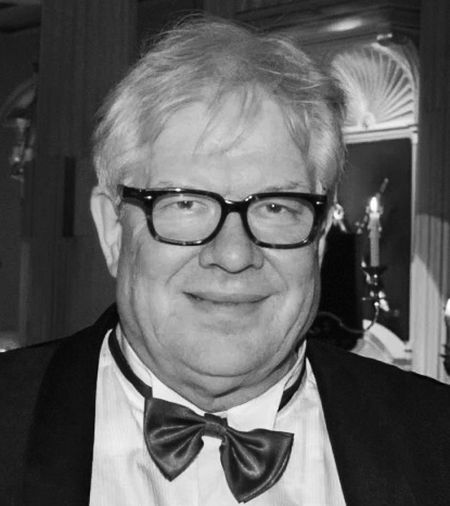
In the years 1983-87, while I was based in London, I had written a column for the South African morning group that was published regularly in the Cape Times with my photograph.
In the column, I often focused on the progress being made by the ANC and its exiled leader Oliver Tambo in winning friends in the West and triggering economic and financial sanctions in the US and worldwide and an international sports and cultural boycott.
Smuggled out of prison
On returning to South Africa in 1987, I was surprised to find that Mandela had quoted from one of my columns from London in a forward that he smuggled out of prison for Oliver Tambo’s book of speeches.
He was making the point that the profiles of Tambo and the ANC were rising and there was growing acceptance in the West of the need for economic sanctions and the isolation of the apartheid government.
After Mandela’s release he would become overwhelmed by the endless demands on his time.
/file/attachments/orphans/ED_South1459_247666.jpg "Nelson Mandela with Winnie Madikizela-Mandela on his release from Victor Vester Prison. (Photograph: Graeme Williams / South Photographs)")
/file/attachments/orphans/AFP_20130608_APP2001021713857_v6_HighRes_BioMandelaCrowdNewspaper_451292.jpg "A jubilant Sowetan holds up a newspaper announcing the release of Nelson Mandela at a mass ANC rally on 11 February 1990. (Photo: Trevor Samson / AFP)")
At these times he would take up the open offer from the late billionaire insurance magnate Douw Steyn to use his sumptuous Johannesburg residence for functions, high-level meetings and simply as a refuge from the maelstrom.
Mandela read and edited the proofs of his autobiography Long Walk to Freedom and later prepared for the painful separation from his wife Winnie in Steyn’s house.
At a gala evening in 1999 at the house – before it was transformed into a luxury hotel – Mandela made a spontaneous speech thanking Douw and Liz Steyn for their hospitality, and Douw for having the courage to change.
Mandela said there was nothing more rewarding than going to bed at night knowing that you had enriched the lives of those less fortunate than yourself.
He said that introspection and self-awareness were essential for self-development.
“One of the most difficult things is not to change society but to change yourself,” Mandela said.
Regular access to Mandela
In the decade from 1990-1999, I was fortunate to having regular access to Mandela first as Christian Science Monitor correspondent from 1989-1994, and later as editor of The Sunday Independent from 1996-2004 after returning from a two-year stint in Jerusalem.
During my time as editor, my wife Denise and I were invited alone to lunch at Mandela’s residence in the leafy suburb of Houghton in Johannesburg several times.
On one occasion in the final year of his presidency, a young assistant entered the dining room with a portable telephone that she handed to Mandela and announced: “It’s the Queen of England.”
“Ah Hello Elizabeth!” Mandela exclaimed. “How are the boys?”
The princes William and Harry had lost their mother when Princess Diana died in a car crash in Paris in August 1997.
Mandela regarded Diana and the queen as close friends and was enquiring about the state of the young princes after such a tragic loss.
/file/attachments/orphans/AFP_20060104_ARP1516517_v7_HighRes_BioMandelaRelease_762530.jpg "Nelson Mandela rides through cheering fans as he exits Victor Verster prison. (Photo: Alexander Joe / AFP)")
Mandela was comfortable with royalty having grown up himself under the tutelage of the elders in the royal Tembu clan of the Xhosa people. His father was a Xhosa chief.
I have never encountered a more media-savvy politician. Mandela shared Winston Churchill’s acuity when it came to understanding the importance of an image.
Mandela had an impish and often self-deprecating sense of humour that he used to put people at their ease by distracting them from the trials and tribulations we experience in our daily lives.
Everyone who met Mandela remarked on how they felt like the only person in the world while interacting with him.
Saddest moment
The saddest moment I ever experienced in Mandela’s presence was the day in 1992, when he announced his separation from Winnie – the love of his life – following an increasingly traumatic relationship. The pain was palpable and felt by all those who attended.
Five years later in 1997 Mandela invited my wife and I to lunch to say that he was ready to formalise his rumoured association with Graça Machel, widow of the revolutionary leader of Mozambique Samora Machel.
He related how he had fallen for Graça after initially meeting her in Mozambique shortly after his release in 1990.
Their friendship had developed after Mandela’s separation from Winnie between 1992 and 1995. But it was in 1996 that Graça and Mandela reconnected in a romantic way following a chance meeting at a university function in Cape Town.
/file/attachments/orphans/AFP_20130628_Par7584650_v3003_HighRes_SafricaMandelaObit_228782.jpg "Nelson Mandela delivers his first public speech since his release from jail on 11 February 1990 in Cape Town. (Photo: Walter Dhladhla / AFP)")
“That is when I had my first dirty thoughts,” he said with a chuckle at lunch. He went on to say that he was overcome by her graciousness.
My story in the Sunday Independent was attributed to “friends of Mandela” in line with the ground rules he set. The couple were married in mid-1998.
Perhaps the most profound insight I had into Mandela’s private life was during a day I spent accompanying him in a private plane to speak at a political rally in the troubled province of KwaZulu-Natal before the local government elections in November 1995.
It was just the pilot, an air hostess, myself and Mandela.
I was there as a journalist to observe and experience a day with the world’s most famous president – not to interview him, which I had done on several occasions.
Mandela was in a pensive mood with his legs up on the opposite seat covered in a blanket. After take-off, he stared wistfully out of the cabin window.
Pressure
There was a long silence and he seemed exhausted from all the pressures on him in an incredibly demanding schedule. At 77, he was working 10-hour days and often into the night.
Eventually he broke the silence by making light of what would become of him when he stepped down from the Presidency. He joked about whether he would join the unemployed pensioners standing at the traffic lights soliciting contributions with a cardboard poster.
But beneath the joking was an underlying sadness born of the distance between his inner-self and his external representation as the symbol of the ANC’s liberation Struggle, which had been thrust on him as a deliberate strategy by the ANC in the early 1980s.
“Who is this Nelson Mandela?” he asked rhetorically beneath his breath on the plane.
As Mandela Foundation Centre of Memory veteran Verne Harris has pointed out, Mandela felt an “enormous burden of responsibility” when the ANC took this decision while he was still in prison.
From that moment everything Mandela did in his private life affected his public representation.
Mandela was acutely aware that he had contributed to creating the iconic – even saintly – image of himself, and he felt uncomfortable about having done so – hence constant disclaimers from him that he was not a saint.
“He was also aware that you pay a price – the human being that you are begins to lose connections with the public representation,” Harris said in an interview with ABC news in 2010.
In a wide-ranging interview I did with Mandela for the Monitor after he stepped down as president in 1999 (published 2000), he said that he would like to be remembered as “part of a team”.
“I would like my contribution to be assessed as somebody who carried out decisions taken by that collective,” he said, adding that even if he wanted to be remembered in a specific way that was not a realistic option.
Mandela readily admitted that the transformation he underwent in prison was crucial to his subsequent achievements.
“It is possible that if I had not gone to jail and been able to read and listen to the stories of many people (including Churchhill, Martin Luther King and Mahatma Gandhi)…vI might not have learned these things.” DM