




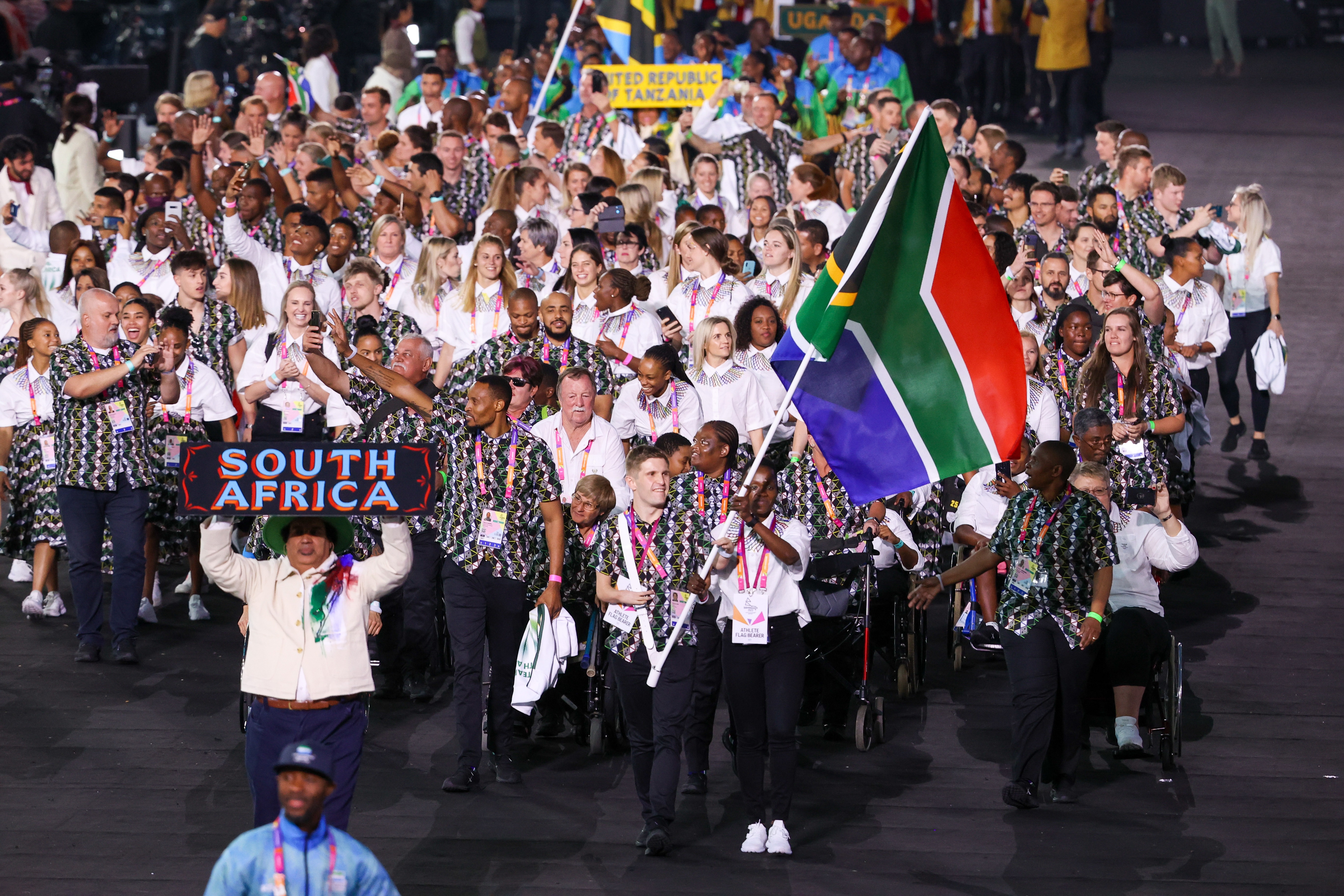
 Team South Africa is among the 74 nations and territories set to compete in this year’s scaled-back Commonwealth Games being held in Glasgow, Scotland, from 23 July to 2 August. (Photo: Roger Sedres / Gallo Images)
The Commonwealth Games entered a turbulent time following the Australian state of Victoria’s withdrawal, amid declining interest from broadcasters and sponsors. Additionally, there was little appetite among member nations to host, mainly due to the financial burden the Games would bring.
Eventually, in late 2024, the Scottish city of Glasgow was confirmed as the host city. However, to ensure its survival, the Games will look slightly different.
Instead of the 19 sports featured four years ago in Birmingham, this year’s edition will feature just 10 sports across four venues.
These include artistic gymnastics, athletics and para athletics, bowls and para bowls, boxing, track cycling and para track cycling, netball, judo, swimming and para swimming, weightlifting and para weightlifting and 3x3 basketball and 3x3 wheelchair basketball.
Approximately 3,000 athletes from 74 nations and territories will compete in the event, which runs from 23 July to 2 August.
/file/attachments/orphans/UP1EI7V168UI4_574071.jpg "South Africa’s Caitlin Rooskrantz on the balance beam at the 2022 Commonwealth Games in Birmingham. Artistic gymnastic is one of the 10 sports to be featured in the 2026 Games, reduced from the 19 featured in Birmingham. (Photo: Reuters / Hannah Mckay)")
Delivering a slimmer Games, with a budget roughly 80% smaller than Birmingham, has been a race against time. Yet, as athletes have begun arriving in Scotland, organisers believe Glasgow 2026 could provide a blueprint for the future of multi-sport events.
While there have been perceptions that the reduced format is evidence of declining relevance, Dr Donald Rukare of Commonwealth Sport – the organisation responsible for the direction and control of the Games and Youth Games – said Glasgow represented something different.
He rejected the connotations of “down-scaled”, preferring to call it a “reimagined Games”.
“It’s true, in 2023 we hit a bump in the road with one of our hosts pulling out,” said Rukare. “But it gave us an opportunity to sit, pause and reflect and reset our agenda. We don’t look at it as a sign of decline or a scaled-back Games. In many ways, Glasgow is a proof of concept of what we are looking at as a reimagined Games.
“They had a very short runway to put everything together, but the local organising company has been extremely fabulous. Our sports team and international federations have been working at pace.
“For us, this is in many ways a rebirth of the Games and a rebirth of our movement.”
A move toward sustainability
The Games have gone from facing an existential crisis not too long ago to attracting what Rukare described as renewed and “unprecedented” interest, from future hosts.
The Commonwealth Youth Games are locked in for Malta next year, while the Indian city of Ahmedabad will stage the centenary edition of the Commonwealth Games in 2030.
The reason for the renewed interest was because Commonwealth Sport, in its reset, no longer wished to be prescriptive but to “co-create” with host cities, said Rukare.
The 2026 edition will cost approximately £160-million, a drastic drop from Birmingham’s budget of £778-million. Victoria 2026 was projected to be four times that amount before organisers pulled out.
/file/attachments/orphans/GettyImages-1322092349_974094.jpg "The Tollcross International Swimming Centre is one of four legacy venues being used at the 2026 Glasgow Commonwealth Games. (Photo: Catherine Ivill / Getty Images)")
Part of the leaner budget for Glasgow stems from the smaller sports programme, but also the city could rely on existing infrastructure.
Glasgow hosted the Games in 2014, and all four of the venues used in this year’s edition – the Tollcross International Swimming Centre, Glasgow International Arena, Scotstoun Stadium and the Scottish Event Campus – were used in 2014.
“Under our reimagined and reset version we are no longer being prescriptive,” said Rukare. “What we’re looking at is co-creating the sporting programme with our hosts. By not requiring Glasgow to build anything new, for example, we believe it’s more sustainable, it’s more affordable, and it’s more attractive to the host.”

A model for major sporting events?
The challenges of sustainability facing the Commonwealth Games were not unique, said Rukare.
Cath Bishop, triple Olympian rower, wrote that Victoria’s withdrawal should serve as a catalyst for multi-sporting events and major tournaments to rethink how events were delivered.
The Olympics faced a similar struggle with just two bids for the 2024 Summer Games, with Paris and Los Angeles awarded 2024 and 2028 respectively, while Brisbane was the sole bidder for 2032, according to Bishop.
For the 2022 Winter Olympics, at least five potential hosts withdrew from the bidding process after public polling indicated a lack of local support, leaving only Beijing and Almaty in contention.
“This crisis goes beyond the growing indifference to the purpose of the event, originally founded as the Empire Games in 1930,” said Bishop. “The old model for hosting major events is broken and a new one is needed.
“We are now aware of other costs that matter, barely visible when these sports events were first set up. Financial costs can no longer be calculated in isolation without reckoning the social value, environmental impact and governance of these events.”
/file/attachments/orphans/GettyImages-2248544995_515848.jpg "Dr Donald Rukare, president of Commonwealth Sport. (Photo: Ian MacNicol / Getty Images for Commonwealth Sport)")
Colonial legacy and alternative competitions
Apart from the costs, the argument also arises around first, the Games’ colonial legacy, and second, the opportunity for athlete exposure in a number of other global competitions.
First held in Canada in 1930 as the British Empire Games, the event originally began as a celebration of the strength of the British Empire and the relationships between its dominions.
Today, however, in a post-colonial society many former territories are engaged in ongoing processes of decolonisation, prompting renewed scrutiny of institutions and traditions linked to imperial history.
One unifying feature of the Commonwealth, for example, was that participants could communicate in English. However, this directly refers to the continuing Eurocentric hegemonic model imposed over indigenous people: colonial languages over local, writing over orality and so on.
These origins thus make the Commonwealth Games feel increasingly anachronistic, but Rukare does not shy away from this.
“We are very acutely aware of our history. There’s no doubt about that,” he said. “We know the common legacy we have of colonialism. But we are very proud of the role sport plays in bringing independent nations and self-governing territories together, through sports, as friends and equals.”
/file/attachments/orphans/TL_1894507_898238.jpg "South Africa's Chad le Clos is set to compete in the 2026 Commonwealth Games in Glasgow from 23 July to 2 August. (Photo: Anton Geyser / Gallo Images)")
Moreover, the Games have traditionally been viewed as an important development platform, particularly for emerging athletes from smaller sporting nations.
However, today athletes have access to a growing number of regional, continental and global competitions that can serve as stepping stones to the highest level.
According to Rukare, there is still a space for the Commonwealth Games.
“The Commonwealth Games remains one of the major multi-sport events on the sporting calendar,” he said. “Yes, there are other events, but many athletes in Glasgow will be appearing on this stage for the first time. For them, it will be a pathway to bigger opportunities.
“In many ways, the Games will continue to be a place where champions are created and where sporting careers go up and up.”
For Rukare, ensuring Glasgow 2026 takes place already represents a significant victory after the uncertainty of recent years.
Whether the reimagined Games become the blueprint for the future remains to be seen. Ultimately, it was about providing a feasible and predictable event where the athlete remained at the centre of celebration, said Rukare.
“For all of us in this space, what we’re looking for is reimagined, sustainable and smart ways of organising these Games to ensure at the end of the day that the athletes have a truly inspiring experience,” he said. DM
Comments
Scroll down to load comments...