




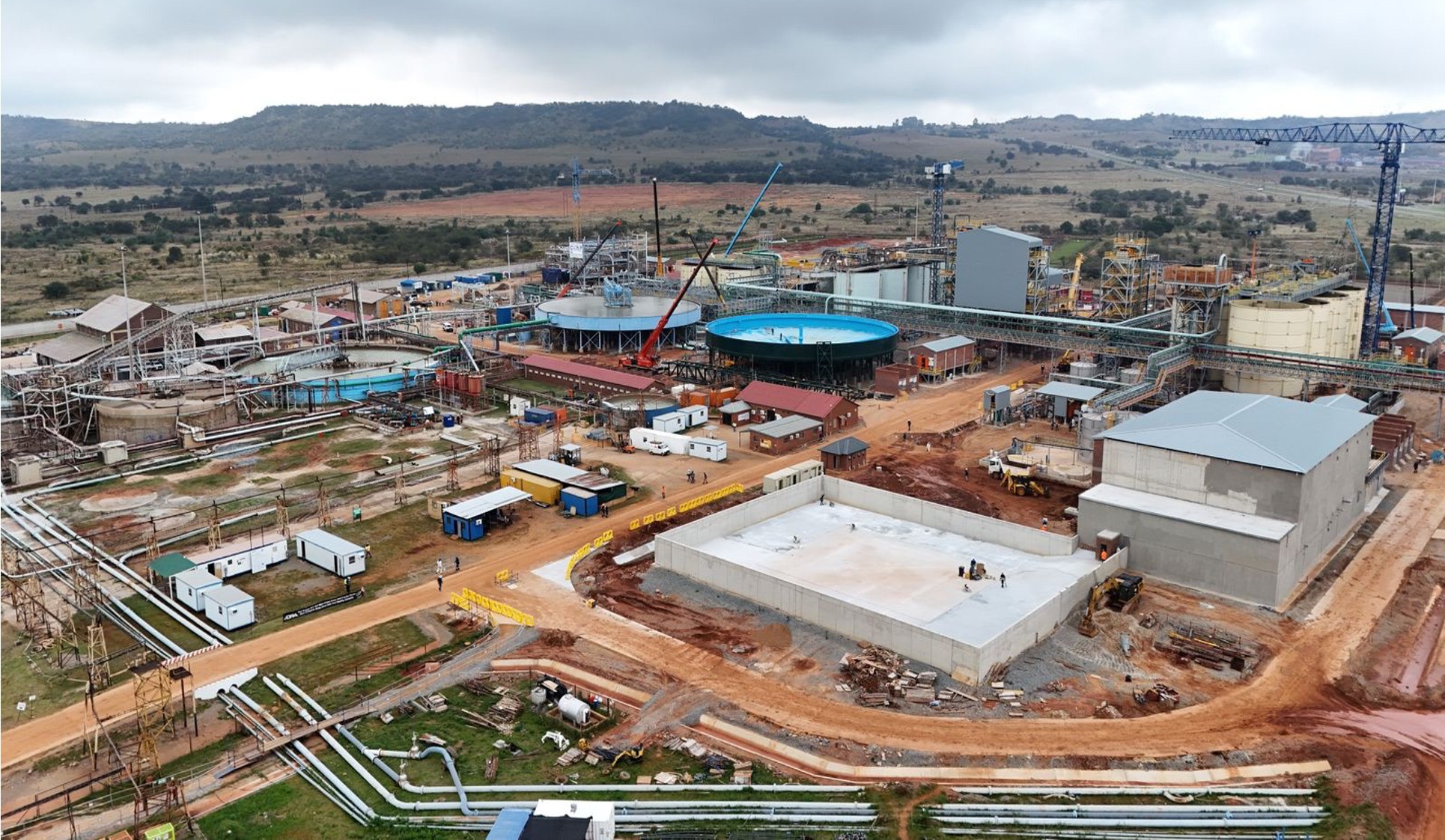
 At Far West Gold Recoveries, commissioning is now under way on the expanded Driefontein 2 (DP2) plant. The new elution circuit and smelt house were commissioned on 14 July 2026, with the plant pouring its first gold on the same day. Once fully ramped up following commissioning, DP2 will increase throughput from 500,000 tonnes per month to 1.2 million tonnes per month. (Photo: DRDGold)
The company on Tuesday, 14 July 2026, provided investors with its most detailed progress update yet on the five flagship projects underpinning the strategy, revealing that some have already crossed important milestones while others remain dependent on regulatory approvals.
Collectively, the projects represent about R10-billion in capital expenditure aimed at increasing processing capacity from 2.15 million tonnes a month to three million tonnes, while lifting annual gold production to six tonnes by 2028.
For a business built on recovering gold left behind by South Africa’s historic mining industry, scale matters. Tailings retreatment is a volume game. Margins are won or lost through processing costs, electricity prices, transport distances and having somewhere to deposit the waste once the gold has been extracted.
It was those constraints that prompted DRDGold’s strategic rethink in 2023.
DRDGold operates two tailings retreatment businesses, namely Ergo on the East Rand and Far West Gold Recoveries (FWGR) in the Carletonville and Westonaria goldfields of the West Rand.
/file/attachments/orphans/IMG_4022JPG_662667.jpeg "DP2 poured its first gold on 14 July 2026. (Photo: DRDGold)")
Its Ergo operation on the East Rand was running out of economically viable deposition capacity, while declining head grades threatened future margins. At the same time, FWGR had effectively reached the limits of its existing infrastructure, with insufficient processing and storage capacity to unlock further growth.
Vision 2028 is designed to solve both problems simultaneously.
The programme consists of five major projects. The DP2 gold processing plant at DRDGOLD’s Far West Gold Recoveries operation, where reclaimed mine tailings are processed to recover residual gold, is being expanded to more than double its throughput capacity. A separate 135km slurry and return-water pipeline network will connect the plant to new sources of tailings and the regional tailings storage facility.
The other projects include building a massive regional tailings storage facility, recommissioning the Daggafontein tailings storage facility at Ergo and eventually constructing the new Withok tailings storage facility. Together they create additional capacity across both operating regions.
/file/attachments/orphans/DRDfiveprojects_658557.jpg "DRDGold’s five projects. (Image: DRDGold)")
The first visible success has already arrived.
DRDGold confirmed that the Daggafontein tailings storage facility has now been commissioned, with water first pumped into the facility on 25 June and the first tailings deposited on 6 July.
/file/attachments/orphans/Firstbankofcyclones_245323.jpg "The first major milestone of Vision 2028, the resumption of deposition onto the Daggafontein tailings storage facility, has now been achieved when, on 25 June 2026, water was first pumped to the facility. The first deposition of tailings followed shortly on 6 July 2026. The project adds 120 million tonnes of tailings storage capacity to the operation, and represents the first completed Vision 2028 project. (Photo: DRDGold)")
This milestone immediately relieves immediate pressure on Ergo’s existing Brakpan storage facility and restores a more balanced deposition strategy.
The recommissioned Daggafontein facility adds approximately 120 million tonnes of deposition capacity, allowing DRDGold to split current monthly deposition between Brakpan and Daggafontein rather than relying predominantly on a single site.
Meanwhile, construction continues at Far West Gold Recoveries, where the DP2 plant expansion remains one of the centrepieces of the strategy.
The expanded plant effectively duplicates existing processing capacity, lifting throughput from 500,000 tonnes a month to 1.2 million tonnes while adding a new elution circuit and smelt house.
Those facilities reached an important milestone this week on Tuesday when the smelt house and elution circuit were commissioned and the plant poured its first gold.
The remainder of the expanded plant is scheduled to be commissioned by the end of the first quarter of the 2027 financial year. Until then, throughput will remain at roughly 500,000 tonnes a month while the original plant undergoes major maintenance. Once fully operational, the project is expected to add 16 years to Far West Gold Recoveries’ life of mine.
“We’re now seeing years of planning and investment translate into operating assets,” says CEO Niël Pretorius. “Vision 2028 is creating the infrastructure that will support the next generation of DRDGold. As each project comes online, we’re not simply adding capacity, we’re strengthening the resilience of the business, improving our ability to generate free cash flow and creating a platform for long-term shareholder value.”
Not every project, however, is progressing entirely under the company’s control.
Final piece of the puzzle
The extensive 135km pipeline network linking DP2, the Libanon dump and the new regional tailings storage facility is already 95% complete. But the final piece of the puzzle, the Libanon reclamation pump station, cannot begin until the company receives a water-use licence.
The station will sit within the buffer zone of a wetland, making regulatory approval essential before construction starts. Once the licence is issued, DRDGold estimates construction will take about nine months.
Libanon is expected to contribute an additional 600,000 tonnes of feed a month, matching the existing contribution from Driefontein 3 and ultimately allowing the expanded DP2 plant to operate at full capacity. Until then, Far West Gold Recoveries’ throughput remains capped at around 500,000 tonnes a month.
The biggest engineering undertaking remains the regional tailings storage facility itself.
The fully lined, 800-hectare facility has been designed to receive an initial 1.2 million tonnes of material every month, with infrastructure capable of eventually doubling that rate to 2.4 million tonnes.
/file/attachments/orphans/DJI_0641_329872.jpg "The regional tailings storage facility is an 800 hectare, fully lined tailings storage facility, designed to receive an initial 1.2 million tonnes a month. The size of infrastructure and area of the dam allow for this deposition rate to eventually be increased to 2.4 million tonnes a month. It is designed to ultimately store up to 800 million tonnes of mine tailings. (Photo: DRDGold)")
Ultimately, the facility is expected to store as much as 800 million tonnes of mine tailings over its operating life.
Construction had reached 67% completion by the end of June and remains on schedule to achieve its initial deposition capacity during the first quarter of the 2028 financial year.
But here, too, regulators remain critical.
Before commissioning can begin, the Department of Water and Sanitation must grant permission for what the company describes as “beneficial occupation”, allowing operations on the completed first phase while construction continues on later phases.
Nature has the final say
And then, nature has the final say.
Commissioning the regional tailings storage facility requires prolonged dry weather to allow engineers to establish protective layers over the drainage system before full deposition begins.
The final project, the proposed Withok tailings storage facility, has intentionally been sequenced later.
The new facility is designed to create another 310 million tonnes of storage capacity, but construction will only begin once the necessary environmental approvals, waste management licence and water-use licence have been secured. DRDGold is targeting regulatory approvals by December 2026, with completion expected during 2029. Until then, the company believes Ergo can comfortably sustain current deposition rates until at least 2031.
Taken together, the projects represent one of the biggest infrastructure investments currently under way in SA’s mining sector.
Unlike traditional mining expansions, however, DRDGold is not chasing new ore bodies. It is investing in the less glamorous infrastructure that allows it to extract more value from what previous generations of miners left behind. DM
Comments
Scroll down to load comments...