




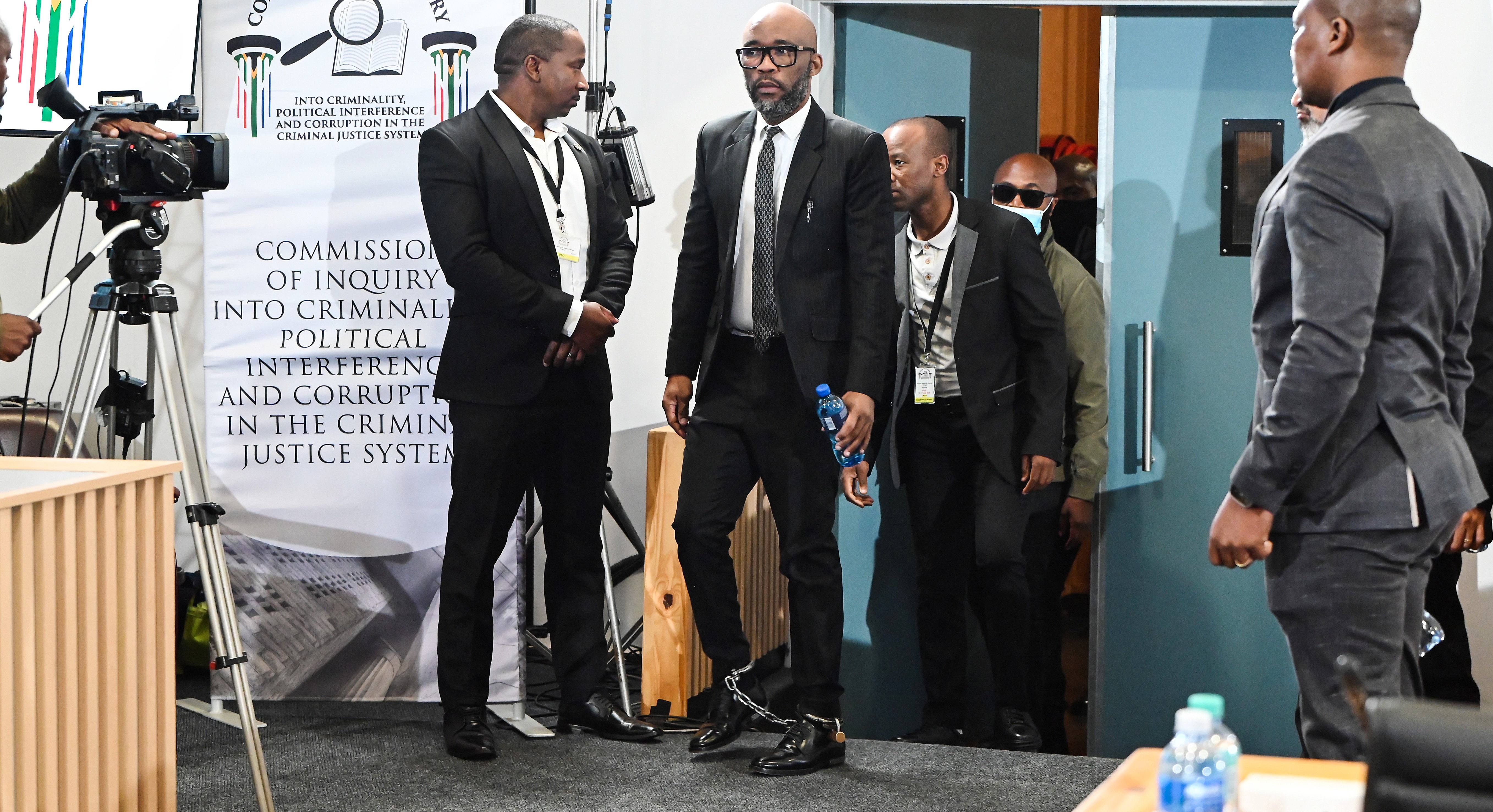
 Vusimuzi Cat Matlala at the Madlanga Commission of Inquiry at Brigitte Mabandla Judicial College on 15 July 2026 in Pretoria. (Photo: Gallo Images / Frennie Shivambu)
 In leg-chains and a sober suit, without the garish designer kit he’s favoured in previous appearances, criminal mastermind Vusimuzi “Cat” Matlala shuffled in and out of the Madlanga Commission of Inquiry on 15 July.
Heavily guarded by police in plain clothes, he carried an orange notebook with handcuffs dangling from his suit pants – a much diminished figure from the larger-than-life persona he has become on social media.
/file/attachments/orphans/ED_615584b_666909.jpg "Vusimuzi ‘Cat’ Matlala at the Madlanga Commission of Inquiry at Brigitte Mabandla Judicial College on 15 July 2026 in Pretoria. (Photo: Gallo Images / Frennie Shivambu)")
Matlala has been granted a postponement to appear before the Madlanga Commission on 1 September, where he is key to the inquiry into criminality, political interference and corruption in the criminal justice system.
He is accused of influencing and bribing politicians for a R228-million police wellness tender. Cabinet ministers and senior police officers, one of whom he gifted a Brazilian butt lift, a complex cosmetic surgical procedure, all fell into this network, the commission has heard.
The hearing on 15 July centred on whether the businessman should be required to file an affidavit and testify before the commission while plea negotiations and possible criminal proceedings remain unresolved. He remains in jail and is due back in court on 20 July to face corruption and other charges after a plea deal collapsed, as Nonkululeko Njilo reported here.
/file/attachments/orphans/ED_615595_247822.jpg "Matlala's advocate, Anneline van den Heever, at the Madlanga Commission of Inquiry on 15 July 2026 in Pretoria, South Africa. (Photo: Gallo Images / Frennie Shivambu)")
Matlala’s advocate, Anneline van den Heever, argued that his Section 35 constitutional rights as a potential accused person trump the commission’s timetable. She insisted they could not responsibly advise him to testify until they had seen documents relating to failed plea negotiations and understood the full criminal case against him. Section 35 of the Constitution sets out the rights of accused, detained and arrested persons.
The commission repeatedly rejected the argument that the entire inquiry should be delayed, stressing that many issues before it had nothing to do with any future criminal proceedings. Commission chairperson Mbuyiseli Madlanga was visibly annoyed at the arguments and pushed hard against them.
Madlanga repeatedly narrowed the debate, asking why Matlala could not answer questions that plainly had no bearing on his Section 35 rights.
His sharpest exchanges included: “When counsel says ‘respectfully’, they mean the opposite,” he told Van den Heever, revealing the steelier side of the usually cheery judge.
When counsel argued broadly about plea negotiations, Madlanga cut her off: “No, no, no – I am not interested in the nitty-gritty. I am looking at the broader question,” he said, referring to precedence – where the commission fitted in to the range of theatres of justice Matlala now faces.
As counsel persisted, Madlanga became visibly impatient: “You will never understand me. Please go onto the next argument.”
His central question throughout remained: Why should the commission stop when there are issues “which can never ever” fall within the Section 35 privilege? That section of the Constitution protects witnesses from self-incrimination.
/file/attachments/orphans/ED_611564_153369.jpg "Commissioner Sesi Baloyi SC at the Madlanga Commission of Inquiry. (Photo: Gallo Images / Frennie Shivambu)")
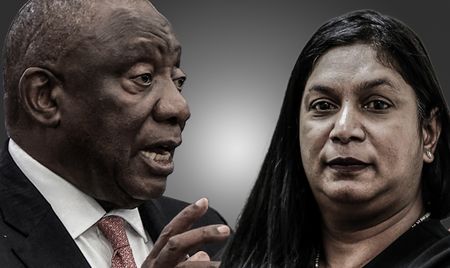
Commissioner Sesi Baloyi took a more forensic approach, repeatedly reducing counsel’s submissions to a simple principle. She rejected any link between the commission’s work and collapsed plea negotiations with the National Prosecuting Authority’s Investigating Directorate Against Corruption (Idac), the boss of whom, Andrea Johnson, is also in hot water for non-appearance before the commission.
Johnson submitted what the commission called “one of those useless” medical certificates on Monday and is in hospital. Qaanitah Hunter’s The Debrief Network has reported that she may resign as the Presidency has her non-appearance firmly on President Cyril Ramaphosa’s radar. He appoints the Idac head and she is meant to be the figurehead and key authority in the fight against grand corruption and the criminalisation of the state.
“That plea negotiation process has nothing to do with us,” said Baloyi.
She repeatedly sought a straightforward yes-or-no answer as Van den Heever held firm that she could not allow her client (Matlala) to possibly incriminate himself.
“I can’t think of any counsel who would advise differently,” said Van den Heever, who is also representing Matlala in his criminal trial.
/file/attachments/orphans/ED_603956_556548.jpg "Advocate Mahlape Sello SC. (Photo: Gallo Images / Frennie Shivambu).")
It fell to evidence leader Mahlape Sello to state the core point. On what were regarded as delaying tactics by the key witness, she said that what transpired was “a complete waste of the commission’s time. It’s a moving target... We are chasing a rabbit we cannot catch.”
Sello nevertheless agreed to the postponement. Matlala must file his statement with the commission by 29 July with a hard start on 1 September. The commission has been granted a postponement to hand over its final report to Ramaphosa on 16 November. DM