



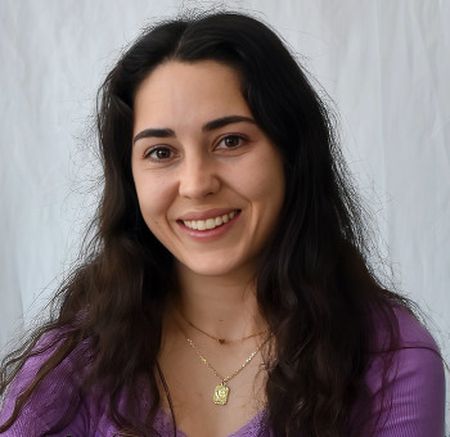
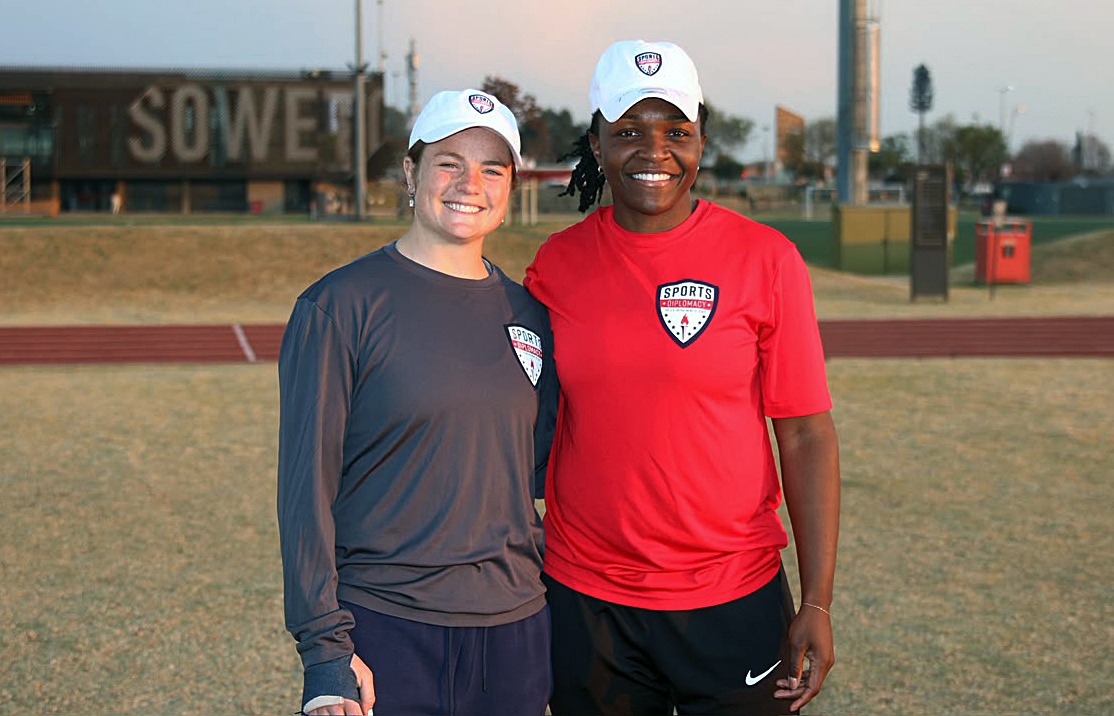
 Emily Henrich (left) and Cheta Emba of the USA Eagles visited South Africa as sports envoys for a week-long programme that started on 13 July at Nike Shapa in Soweto where they led a rugby clinic and workshop for young women rugby players. (Photo: Supplied / US Mission to South Africa)
 The global women’s rugby landscape is steadily growing, and in South Africa the Springbok Women’s quarterfinal appearance at the 2025 Rugby World Cup was a tangible marker of how far the team has come as a genuine contender on the international stage.
Rather than slowing their momentum, the Springbok Women have remained committed to building on that success and developing their game further. Their 2026 schedule includes a string of demanding Tests against the Black Ferns, Fiji, Italy, Wales, Spain and Ireland – all ranked among the world’s top 15 teams.
More recently, the Springbok Women hosted the USA Eagles in two historic Test matches at Ellis Park on 4 July and Loftus Versfeld on 11 July. In the first Test, South Africa stunned the visitors when they secured their first victory over the Americans since 2011.
/file/attachments/orphans/TL_2584204_731552.jpg "South Africa’s Logan Welman during the first Test match between South Africa and the USA at Ellis Park on 4 July. SA secured a commanding 34-21 victory, making it the first time since 2011 that they had managed to beat the Eagles. (Photo: Ashley Vlotman / Gallo Images)")
Although the Eagles bounced back to win the second Test in Pretoria, Emily Henrich, who plays outside centre for the Eagles, said she was impressed by the physicality and professionalism displayed by the Bok Women throughout the series.
“I was really impressed by these most recent matches, the level of physicality and just how quickly they [South Africa] came out of the gates, especially in that first game at Ellis Park,” Henrich told Daily Maverick. “They caught us flat footed, and we were shocked when they put over a couple of quick tries against us.”
Henrich was originally selected for the tour but broke her hand during training and was unable to take to the field. She nevertheless remained involved through the United States (US) Embassy’s Sports Envoy programme alongside Cheta Emba, a three-time Women’s Rugby World Cup player, Olympic bronze medallist and former Eagles player.
The week-long programme, which started in Johannesburg yesterday – and will head to Pretoria and Durban – saw the pair lead clinics and workshops aimed at helping young women rugby players develop their skills and expose more girls to the sport.
Their visit comes at a time when women’s rugby is experiencing significant growth worldwide, with professional leagues expanding rapidly and increasing numbers of players earning professional contracts.
Expanding professional structures
When Henrich earned her first cap at 18 years old in 2018, opportunities to play rugby professionally were still limited, she said. For most players, the sport offered little financial security, forcing women to balance full-time jobs with the demands of high-performance rugby.
It was only around that time that elite women’s competitions began to gain traction. For example, the Premiership Women’s Rugby (PWR) league in England was launched in 2017, followed by Australia’s Super Rugby Women’s league in 2018, and South Africa established its own Women’s Premier Division in 2019, now known as the Pick n Pay Women’s Super League (WSL).
Even so, many competitions around the world have remained largely amateur, with players being paid on a per diem basis rather than full-time contracts. It was only in 2023 that the Bulls Daisies in SA made the landmark decision to offer full-time professional contracts. The union has since contracted 35 players.
Overall, South African Rugby Union Chief Executive Rian Oberholzer confirmed in March that 120 women players had been centrally contracted so far.
/file/attachments/orphans/Cheta_511206.jpg "Cheta Emba helps young South African girls improve their rugby skills during a clinic held at Nike Shapa in Soweto on 13 July. Emba is a US Olympian, a Harvard graduate, an Olympic bronze medallist, and a three-time Women’s Rugby World Cup player. (Photo: Supplied / US Mission to South Africa)")
In the US, a fully professional domestic competition only arrived in 2025 with the launch of Women’s Elite Rugby. The same year, USA Rugby began offering year-round contracts to national team players before the Women’s Rugby World Cup.
“We had our first year-round women’s rugby contracts leading into the 2025 World Cup,” said Henrich. “They’ve continued that structure post-World Cup, which is pretty historic for us.
“Before that, we were on per diems, and so it didn’t give any security. If you got injured or if you weren’t selected, you weren’t getting that income. Now it’s opened a space where we can really focus on our craft and become better rugby players.”
Henrich, who plays for the Leicester Tigers in the Premiership Women’s Rugby, said that playing professionally had transformed her game.
“Playing against world-class competition week in and week out, and going up against players who are now world champions and have years of experience, forced me to raise the level of my game to be able to compete.”
Imperative need for visibility
Despite the progress, both Henrich and Emba believe there is “still room to grow”.
The two Tests between South Africa and the USA served as curtain-raisers to the men’s Springbok fixtures later in the day. While it offered exposure through association with the men’s game, it also highlighted one of women’s rugby’s enduring challenges.
In a not so unfamiliar sight, the stands at Ellis Park and Loftus were largely empty during the women’s game. Spectators slowly trickled in closer to kick-off for the men’s games. Whether that reflected a lack of awareness due to limited marketing or a lack of interest, Henrich described it as “jarring” nonetheless.
“Playing in Ellis Park and Loftus, they’re such incredible stadiums, but it made it even more jarring how empty it was,” she said.
/file/attachments/orphans/ChetaEmba_EmilyHenrich_DanielNgwepe_175150.jpg "USA Eagles players Emily Henrich (left) and Cheta Emba are joined by Daniel Ngwepe, the Nike Shapa Centre Government and Public Affairs Manager. (Photo: Annemieke Thomaidis)")
When asked what needs to change, both players pointed to visibility through media coverage and accessibility as crucial drivers of growth, alongside subverting stereotypes about women in rugby.
In England, the PWR has benefited from consistent broadcast and streaming partnerships. According to RugbyPass, matches have been widely available through platforms such as YouTube, BBC iPlayer and, more recently, TNT Sports.
In contrast, coverage of South Africa’s WSL has been inconsistent. While some matches have appeared on SuperSport or YouTube, many were not streamed.
“I do enjoy being a curtain-raiser for the men’s games,” said Henrich. “But with that, you do want to be able to host big events that bring people out only for a women’s game. How you achieve that is a question everyone’s trying to hack at marketing teams around the world.
“But by continuing to provide access through media, people can watch games at home first. That’s how they start rooting for teams and players.”
For Emba, having a consistent conversation about women in rugby would also help grow the game.
“Not just the day before the match or the week before, but having a consistent conversation and being conscious of how we’re talking about rugby and women’s sport in our communities,” she said.
Both players believe SA’s recent investment in the women’s game is already producing visible results.
“The Springbok Women really made their mark at this most recent World Cup when they made it to the quarterfinals,” said Henrich. “If they continue attracting more people to matches and continue receiving investment in their game, it will only make them better.”
Emba agreed, pointing to the progress she has witnessed first-hand through both Sevens and 15s rugby.
“We’ve been able to face South Africa a number of times on the Sevens circuit and now a few times with the 15s team,” she said. “So many of us were remarking, even at the World Cup, on how evident the development and growth of the programme has been. It’s been really exciting to see what comes with investment in the game and support through resources.” DM