




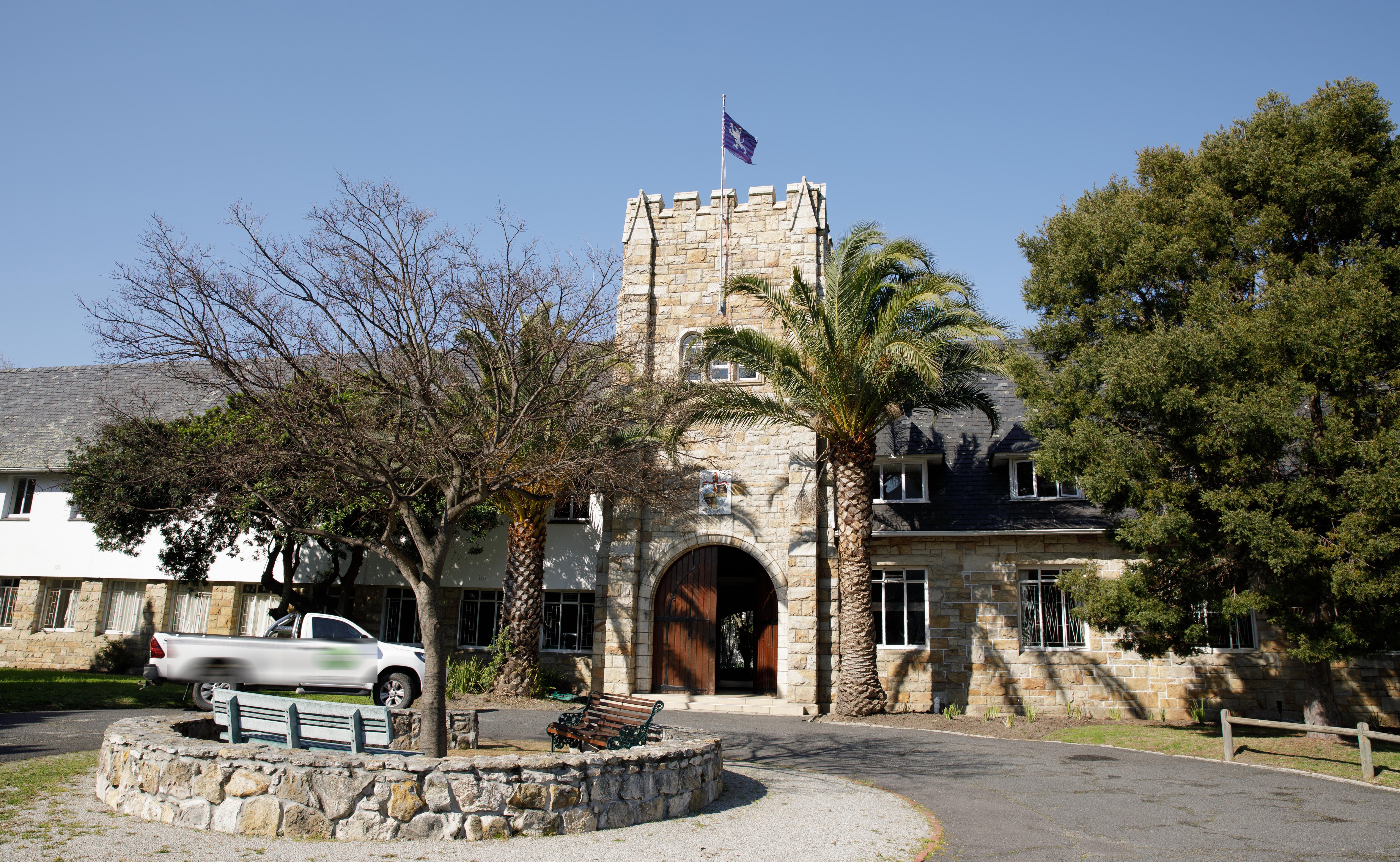
 Bishops Diocesan College in Cape Town. (Photo: Gallo Images / ER Lombard)
Bishops Diocesan College, a leading Anglican private boys’ school in Cape Town, has flown the Pride flag for two days every June since 2021. But this year, the school finds itself embroiled in a renewed and bitter dispute over the practice.
The latest furore stems from a 23 June letter from the Old Diocesan Committee (ODC), the body representing Bishops alumni, to the Diocesan College Council, the school’s governing authority. In the letter, the ODC demands that Bishops restrict its official flagpoles to three banners only: the South African flag, the Bishops flag and the St George’s flag.
“These three belong to all of us. They carry no faction and ask no member of the community to take a side,” the committee writes.
Adopted by a 10-1 vote (with one abstention), the ODC’s position is that every other flag, however worthy the cause, forces the school to “align itself in a contested matter”, turning the presence or absence of each banner into a political statement. The committee calls on the council to “settle the matter, openly and for the long term, through a clear written policy” and to halt the flying of any flag beyond the three suggested official ones pending such a decision.
Should the council choose to keep rotating cause flags, the ODC wants a published policy that applies evenly across potentially contentious symbols, listing examples such as “the Palestinian and Israeli flags, the Ukrainian, the Taiwanese, the Tibetan and the rest”.
/file/attachments/orphans/Giuseppe-Pride-at-High-school6_938471.jpg "The Pride flag was hoisted in Pride Month at Bishops Diocesan College for the first time in 2021, although there was a backlash. (Photo: Supplied / Bishops Diocesan College)")
While the letter acknowledges that the flag presently at issue is the Pride flag, the ODC insist this is not about excluding lesbian, gay, bisexual, transgender and queer (LGBTQ+) members of the Bishops community, but rather the instrument.
“The message these boys are owed: you are welcome, you are safe, you are ours, is owed to them directly, in the school’s own voice and by its own conduct, and it is stronger said that way than flown on a pole next to the question of ‘Whose flag comes next?’ ” the ODC writes.
Parents and alumni push back in defence of student dignity
The ODC’s letter has triggered a pushback from an independent, unofficial group of parents, Old Diocesans, staff and friends calling itself “Supporting a Progressive Bishops”.
The group anchors its support in both law and faith. It invokes South Africa’s Constitution, noting that the country was the first nation in the world to protect people from discrimination based on sexual orientation. It then leans into Bishops’ Anglican identity, pointing out that St George’s Cathedral, the Archbishop of Cape Town’s seat, “has flown the Pride flag since the mid‑1990s, for some thirty years”.
Shifting the focus back to current students, the group reframes the debate around basic human dignity rather than administrative policy.
“This flag is close to home. It speaks to the dignity and care of our own children, and a school that exists ‘to inspire individuals’ must first let every individual know that he matters.”
While acknowledging that the flying of flags rests with the Diocesan College Council, the signatories state they write “only to make plain that a broad and diverse body of people who care about Bishops, hope the school will continue this quiet sign of welcome”.
This is not the first time the issue has generated controversy at Bishops. In 2022, News24 reported that a group of parents had criticised the school’s decision to fly the Pride flag, arguing that it associated the school with the broader Pride movement and made some pupils uncomfortable.
ODC maintains that the matter is a council issue
A senior member of the ODC who did not want their name revealed emphasised to Daily Maverick that this was strictly around administrative protocol.
“I vehemently believe that this is something that the council must decide, and not the old boys. The request made by the ODC to council is simply that council formulate a clear policy, and the matter now rests with council,” they said.
Behind closed doors, however, the senior ODC member contends that the annual hoisting of the flag was a unilateral overreach by principal Tony Reeler, executed without council backing.
“It was the headmaster’s decision, and that’s the whole issue – it wasn’t council. We are saying this issue should be the council’s decision, not the headmaster in his individual capacity. He did not consult the council or anyone else,” said the ODC member.
The ODC member provided a detailed breakdown of internal student balloting within the Student Representative Forum (SRF) across multiple years, arguing that the boys themselves have repeatedly rejected the hoisting of the flag. During a May 2023 SRF session, the student forum was presented with a range of options: flying the flag for the first day of Pride Month, the first three days, the first week, the full duration of the month, or not at all. Only the final option, not flying it at all, passed.
“The boys voted and asked him not to put up the flag. In that session, there were zero votes in favour and 26 against. Nobody voted for it. There were simply no votes for it,” the ODC member said.
According to the ODC member, this was not an isolated incident, as a subsequent SRF voting board from 16 May 2024 reportedly revealed a similar ledger of 29 votes against the flag, zero in favour and four abstentions.
What the flag means to learners
For some alumni, the flag represents a welcome departure from the past. Speaking anonymously, a former pupil recalled the pervasive homophobia of their school days, praising current management for attempting to dismantle what they described as a culture of toxic masculinity.
“By flying the flag, it shows boys who aren’t heterosexual that they are acknowledged and accepted, rather than mocked and isolated. When I was there, the environment left many boys vulnerable; you felt alone and isolated, so seeing that flag could make a significant difference for a struggling young man,” he said.
/file/attachments/orphans/Giuseppe-Pride-at-High-school_575157.jpeg "Paul Malherbe founded Bishops Pride in 2021. The matric class of 2020 had demanded that the society be established in a memorandum handed to the school at the height of the Black Lives Matter protests. (Photo: Supplied / Bishops Diocesan College)")
This need for visible affirmation is central to the argument made by LGBTQI+ advocacy groups. Njinji Magwaza, founder and director of Parents, Families & Friends of South African Queers, warned that when institutions withdraw symbols of inclusion to avoid controversy, they are not actually remaining impartial. Instead, they are simply reinforcing the invisibility of marginalised students.
“Educational institutions have a responsibility not simply to avoid discrimination but to cultivate environments where every learner experiences dignity. In that context, visible expressions of inclusion are not departures from neutrality but affirmations of the constitutional values of equality, dignity and non-discrimination,” Magwaza explained.
Juliana Davids, co-director at the Triangle Project, echoed this by pointing to the stark reality on the ground. She said that despite South Africa’s constitutional protections, research consistently showed that many LGBTQI+ learners still faced severe bullying, exclusion and isolation in schools.
Through the organisation’s Creating Inclusive and Affirming Schools work across the Western Cape, Davids has spoken directly with these students. What was clear was that young people did not see the Pride flag as a political symbol; they saw it simply as a sign that they belonged, that they were safe, and that they did not have to hide who they were.
The students themselves best describe the weight of that visible support. As one learner said: “The Pride flag is more than just a multicoloured flag, but it is a reminder of how much work, love, and effort was put into building this community, and for that we are grateful.”
Davids encouraged people to pause and consider how LGBTQI+ learners might experience these discussions. She said that young people were highly sensitive to how adults treated their identities, noting that what administrators viewed as an abstract debate over a symbol, queer learners experienced as a direct verdict on whether they genuinely belonged in the school community.
She said that whatever decisions schools made, the key question should be: What helps young people feel safe, respected, and able to thrive?
“If LGBTQI+ learners emerge from this debate feeling less welcome, less visible, or less valued, then we need to ask ourselves whether we have truly centred their best interests. Schools are at their strongest when every child knows that they belong, and that they do not need to leave any part of themselves at the school gate,” she said.
At the time of publication, the Diocesan College Council had not publicly responded to the ODC’s letter or its demand to suspend the display of the flag. Questions sent to Bishops by Daily Maverick had not been answered by the time of publication. DM
Comments
Scroll down to load comments...