



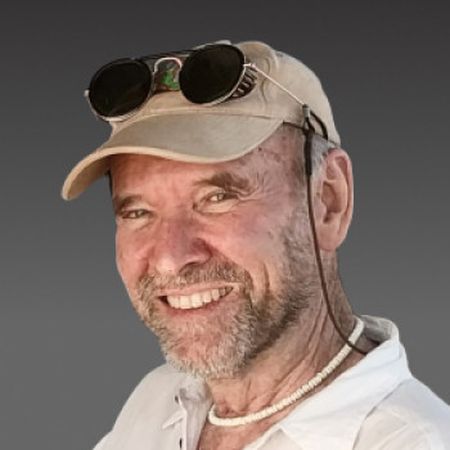
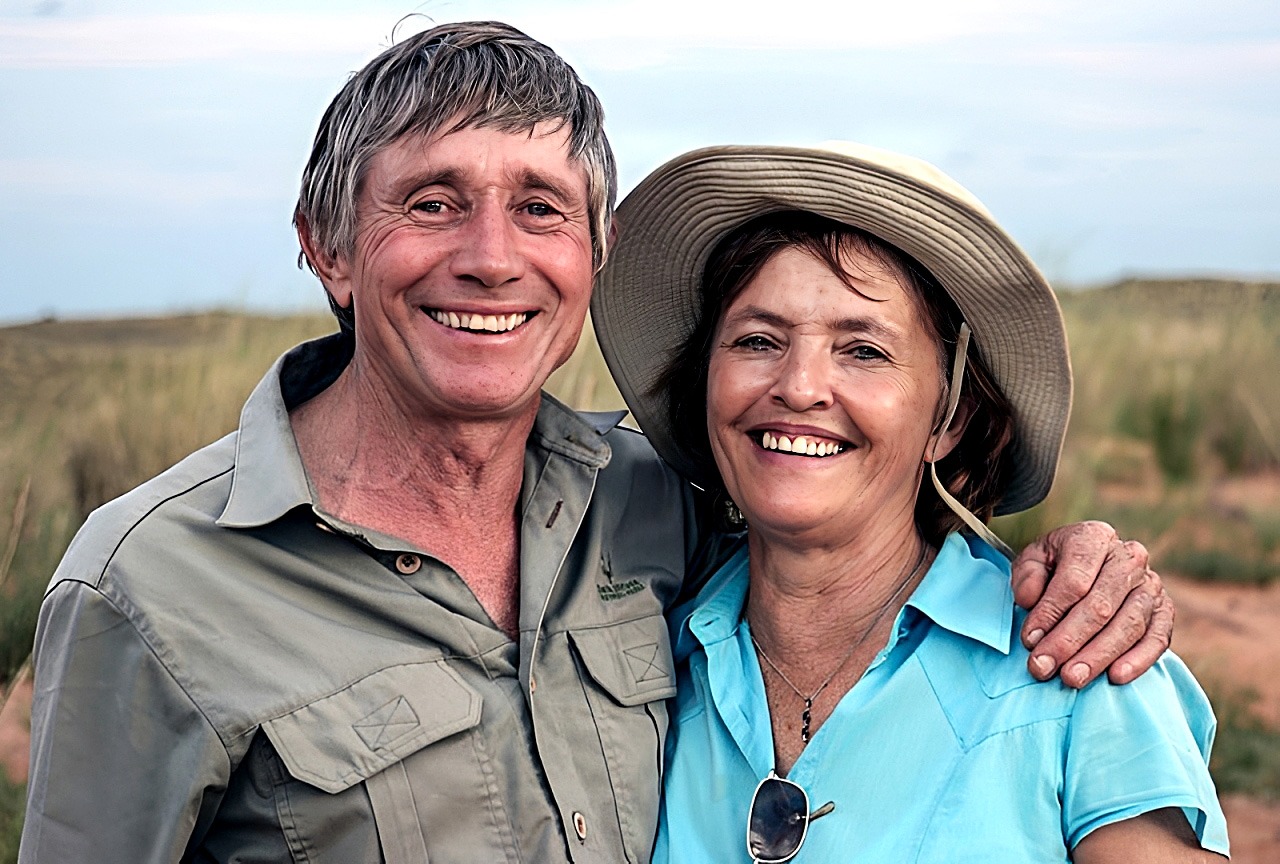
 Respected carnivore scientists Gus Mills with his wife and collaborator Margie Mills. (Photo: St Johns College)
For more than half a century, Michael “Gus” Mills followed predators across the red dunes of the Kalahari and through the savanna of Kruger National Park. He studied hyenas, lions, cheetahs and African wild dogs, but his true subject was larger than any single species.
He wanted to understand how predators, prey, landscape and climate fitted together and how conservation could protect those relationships without turning wild places into controlled outdoor zoos.
It was an unlikely career. Mills described himself as a poor student who initially failed matric and later stumbled through psychology. The decisive moment had come earlier, on his first visit to Kruger in 1954, when he was eight. The experience changed him.
After completing a BSc at the University of Cape Town and an Honours degree in wildlife management at the University of Pretoria, he secured a position researching brown hyenas in the Kalahari. In 1972, he and his newly married wife, Margie, headed into the desert. What was supposed to be a two-year assignment became 12 years.
For their first years, the couple lived in a tent and small caravan beneath a camelthorn tree, enduring furnace-like summers, freezing winter nights, dust storms and large distances from doctors and telephones.
But the isolation gave Mills something increasingly scarce in modern science: time. He could follow animals for years, learn their individual habits and watch social systems reveal themselves slowly.
His work transformed understanding of the much-maligned hyena.
/file/attachments/orphans/GusMills_679093.jpeg "Gus Mills and a friend. (Photo: Facebook)")
Brown and spotted hyenas were commonly dismissed as cowardly scavengers. Mills showed them instead as intelligent, socially complex and ecologically important animals, shaped by different strategies for surviving the same harsh landscape.
His research culminated in Kalahari Hyenas: The Comparative Behavioural Ecology of Two Species. With Margie, he later told the human story behind the science in the book Hyena Nights and Kalahari Days.
The family’s life also contained deep joy and terrible loss. Gus and Margie had three children: Michael, Stevie and Debbie. Michael and Stevie spent their early childhood in the Kalahari. After the family moved to Kruger, Stevie died from complications of chickenpox. Debbie was born the following year.
Margie later wrote that the loss changed the family forever and clarified what mattered most.
In Kruger, Mills widened his attention to the whole community of large carnivores. His research on African wild dogs ran for 15 years and helped shape SA’s conservation strategy for the species.
He coordinated work that contributed to a managed network of wild dog populations outside Kruger, credited with doubling the country’s managed population. He also established photographic surveys of wild dogs and cheetahs, asking park visitors to submit pictures so individual animals could be recognised by their markings. Begun in 1989, this was an early and influential South African citizen-science programme.
Mills also influenced how national parks were managed. Between 1989 and 2006 he served on Kruger’s Conservation Management Committee and helped develop plans for Kruger and the Kgalagadi.
He coordinated a pivotal workshop on elephant culling that contributed to Kruger ending routine culling and reducing artificial water provision, part of a shift towards allowing ecological processes to shape the park.
/file/attachments/orphans/Book_400124.jpg "The cover of Fast Cats on Red Sands. (Photo: Supplied)")
/file/attachments/orphans/Screenshot2026-07-13at35223PM_930267.jpg "(Image: SANParks)")
In 1995 he founded the Endangered Wildlife Trust’s Carnivore Conservation Group and served on International Union for Conservation of Nature specialist groups dealing with hyenas, cats and canids. He helped compile a global conservation action plan for the hyena family and advised carnivore programmes in Africa and Asia.
His authority came from the field. He knew what it meant to stay awake through a Kalahari night, follow spoor across dunes and wait without certainty for an animal to appear.
Retirement from SANParks in 2006 didn’t end the work. Gus and Margie returned to the Kalahari for a six-year study of cheetahs, examining how the species survives in an arid environment unlike the grasslands in which most cheetah research had been conducted.
Their findings became Kalahari Cheetahs: Adaptations to an Arid Region and, later, Fast Cats on Red Sands. Their work showed cheetahs not as fragile creatures following one narrow ecological script, but as adaptable hunters responding to landscape, prey and competition.
Mills became increasingly critical of conservation’s obsession with numbers and intervention. A population did not have to be large, he argued, if it was viable and able to live naturally. Quality of ecosystem mattered more than an impressive headcount.
His instinct was to enlarge and reconnect landscapes, remove unnecessary fences and give ecological processes room to work. Wildlife, in his view, should not be reduced to inventory.
His output was formidable: more than 150 peer-reviewed papers, chapters and International Union for Conservation of Nature reports, major books on hyenas and cheetahs and more than 100 presentations.
He supervised postgraduate researchers, served as an Extraordinary Professor at the University of Pretoria and worked with Oxford University. He mentored younger scientists and supported San trackers and training programmes in the Kalahari.
In 2016 he received the Southern African Wildlife Management Association’s Wildlife Excellence Award, followed by the St John’s College Golden Eagle Award in 2023.
/file/attachments/orphans/Gus-and-Margie-2_303646.jpg "Gus and Margie doing cheetah research. (Photo: Oppenheimer Generations Research & Conservation)")
At the centre of it all was his partnership with Margie. She shared the hardship of the early Kalahari years, assisted in the field, raised their children in remote parks and became his co-author. Their books are records not only of animals but of a life built together around attention, endurance and wonder.
Gus Mills leaves his surviving children, Michael and Debbie, a community of colleagues and students, and generations of conservationists who learned from his work.
He also leaves something less easily measured: a way of looking. He taught that animals must be watched for long enough to surprise us, that ecosystems are wiser than our management targets, and that conservation begins with humility.
The lion has gone, but across the Kalahari and Kruger, the landscapes he helped us understand remain full of tracks. DM


Comments
Scroll down to load comments...