




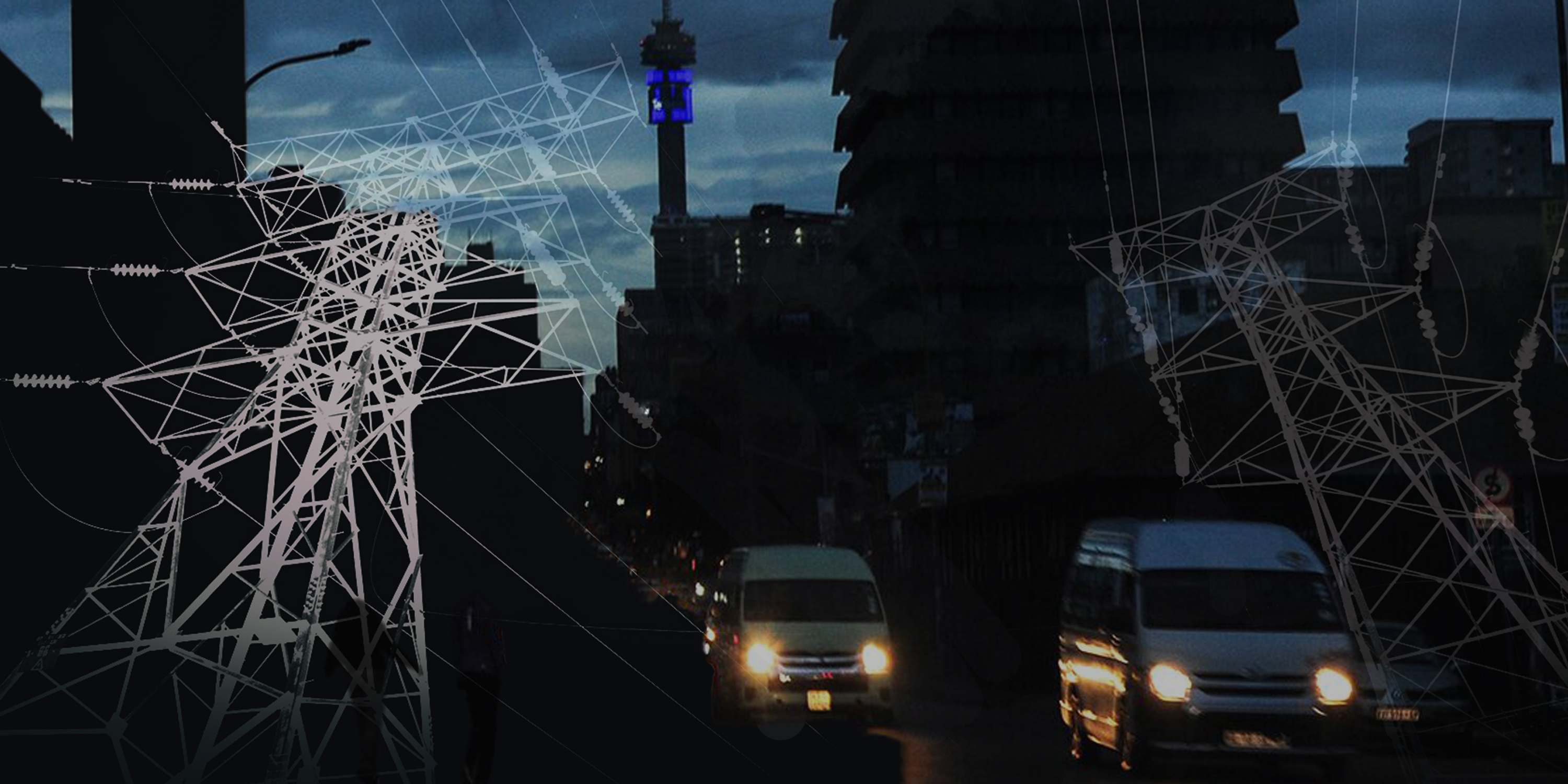
 Illustrative image | Electricity pylons in Johannesburg, South Africa. (Photo: EPA / Jon Hrusa) | Vehicles travel along a darkened street during a power outage in central Johannesburg. (Photo: Supplied)
Johannesburg’s electricity crisis has intensified into a citywide emergency, with more than 1,200 outages since 1 July crippling neighbourhoods and businesses. Councillors warn City Power is buckling under the weight of repeated failures, idle fleets and mounting allegations of corruption.
Oversight visits to depots have revealed trucks standing idle, stores lacking critical spares, and officials unable to properly account for outstanding faults.
Ward 118 councillor Neuren Pietersen said the centralised fault reporting system at Reuven depot was failing to allocate complaints effectively: “Things are getting worse. Trucks are standing, there are no parts and stores are empty, and this is leading to extortion and bribery.”
Residents across Malvern, Cyrildene, Observatory and Dewetshof have endured blackouts lasting from several days to more than 20 days, with dangerous voltage spikes exceeding 300 volts and repairs failing within days.
Other areas affected by outages on Monday include: Sandton, Bryanston, Hurlingham, Craighall Park, the inner city, Rispark, Naturena, Southfork, Kibler Park, Comptonville, Alveda Park, Devland, Mayfield Park, and areas around Midrand.

Pietersen warned: “The theft of breakers spikes when there are many outstanding outages. Working substations and electricity boxes are being stripped of components to restore supply elsewhere, while in other cases there are reports of cables being deliberately cut before residents are approached and offered repairs for payment.”
Ward 66 councillor Carlos Da Rocha said his constituency in Bez Valley and Kensington had been particularly hard hit, with outages stretching up to three weeks.
“They keep giving us official restoration times, but they can say what they want because no one can prove anything different. They are just trying to pacify residents,” he said.
“If City Power has indeed collapsed due to financial or operational difficulties, they must address the public directly. Until such a statement is made, I will attribute the current state of service delivery to total incompetence by City Power management.”
Da Rocha added: “I am receiving consistent reports of corruption and extortion in my area, with officials and contractors allegedly demanding money from residents for repairs. There appear to be two parallel systems operating: the official City Power service during the day, and a night‑time operation run by contractors who only work after payments are extorted from residents.”
Richard Francis, Community Policing Forum chairperson, confirmed at least 10 complaints of extortion: “We urge residents not to pay bribes. We realise people are desperate out there, but these extortionists are taking full advantage and are probably making things worse for everyone.”
City Power’s response
City Power spokesperson Isaac Mangena rejected claims of collapse: “These are largely driven by infrastructure faults, cable theft, vandalism, ageing infrastructure and network overloading. The number of outages changes continuously throughout the day as new faults are reported, existing faults are resolved and incidents are reclassified following technical assessments.”
He denied that restoration times were automated: “These updates are not automated without assessment and are informed by operational teams on the ground.”
On extortion, Mangena said: “Customers are repeatedly warned never to make payments directly to employees, contractors or any individual claiming to represent the utility.”
He added: “City Power does not authorise the removal of network infrastructure from one area to restore supply elsewhere. Should any employee or contractor be found to have engaged in such conduct, it would constitute serious misconduct and potentially criminal behaviour.”
Mangena said that vehicles seen idle at depots may be awaiting shift changes, safety briefings or clearance to access vandalised sites, and that prolonged outages were linked to faults, theft, vandalism and access constraints.
One ward’s outages
Pietersen, the Ward 118 councillor, sent a list of recent outages in his area, showing the extent of the current problem:
All faults listed below fall under the operational responsibility of the inner-city depot.
CRITICAL SAFETY FAILURE – HIGH VOLTAGE (300–369V)
Orion / Orwell / Derby Cluster
• Repeated neutral failures
• Breakers burning out
• Temporary connections failing within hours
• Voltage spikes above 300V
• Burning cables and explosion‑risk conditions
This is a life‑safety hazard requiring immediate executive intervention
20+ DAYS WITHOUT POWER
Cyrildene – Tainton Street
Malvern – St Frusquin Street
14–20 DAYS WITHOUT POWER
Kensington – Derby Road
Malvern – Jules Street
Malvern – 11th Street
Malvern – Twentieth Street
Cyrildene – Rollo Street cluster
Observatory – Eckstein Street
10–13 DAYS WITHOUT POWER
Kensington – Ocean Street
Malvern – Persimmon Street cluster
Kensington – Pandora Road
Cyrildene – Silas & Siegfried cluster
5–9 DAYS WITHOUT POWER
Cyrildene – Beryl Street
Cyrildene – Christeen Avenue
Cyrildene – Cooper Street
Cyrildene – Daphne Street
Cyrildene – Marcia Street
Cyrildene – Friedland Avenue
Cyrildene – Hastings Avenue
Kensington – Orwell Street cluster
Kensington – Protea Street
Malvern – 20th Street
Malvern – 32nd / 33rd / 30th Street cluster
Dewetshof – Da Gama Street
Dewetshof – Turnstone Street
Dewetshof – Aida Avenue
Dewetshof – Dias Street
Dewetshof – Tulbach Street
Observatory – Observatory Avenue
1–4 DAYS WITHOUT POWER
Cyrildene – Devon Road
Cyrildene – Bayne Avenue
Cyrildene – Silas Street
Kensington – Derby Road (partial supply)
Malvern – 10th Street
Malvern – St Amant Street
Dewetshof – multiple streets (post‑Sebenza instability)
Observatory – Bez Valley East feeder. DM
Comments
Scroll down to load comments...