




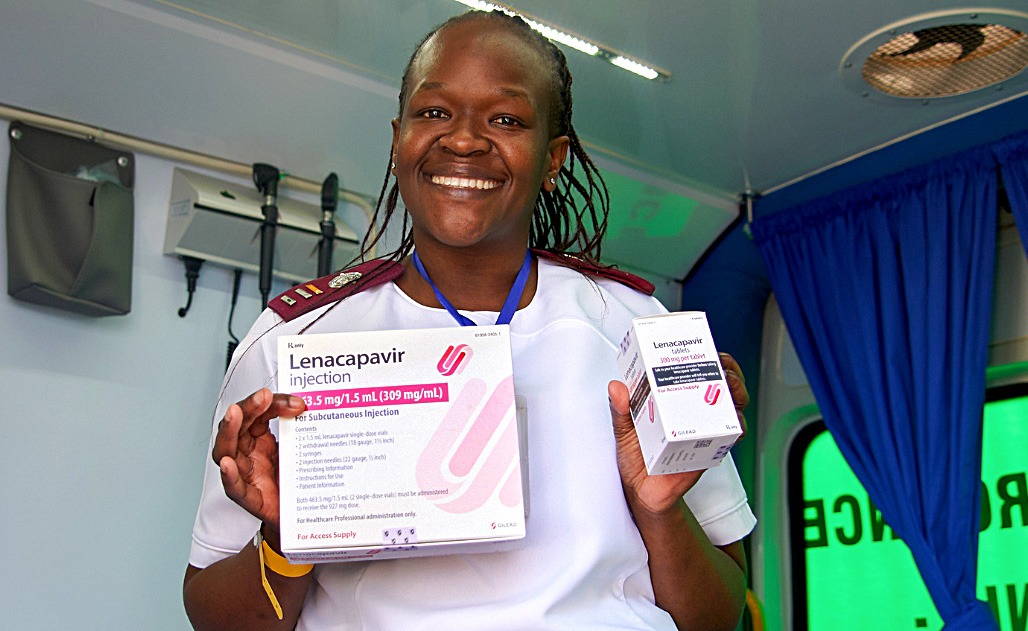
 Scientific papers don't travel to fireside conversations. People do. Here, a young scientist explains how he got to know this. As the anti-HIV jab begins rolling out across Africa, this lesson couldn't be more timely. (Photo: Kayleen Morgan / Associated Press / Bhekisa)
 The last person I expected to catch me off guard that summer’s evening was my 52-year-old aunt. We were roasting fresh maize around a fire in Chisamba, a rural farming town about 100km of Lusaka.
“Is the injection which cures HIV available in Zambia?” she asked.
It was December 2025, about a decade after my aunt had been diagnosed with HIV. I came home for Christmas from South Africa where I was a postdoctoral researcher at the South African Medical Research Council.
In late November that year, Zambia had become one of the first two countries (the other country was Eswatini) to receive the first (albeit small) shipments of lenacapavir (LEN), the once-every-six-month HIV prevention injection, which SA also started to roll out in June this year.
My aunt had a complete misconception of what LEN could – and couldn’t – do.
Antiretrovirals
Yet she understood her own HIV infection well enough to use her antiretroviral drugs (ARVs), which keep the HIV in her body under control, diligently. She never missed a clinic appointment. She had easy access to health workers for all the HIV-related questions.
But she didn’t know how LEN worked – and who it was meant for.
If she, who had received numerous HIV counselling sessions and regularly visited health facilities for her medication, didn’t know LEN was a preventive medication to stop new infections – and not a cure for HIV infection – what about the tens of thousands of other people in Chisamba who know far less about HIV than my aunt?
Something shifted in me.
Not panic, more like a recognition of how far the labs, in which I spend my days, were from where I was sitting around a fire with family and friends.
My aunt was typical of someone living in Chisamba. She did odd jobs and left school after Grade 9. She has five kids.
In her case, her husband had recently died.
We never explicitly spoke about what caused his death, but his medical records listed pneumonia. In people with advanced HIV, pneumonia is a common and often life-threatening complication.
Shortly before my visit, my aunt had received a video via a WhatsApp group saying some people had been cured of HIV.
“Is it true? Is the injection coming here?” she asked, her eyes full of eagerness and curiosity.
I had spent five years studying tuberculosis (TB). I could explain T-cell activation (the body’s way of switching on specialised immune cells called T cells to fight infections) and cytokine signalling (how immune cells send messages to each other to coordinate the body’s fight against an infection) to graduate students. But sitting beside that fire, I realised none of that had prepared me for this conversation.
I didn’t have slides. I didn’t have journal articles. I only had my aunt, looking at me with the quiet expectation that I would know.
So, I explained what I could.
Not a cure
Lenacapavir is not a cure. It’s a twice-a-year injection that gives someone who doesn’t have HIV near perfect protection against getting the virus. It gives someone six months of protection at a time, because it slowly releases itself over the period in someone’s body.
“But it’s not for you, Auntie,” I explained. “Because you’re already HIV positive. It’s for people who don’t yet have HIV.”
On the question of the cure, I slowed down.
It’s true that some people have been cured of HIV, but they are extremely rare. The people who were cured had undergone stem cell transplants, mostly to treat blood cancers. By chance, the donor cells carried a rare genetic mutation that also protects against HIV. It’s an extraordinary scientific breakthrough, but not yet a treatment available to 40.9-million people around the world who lived with HIV in 2025 (because the treatment is far too risky).
As I spoke, I watched my aunt’s face. She nodded. I wasn’t entirely sure I had answered all her questions. That uncertainty stayed with me long after the fire went cold.
The evidence behind LEN is remarkable. The Purpose 1 and 2 trials showed unprecedented levels of protection against HIV. But trial results don’t reach my aunt’s village on their own.
Sophisticated scientific papers don’t sit beside her at a fire. They don’t explain why an HIV prevention injection is different from a cure. They don’t answer the questions people ask after watching videos on their phones.
Translation
That work needs something different from what scientists like me had trained for. It requires translation.
Lenacapavir offers people freedom from taking a pill every day (the most common preventive medication that was available before LEN), and that means greater privacy, dignity and choice. In communities where carrying HIV medication “marks you”, where being seen at a clinic can cost you something socially (stigma), removing having to carry HIV prevention medication with you, or keeping the pills at your home, could make the difference between using prevention medication consistently or not at all.
Many African countries have made enormous progress with getting people with HIV onto treatment. But prevention still depends on trust. Even the best medicine cannot protect people if fear, confusion or misinformation keep them away.
Scientists often think our job ends when we publish a paper. Mine certainly did.
But after that conversation with my aunt, I realised that knowledge has little value if it cannot travel beyond journals and conference walls.
It has to travel the same dusty roads that people do. Cross the distance between a journal and fireside conversations.
I am still learning how to make that crossing.
Perhaps that is the most important journey a scientist can make – not to a conference, but back home, where science meets everyday life, and where understanding can save lives. DM
Brian Munansangu is a postdoctoral research fellow at the South African Medical Research Council, where his work focuses on how immune cells use energy and nutrients to fight infections. He holds a PhD in molecular biology from Stellenbosch University, for which his research focused on tuberculosis. His current research looks at diabetes.
This story was produced by the Bhekisisa Centre for Health Journalism. Sign up for the newsletter.
/file/dailymaverick/wp-content/uploads/2025/02/Bhekisisa_logo_hi_res.jpg)