




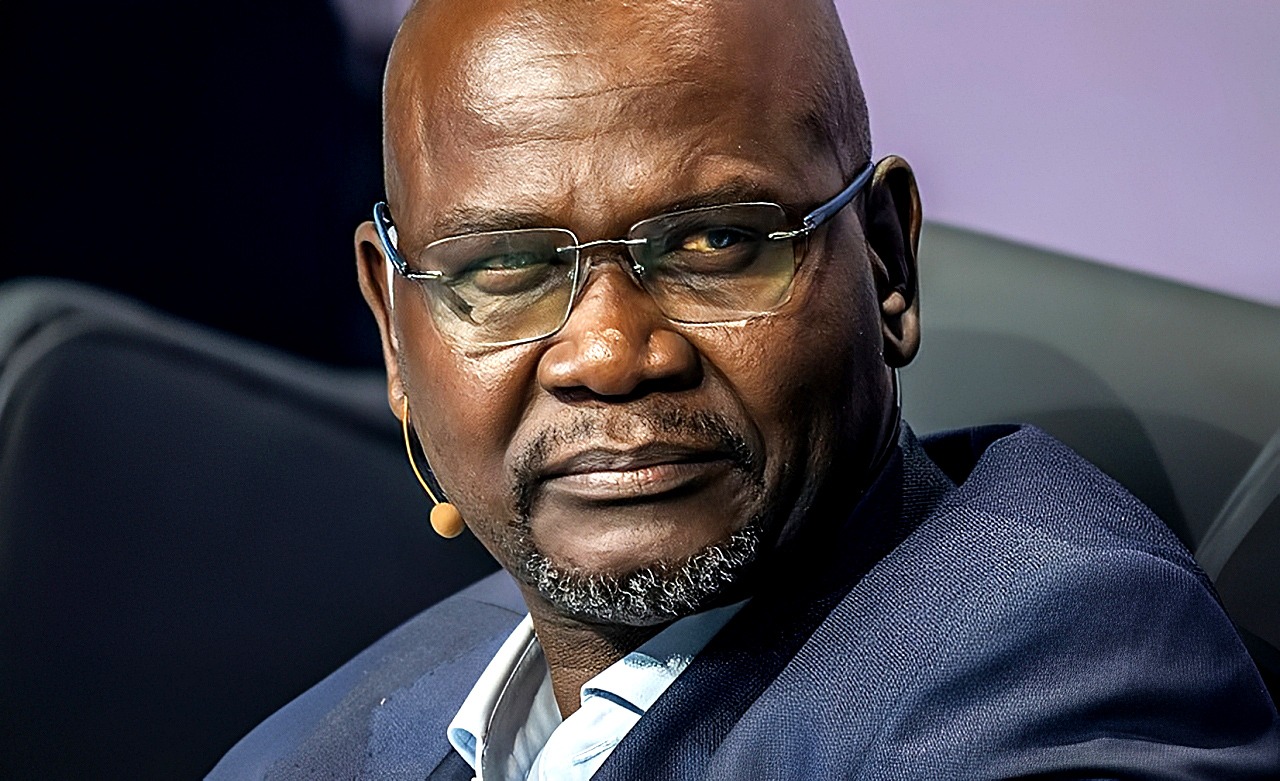
 The Public Investment Corporation has placed CEO Patrick Dlamini, above, on precautionary suspension. (Photo: Leon Sadiki / Bloomberg via Getty Images)
The country’s largest asset manager, the Public Investment Corporation (PIC), has placed chief executive Patrick Dlamini on precautionary suspension pending an independent investigation into whistleblower allegations against him, marking a dramatic escalation of the governance crisis that has engulfed South Africa’s state asset manager over the past month.
The suspension comes barely three weeks after Daily Maverick revealed that the PIC board had received a whistleblower complaint alleging governance failures, conflicts of interest and irregularities surrounding the corporation’s handling of the long-running Lanseria Airport dispute.

In a statement issued late on Monday night, the PIC stressed that the suspension was “precautionary” and “does not, in any way, constitute a finding nor is it a pronouncement of any wrongdoing on the part of the CEO”.
Instead, the board said it wanted to provide Dlamini with “sufficient space and time to respond to allegations of impropriety” contained in the whistleblower report submitted last month while allowing an investigation to proceed independently.
The decision is significant in that it suggests the board has moved beyond its earlier position of merely assessing the credibility of the allegations and has concluded that an investigation into issues that may be serious enough to warrant removing the chief executive from office is now necessary.
The board is finalising arrangements for an acting chief executive.
Lanseria dispute reaches turning point
Dlamini’s suspension follows weeks of growing pressure over the whistleblower allegations.
As previously reported by Daily Maverick, the complaint alleges Dlamini authorised a forensic investigation into the Lanseria Airport transaction without an approving board resolution, failed to manage potential conflicts relating to his previous involvement with Lanseria-linked entities and Harith General Partners, and did not recuse himself from matters where complainants argue that conflicts should have been declared.
The PIC previously rejected suggestions that Dlamini acted outside his authority, maintaining that he had acted within delegated powers when commissioning the PricewaterhouseCoopers forensic investigation into the Lanseria investment.
The corporation also argued that the review was intended to determine whether the PIC had adequately protected the interests of its client, the Government Employees Pension Fund (GEPF), rather than to overturn an arbitration ruling involving Lanseria shareholder Acapulco Trade and Invest 164.
The board’s latest decision does not indicate whether any of those allegations have merit.
Instead, it reflects a governance principle that has become increasingly important in corporate South Africa: serious whistleblower complaints should be investigated independently and without interference from executives who are themselves the subject of those complaints.
CIO change follows GEPF intervention
At the same time, the board also announced another major leadership shake-up.
/file/attachments/orphans/images23_338449.jpg "Acting PIC Chief Investment Officer August van Heerden has ceased serving in that role after a GEPF resolution prompted his departure. (Photo: Instagram)")
Acting chief investment officer August van Heerden will immediately cease serving in that role after the GEPF, the PIC’s largest client, adopted a resolution affecting his appointment.
Leon Smit, who has spent more than two decades at the PIC and heads listed fixed income investments, will serve as acting CIO.
Unlike the suspension of Dlamini, the PIC did not elaborate on the GEPF resolution that prompted Van Heerden’s departure.
In May this year, there were several media reports about the GEPF “taking a major hit of R200bn” in losses based on the impact of the Middle East conflict. The reports followed a radio interview where Frans Baleni, chair of the GEPF, told Moneyweb Radio: “With the war in Iran, in the first week it wiped out R200-billion from our investment. So clearly it means that we have to adapt, given the developments.”
About a week ago, the GEPF issued a statement pointing out that it is a defined benefit fund, which means member benefits are paid as expected, regardless of market performance.
“It is not unusual for market values to decline during major geopolitical events like an outbreak of war, pandemics or other global events due to sudden market-wide asset devaluations driven by investor panic, rising inflation and spiking energy costs. The GEPF has been here before, where its market value has been affected by market shocks, but it has subsequently always recovered all its losses, even surpassing its market value prior to the declines,” the GEPF statement issued on Monday, 6 July said.
Governance questions return
The latest developments are likely to reignite debate about whether the PIC has fully implemented the recommendations of the Mpati Commission of Inquiry.
The Association for Monitoring and Advocacy of Government Pensions (AMAGP) argues that the current turmoil demonstrates that two key Mpati recommendations remain unresolved: removing the deputy finance minister as automatic chairperson of the PIC board and ensuring board appointments are based on professional merit rather than political appointment.
Chairman of the AMAGP Zirk Gous noted that recent weeks had seen unprecedented public scrutiny focused on the GEPF’s asset manager, the PIC. “Headlining concerns include intense boardroom infighting, systemic lapses in governance and growing questions regarding the PIC’s unlisted investment portfolio, specifically the Isibaya Fund,” he said.
Gous maintains that “at the core of this institutional instability is the persistent failure by the PIC to implement the key recommendations of the Mpati Commission of Inquiry into allegations of impropriety at the PIC”.
He further questioned the PIC’s previous reporting to Parliament, noting that the corporation’s December 2025 implementation report classified all Mpati Commission recommendations as fully implemented, despite those governance reforms not having been adopted.
The PIC’s own implementation report presented to Parliament shows every recommendation as “fully implemented”, including governance reforms, strengthened whistleblower protections and revised conflict-of-interest policies. Among them are recommendations requiring a comprehensive whistleblower policy, enhanced ethics oversight and improved governance controls.
Ironically, it is those very whistleblower procedures that are now being tested.
The current investigation is taking place under the whistleblower framework the PIC says it introduced following the Mpati Commission. According to the implementation report, the board approved an anti-fraud, corruption and whistleblower policy, established an ethics office and strengthened procedures for independently investigating disclosures.
Bigger than one executive
The PIC manages more than R3-trillion in assets on behalf of the GEPF, the Unemployment Insurance Fund, the Compensation Fund and other public sector clients. Its decisions influence everything from listed equity markets to infrastructure funding and developmental investments.
All of that means the issue facing the board extends well beyond the future of one executive and is now about whether South Africa’s largest asset manager can demonstrate that governance systems introduced after the Mpati Commission are capable of functioning when they are needed most.
For months, the PIC has insisted that lessons from the commission have been learnt.
The coming investigation will show whether those reforms were merely written into policy, or are robust enough to withstand the institution’s biggest governance test since the commission itself. DM
Comments
Scroll down to load comments...