




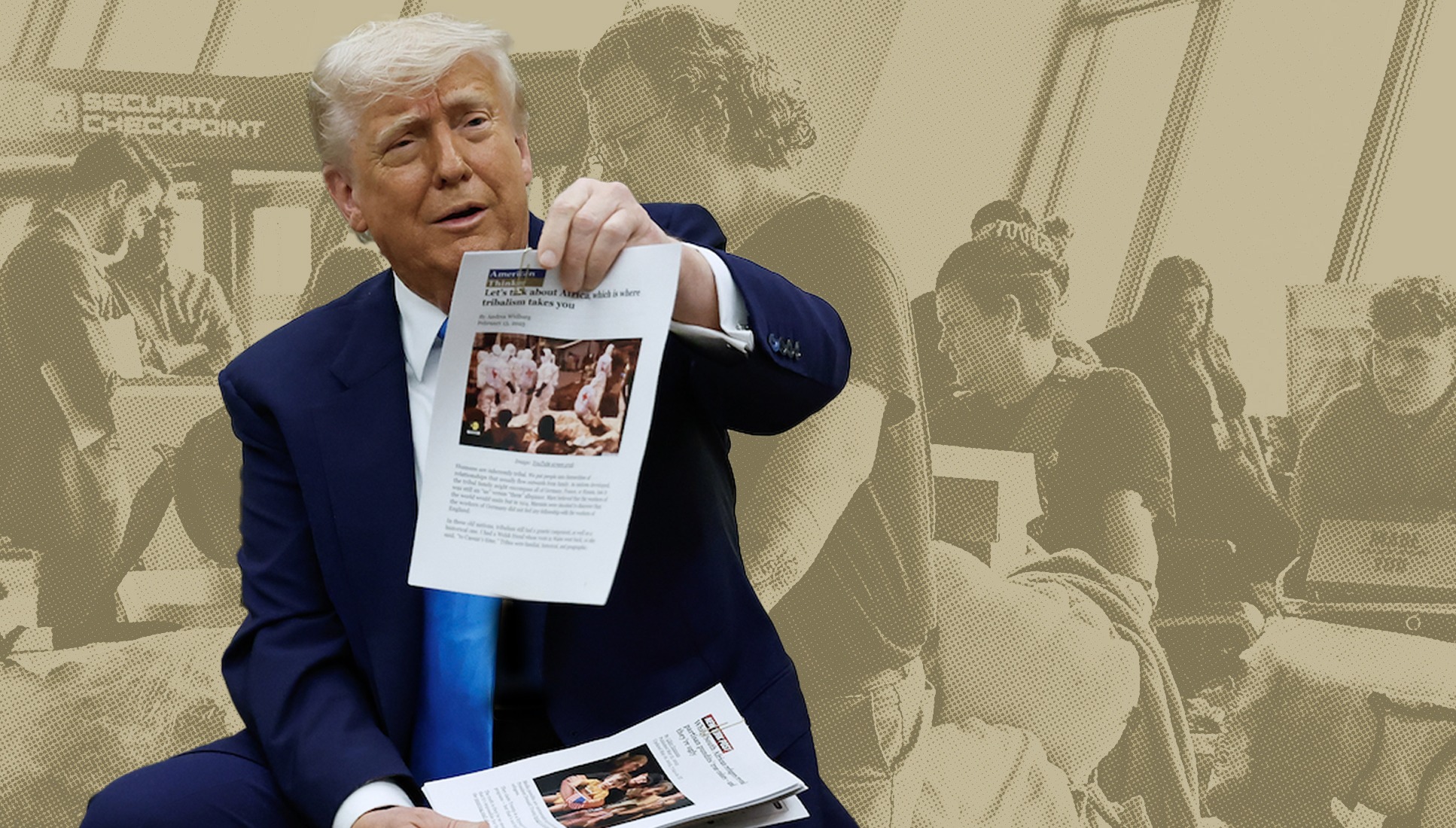
 Illustrative image | U.S. President Donald Trump holds up a printed article from "American Thinker" while accusing South African President Cyril Ramaphosa of state-sanctioned violence against white farmers in South Africa during a meeting in the Oval Office at the White House on 21 May 2025 in Washington, DC. (Photo: Chip Somodevilla/Getty Images) | People from the first group of white South Africans granted refugee status for being deemed victims of racial discrimination under U.S. President Trump's Refugee plan, check in for a connecting flight, at Dulles International Airport, in Dulles, Virginia, U.S., May 12, 2025. (Photo: REUTERS/Jonathan Ernst)
Immigration policies in the United States have seen thousands of South African “refugees” allowed into that country, while foreigners from elsewhere, including Syria and Iran, already residing in the US, have struggled for benefits such as work authorisation.
Some of those immigrants fear that even though they have made it into the US legally, they may be forced to return home, where they face persecution.
The US has officially opened its arms to Afrikaners from South Africa, in keeping with an order issued by US President Donald Trump early last year.
‘Bent to benefit Afrikaners’ — report
But it has not been plain sailing for all those trying to get into America – Rapport noted last weekend that hundreds of Afrikaners had been denied refugee entry.
Some of the unsuccessful applicants, it reported, had already resigned from their jobs because they were so confident they would resettle in the US.
The Afrikaner issue has been picked up by the media in the US.
/file/attachments/orphans/GettyImages-2214743789_399305.jpg "Newly arrived South Africans wait to hear welcoming statements from US government officials in a hangar at Atlantic Aviation Dulles near Washington Dulles International Airport on 12 May 2025. (Photo: Chip Somodevilla / Getty Images)")
On Monday, 13 July 2026, CNN reported: “The refugee program, largely shuttered for the rest of the world, has sparked diplomatic spats, prompted a scramble to open a processing site in South Africa, generated highly unusual requests from applicants and produced high denial rates, due in part to criminal records among some applicants, according to more than a dozen people familiar with the program.
“While the processing of refugees can be a difficult task, particularly in urgent situations, the people familiar with the program told CNN that the hurdles it has faced stem from the administration’s desire to bend the program to only benefit Afrikaners.”
All but three of 7,730 from SA
Daily Maverick has established that over eight months from around November 2025 to the end of June, 7,730 refugees were allowed into the US and the outright majority – 7,727 – were from South Africa.
The remaining three were from Afghanistan.
In 2026, it appears that only South Africans were accepted as refugees into the US, with peaks from February to April when a collective 4,418 entered the US.
Last month, another 1,062 made their way into the country.
These figures are contained in a US government refugee admissions report.
According to the US, it is one of the “most up-to-date reports on admissions and arrivals through the U.S. Refugee Admissions Program (USRAP) for the current fiscal year.”
SA in key US court cases
US President Donald Trump’s attitude towards immigration, meanwhile, has been the focus of a court case, which cites related figures and outlines what is effectively his soft spot for white Afrikaners from South Africa.
South Africa and the US have tetchy relations, especially in terms of Trump’s stance that white Afrikaner people in South Africa are being intentionally discriminated against and violently targeted, a narrative certain Afrikaner rights groups have pushed.
On 7 February 2025, that narrative saw Trump sign an Executive Order which cut off aid to South Africa and offered refuge to “Afrikaners in South Africa who are victims of unjust racial discrimination”.
(At the time, South Africa’s international relations and cooperation ministry issued a statement saying: “It is of great concern that the foundational premise of this order lacks factual accuracy and fails to recognise South Africa’s profound and painful history of colonialism and apartheid.”)
/file/dailymaverick/wp-content/uploads/2025/05/13068319.jpg "US President Donald Trump meets South African President Cyril Ramaphosa in the White House Oval Office in Washington, DC, on 21 May 2025. (Photo: EPA-EFE / Jim Lo Scalzo)")
There are several other matters causing friction between South Africa and the US.
Last week, Daily Maverick reported on how a retired SA Air Force brigadier general, Portia Anyamba, was sentenced to six months’ imprisonment in the US last month after she pleaded guilty to being a foreign agent for South Africa.

That case suggested Anyamba was paid to secretly monitor certain think-tank events in the US and report back to South African officials.
Now, the other recent US case also refers to South Africa – and hinges on immigration issues.
‘Negative factor nationality’
That case resulted in a court order issued in Ohio last week, on 6 July 2026.
The order was in favour of 25 anonymous plaintiffs (or applicants) who were foreigners already residing in the US.
At the centre of the case was the legality of policies created and implemented by the US Citizenship and Immigration Services (USCIS) and the Department of Homeland Security.
According to the court order: “These policies indefinitely pause USCIS’s final adjudication of pending immigration benefit applications submitted by foreign nationals from certain countries, and treat nationality from those countries as a significant and negative factor in that adjudication process.”
In other words, indefinitely paused policies were preventing legal immigrants from, for example, being able to work, and their nationalities were counting against them.
The Ohio court found in favour of the plaintiffs last week and ordered, with conditions, that the relevant US authorities cease applying certain policies while the case unfolds.
“Many similar challenges have been levied by other plaintiffs against these same policies across the country, and courts have consistently granted preliminary relief against USCIS and the Government,” the order said.
The case that resulted in last week’s order involved people with citizenship in countries including Iran, Canada, Burma, Nigeria, Syria, Tanzania and Venezuela.
They had all submitted applications for “immigration benefits,” including for work and green cards, that had been pending with the USCIS. (Policies had resulted in these benefits being paused indefinitely.)
Pharmacist, cancer researcher, young couples
The court order explained: “These foreign nationals are not outside the country; they reside across the United States. Many of them have been in the United States for years, and already have received prior authorization to work here.
“Plaintiffs include a hospital pharmacist, a registered nurse and cancer researcher receiving federal funding, college graduates with pending job offers in the fields of science and engineering, a university professor, and young couples raising families.”
The court order listed what some of them were experiencing because of effectively paused immigration benefits.
“John Doe 1, a licensed pharmacist, feels as though he cannot ‘move forward’ with his life, career, home, and community in Columbus, Ohio,” it said.
“He fears that despite being granted asylum in the United States, he may be forced back to Syria and face persecution.”
Another individual, Jane Doe 13, was a registered nurse from Canada.
“Constant uncertainty” was causing “significant mental strain,” and she feared being detained by the US’s Immigration and Customs Enforcement.
/file/attachments/orphans/GettyImages-2214742189_569888.jpg "South Africans who went to the United States as refugees listen to US Deputy Secretary of State Christopher Landau and Homeland Security Deputy Secretary Troy Edgar deliver welcome statements in a hangar at Atlantic Aviation Dulles near Washington Dulles International Airport on 12 May 2025. (Photo: Chip Somodevilla / Getty Images)")
The challenged policies had been implemented after Trump made it abundantly clear that he was prioritising immigration matters.
He and US Vice President JD Vance have been outspoken on these issues.
“As President Trump promised during a stop in Mount Pocono, Pennsylvania on December 9, 2025, his administration would, through a series of policies, create ‘a permanent pause on third world migration, including from hellholes like Afghanistan, Haiti, Somalia, and many other countries,’” the Ohio court order from last week said.
“In sum, both the President and the Vice President have publicly and repeatedly expressed outright hostility toward immigrants, both before and after the 2024 presidential election.”
Trump had ordered various proclamations and orders, including a January 2025 Executive Order titled Protecting the United States from Foreign Terrorists and Other National Security and Public Safety Threats.
The following month, the Executive Order offered refuge to “Afrikaners in South Africa who are victims of unjust racial discrimination”.
‘Preference for the migration of white people’
Last week’s Ohio court order cited a “general hostility to immigration [that] contrasts with an apparent interest in and preference for the migration of white people.”
It added: “Aside from a stated desire for more Scandinavian immigration, President Trump has sought to welcome white South Africans.”
The Executive Order signed in February 2025 was also noted.
The Trump administration plans to admit up to 10,000 more white South African refugees into the United States in the coming months, arguing that their status as Afrikaners has left them open to discrimination and persecution at home.
— ABC News (@ABC) May 19, 2026
Read more: https://t.co/CGM2Y5mOUC
“In accordance with President Trump’s Executive Order, the overwhelming number of refugees to the United States appear to be white Afrikaners from South Africa, and the White House has touted the plight of ‘white farmers in South Africa,’ ” the court order said.
“Thus, from October 1, 2025 through May 31, 2026, 6,665 of the 6,668 refugees admitted into the United States were from South Africa.”
SA’s anti-foreigner chaos
While Trump appears to favour Afrikaners from South Africa entering the US, South Africa has serious immigration problems of its own.
There have recently been anti-foreigner protests and xenophobic attacks.
Those driving this chaos also imposed an unofficial 30 June 2026 deadline for all undocumented immigrants to leave South Africa.
Read more: Over 53,000 repatriates have left SA — here’s where they’re going
This led to tens of thousands of foreigners fleeing the country.
Last week, on the same day the US court order was handed down in the immigration benefits policy case, South Africa’s Department of Home Affairs announced it was strengthening its “immigration enforcement capacity”.
The department had “only 868 immigration officers,” and was seeking to boost this figure by recruiting another 301. DM
Comments
Scroll down to load comments...