




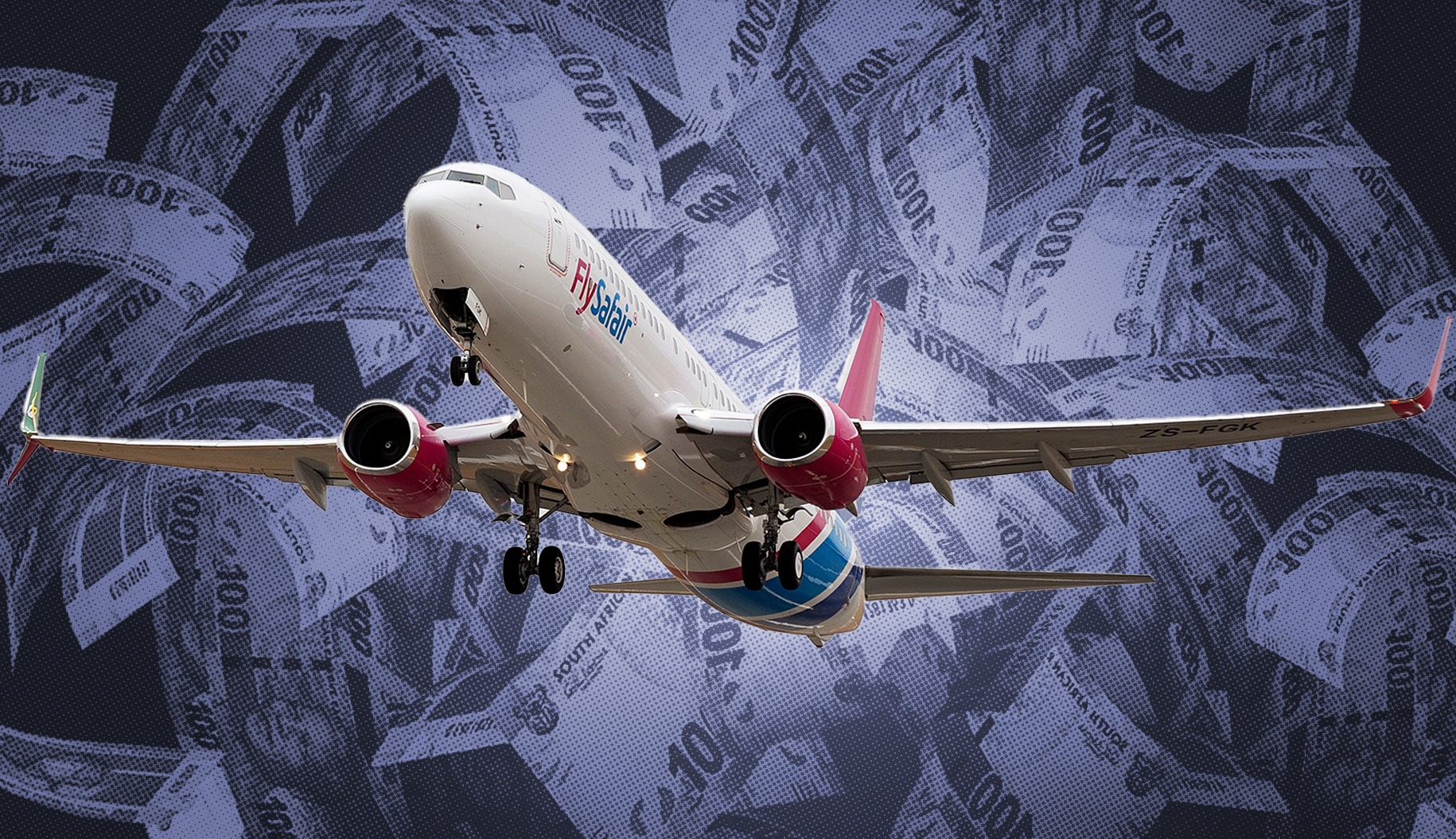
 Illustrative image: A FlySafair aircraft takes off from OR Tambo International Airport in Johannesburg. (Photo: Supplied) | South African banknotes. (Photo: Adobe Stock)
Like Rassie putting out his team sheet for the weekend clash, the Competition Commission didn’t let the markets wait until Thursday to deliver its recommendation that the Competition Tribunal approve the acquisition of Safair Holdings by Harith Aviation, subject to specific public interest and competitive remedies.
First among the potential issues that could torpedo the deal was the matter of Harith’s ambition to own an airline. The commission found that because Harith mutually terminated its interest in acquiring SAA in March 2024, the deal does not remove any competitor or aircraft from the skies; it simply replaces an Irish shareholder with a South African one.

But it’s the other aviation interests that caused some turbulence. Because Harith holds a significant interest in Lanseria International Airport, the parties must guarantee that airline- or airport-related goods and services provided to competing airlines at Lanseria are not offered on unfair, unreasonable or discriminatory terms.
Since that is now cleared up, Harith is one Competition Tribunal ruling away from doing its best Emirates impression; turning Lanseria and its newly acquired anchor tenant FlySafair into a glamorous local and international aviation oasis – but just north of Randburg.
Accelerated compliance
FlySafair, in a statement shared with Daily Maverick, has welcomed the progress, framing the deal as a major step toward securing its long-term future after a regulatory dispute with the Air Services Licensing Council (ASLC) over South Africa’s 75% local ownership mandate.
You may recall that in early 2025, the ASLC ruled that FlySafair’s foreign parent structure breached the 75% local ownership rule, granting a 12-month grace period to restructure or face licence revocation.
While the airline secured an urgent high court interdict suspending this deadline pending judicial review, the transaction permanently cures this defect.
Harith, meanwhile, has framed the acquisition as a central anchor for its broader regional infrastructure and mobility vision (read: aviation oasis just outside Randburg).
Silent close
FlySafair doesn’t like to air its laundry, so the transaction price is shrouded in private equity terms and conditions. Harith, however, does like to boast of its assets under management cresting the $3-billion mark.
And because Harith Chairman Tshepo Mahloele confirmed on the record that the FlySafair acquisition will account for about 15% of Harith’s overall investment portfolio, it would be a simple calculation to estimate a ballpark figure of above R8-billion – after you’ve done the currency conversion, of course.
But the devil is in the details of how Harith put the capital together:
The CompCom ruling lists GP Fund 2 Proprietary Limited as the registered corporate General Partner managing the Pan-African Infrastructure Development Fund 2 (PAIDF 2) SA en commandite (read: limited) partnership. It acts as the legal conduit to direct PAIDF 2’s capital into the Harith Aviation special purpose vehicle to execute the acquisition.
The PIC owns 30% of Harith General Partners (the asset manager), so the PIC will therefore directly profit from the management fees and performance carries generated by this acquisition.
Then the PIC, deploying capital on behalf of the Government Employees Pension Fund (GEPF), acted as the foundational anchor Limited Partner in PAIDF 2.
Fascinating turn
So if you’ve been keeping track, a substantial portion of the estimated R8-billion capital stack deployed by GP Fund 2 to purchase FlySafair originates from the retirement contributions of South African government employees.
And then, by acquiring FlySafair through a fund heavily backed by GEPF/PIC capital, the public (theoretically) holds indirect economic exposure to roughly 76% of the entire domestic aviation market – this, of course, includes our full shareholding of SAA (via its state ownership model).
But that is pure conjecture and back of brown envelope scribbles. Although, in a world where the incumbent market leader is now armed with patient, long-term institutional capital, FlySafair is now highly insulated from foreign ownership licensing threats.
The business is strongly positioned to maintain its operational dominance, defend its domestic market share against regional rivals like Airlink and Lift, and accelerate strategic expansion into lucrative regional African routes.
All is fine as long as they stay on time. DM
Comments
Scroll down to load comments...