




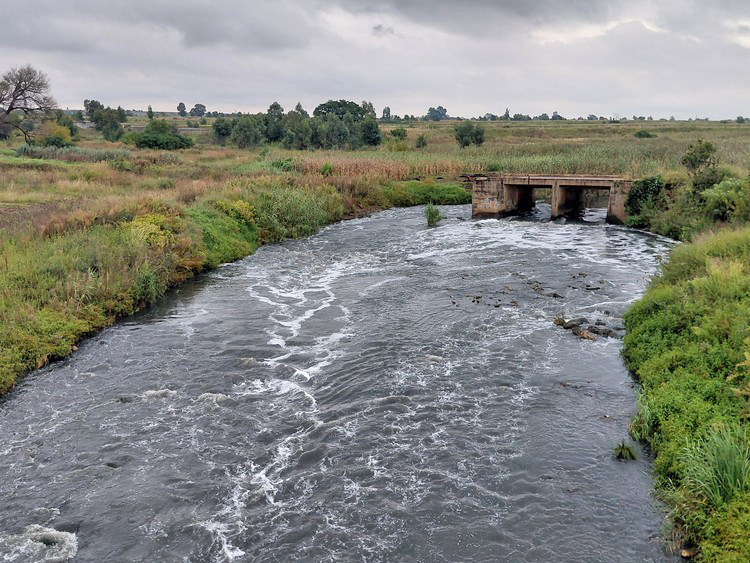
 The Klip River in Gauteng is polluted by untreated sewage spilling from the Olifantsvlei wastewater treatment works. (Photo: Seth Thorne)
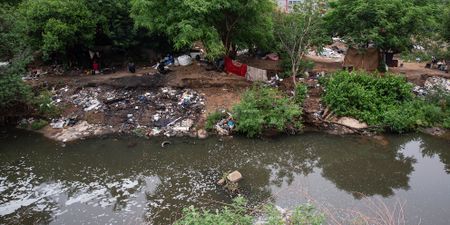
Just off the banks of the Moreleta River in Pretoria East lies a sewerage pipe split in two. Raw effluent runs from the pipe into the river, forming brown sludge and white foam as it enters the waterway.
Leanne de Jager, the Democratic Alliance’s Gauteng environment spokesperson and a member of the provincial legislature, said the leak was reported last year and, after months of inaction, was finally repaired in March, only for the repair to fail some weeks later.
Describing the repair as a “make-do” solution, De Jager said, “If you stand there, the sewage is running on either side of that pipe. So [the repair] has actually done nothing.”
The Moreleta sewer leak is a micro-study of a wider collapse in municipal infrastructure management, one in which ageing pipes, overloaded systems, failing wastewater treatment works and weak accountability turn Gauteng’s rivers into de facto sewers, driving an environmental and public health crisis.
WaterCAN executive director Ferrial Adam said the pattern is unmistakable. “We are still living largely with contaminated rivers,” she said. “Something’s fixed, and then it’s okay for a while, and then it deteriorates.”
The result is that Gauteng’s rivers are “terribly polluted” because of the condition of wastewater treatment works and recurring sewer leaks.
In its December 2025 report, WaterCAN found that out of the 23 rivers and five dams it tested across Gauteng, 21 river samples and all five dam samples contained unsafe levels of coliform bacteria. Moreover, 18 rivers and all five dams had unsafe levels of E.coli.
/file/dailymaverick/wp-content/uploads/2024/02/20V3791.jpg "Volunteers collect bags of waste during a cleanup at the confluence of the Braamfontein and Sandpruit rivers in Joburg. (Photo: Felix Dlangamandla / Daily Maverick)")
Ripple effect
Because rivers flow, pollution entering the Moreleta system in Pretoria East quickly spreads through interconnected waterways. The Moreleta, Hennops and Jukskei systems all feed into the broader Crocodile River system, which is a major tributary of the Limpopo River.
“If you’ve got a burst pipe in a part of Pretoria or somewhere else, it’s actually a bigger problem,” said De Jager, because the system ultimately serves “millions of people in different provinces”.
The Moreleta River lies within a catchment of public green spaces and protected urban ecology. The Moreleta Kloof Nature Reserve is a 100-hectare reserve with birdlife and small game, through which a tributary of the river flows. Pollution entering these systems is not simply a nuisance to nearby residents; it contaminates habitat, wetlands, riparian vegetation and downstream recreational water bodies.
Downstream, the Moreleta joins the Hartbeesspruit system, drains into the Pienaars River catchment and ultimately into Roodeplaat Dam; beyond that, contamination moves into the Pienaars River, the Crocodile River and towards the Limpopo system.
Malfunctioning wastewater plants, urban runoff, and farming have left Roodeplaat Dam heavily overloaded with nutrients. A 2025 study found that phosphorus and nitrate-nitrite levels exceeded permissible limits near wastewater outlets. This severe eutrophication threatens the entire aquatic ecosystem, crippling water quality while triggering dangerous algal blooms and invasive weed infestations.
/file/dailymaverick/wp-content/uploads/2021/11/IMG_20211113_110708.jpg "The polluted Roodeplaat Dam. (Photo: Supplied)")
That is the ecological cost of sewage: nutrients feed algal blooms, oxygen levels fall, aquatic life is stressed, and rivers lose the frogs, fish, plants and invertebrates that make them living systems. Adam put it plainly: “When you create dead rivers, it has a direct impact on life in general.”
Accountability at a snail’s pace
The Department of Water and Sanitation (DWS) has been forced into an extraordinary position: opening criminal cases against municipalities, its own sister organs of state, for sewage pollution.
In a parliamentary reply on 24 June, the DWS said there were 96 active criminal cases for sewage pollution involving 53 water service authorities across all nine provinces. Of these, 53 were still under investigation, and 42 had been referred to the National Prosecuting Authority (NPA) for a decision on whether to prosecute. In only one case had the NPA decided to prosecute, while five cases had been concluded through plea and sentence agreements.
Those numbers reveal the bottleneck. The DWS may issue notices, directives and charges, but once matters enter the investigative and prosecutorial pipeline, accountability slows to the pace of paperwork. Evidence must be collected. Dockets must move. Prosecutors must decide. Court dates must be secured. Municipalities continue operating.
Adam said the problem is not simply the absence of laws. It is the absence of consequences for those responsible.
“Charging the municipalities and then the municipalities paying a fine, it doesn’t solve the problem because there is no consequence management. There has to be someone that you can say, ‘Actually, why is this happening? Why is this continuing?’” said Adam.
Municipal managers could soon face personal criminal charges for environmental failures. The DWS is pushing for legal reforms to strip away institutional shields, while amendments to water legislation look to tighten personal liability. According to the 24 June parliamentary reply, the NPA will decide whether to prosecute individual officials in their personal capacity based on the available evidence.
“The wheels of justice turn very slowly,” said Adam. “By the time these cases actually get investigated, get to court, there’s still about 500,000 litres of sewage that flow into the river anyway. It doesn’t stop it happening immediately.”
While De Jager welcomed the DWS’s strategy to litigate against municipalities, she added, “I don’t even think criminal cases are the solution. It’s like a backstop. It’s not a fix. By the time DWS is filing charges, the communities have already been drinking or bathing in that water for months or years.”
Daily Maverick asked the DWS for information about the progress of its litigation against municipalities in Gauteng, but had received no response by the time of publication.
This is the failure of accountability by delay. The law may eventually punish, but pollution happens in real time. The NPA docket becomes a symbol of future consequence while the present-tense disaster continues downstream. DM


Comments
Scroll down to load comments...