



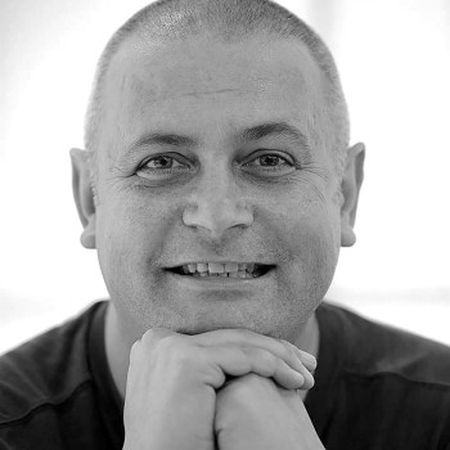
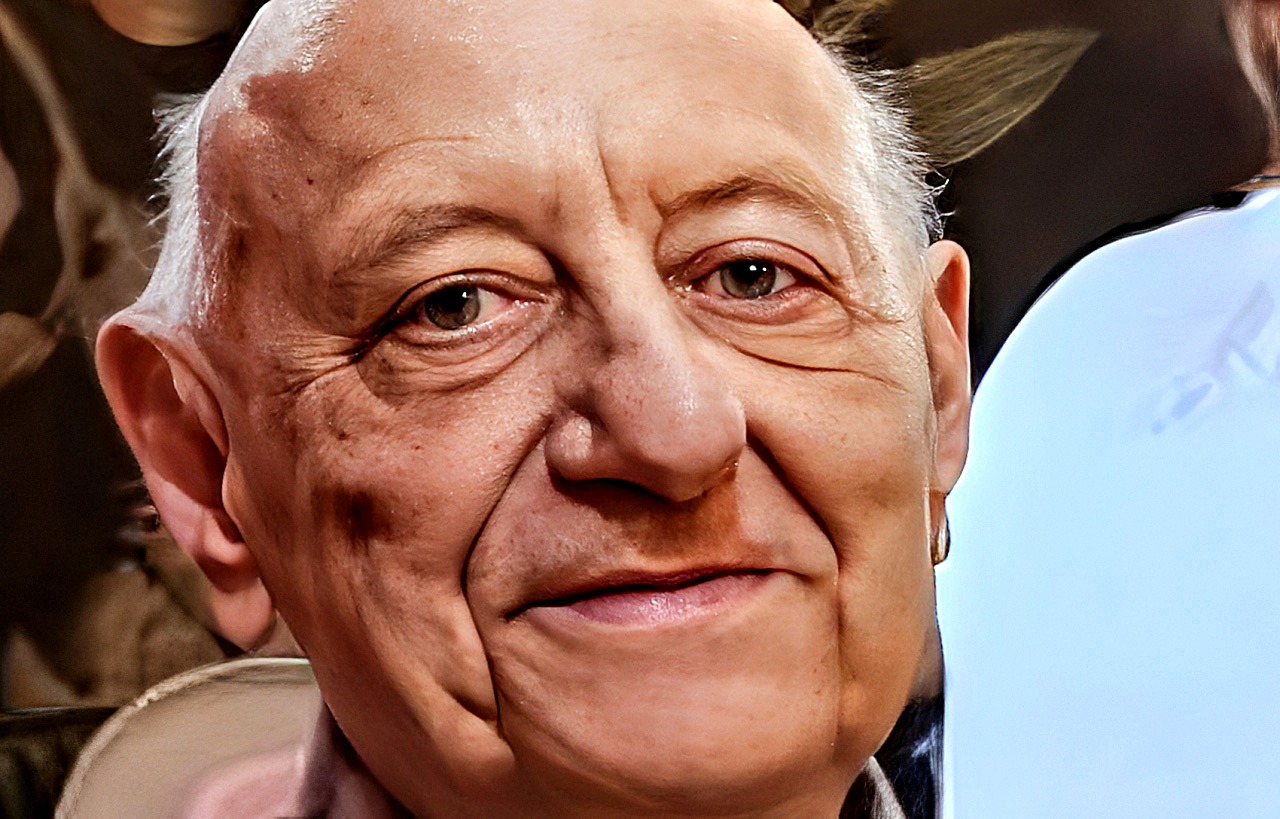
 Dieter Felix Gerhardt, born 1 November 1935, is a former commodore in the South African Navy who commanded the strategic Simon’s Town naval dockyard and conducted espionage for the Soviet Union’s KGB from 1965 until his arrest in 1982. (Photo: Morné van Rooyen / Facebook)
 Former South African Navy Commodore Dieter Felix Gerhardt, who commanded the Simon’s Town naval dockyard before being unmasked as one of the Soviet Union’s highest-ranking spies in apartheid South Africa, died at his home in Noordhoek on Wednesday 8 July at 11.40am. He was 90.
Gerhardt was born in Sea Point, Cape Town, on 1 November 1935, to Austrian-German parents, and not, as is often claimed, in Berlin. His life resists a settled account.
“The Wikipedia page is full of mistakes,” his widow, Ruth Gerhardt, said from their home in Noordhoek. “So are many of the other so-called authoritative sources.” She laughed when asked whether he had spied for money. “What money? We both worked hard. I was interested in sport, not expensive clothes or luxury. We simply lived our lives.”
She insisted he never abandoned the ideals that had shaped his life.
“He believed in the Freedom Charter right to the end. His health had failed since a fall on 6 May, but his mind had not. He remained mentally sharp. It was just that his body stopped working.”
She rejected, too, the persistent claim that she had been recruited by East Germany before she ever met her husband.
“That’s simply not true,” she said.
Married for almost 60 years, the couple spent a stretch of that marriage in separate prison cells, both convicted of high treason for an act whose motive is still argued over today. Accounts of the exact term vary. Ruth put her husband’s sentence at seven-and-a-half years; the Israeli investigative journalist and Mail & Guardian contributor Ronen Bergman later wrote, drawing on Gerhardt himself, that the sentences amounted to nine-and-a-half years for him and eight for her.
Interned
Alfred Gerhardt, his father, had emigrated from Germany five years before his son’s birth, and the family spoke German at home. In 1940 the elder Gerhardt was interned as a South African nationalist sympathetic to Germany, and released in 1946 alongside men who would go on to lead the apartheid state, among them John Vorster.
Gerhardt later traced his politics to that household.
“I grew up in a German milieu,” he told the Mail & Guardian in 2000. “The manifestations of racism around me, including on the part of my father, who was a member of a party that can only be called Nazi, had a decisive impact on my future actions.”
He was, by his father’s design, sent to the navy to be disciplined. Alfred persuaded the naval chief Hugo Biermann to take the troubled teenager under his wing, and Gerhardt graduated from the Naval Academy at Saldanha Bay in 1956, winning the Sword of Honour.
Six years later he sailed for Portsmouth to train at a Royal Navy mine school, completed a parachute course at RAF Abingdon, and was seconded into the Royal Navy proper, serving aboard HMS Tenby and training at HMS Collingwood. It was there, still a junior officer in his late twenties, that he approached the South African Communist Party and offered his services.
Bram Fischer put him in touch with the Soviet embassy in London, where the GRU, Soviet military intelligence, recruited him as a “walk-in” and told him to stay in uniform and rise. The operation was given the codename Felix.
Britain trusted him. He passed to Moscow details of the Seacat and Sea Sparrow missile systems, and the first intelligence on the French Exocet to reach Soviet hands.
“A senior officer in British counter-intelligence, with whom I became friendly, frequently lamented that they knew the Russians knew everything,” he told the Mail & Guardian.
He crossed to Moscow itself under the cover of a skiing holiday, switching flights and identities through Vienna and Budapest, and was met at the runway by a black Zil that carried him straight to GRU headquarters. There he learned microphotography, Morse code, and the tradecraft of evading a polygraph, and sat for the photographs, in wigs and false beards, that would later fill his collection of forged passports.
He married young. Janet Coggin met him at a wedding when she was 21; four months later they wed. She discovered his double life only in 1966, eight years into the marriage, when he took her for a walk in case the house was bugged and produced a letter pierced with a microdot.
“I refused to believe him at first.”
He asked her to become a spy too. She refused and went to Ireland with their children and divorced him.
Shortlist
Moscow, meanwhile, had decided he needed a new wife, and had assembled a shortlist of its own. Gerhardt got there first. At Klosters, a Swiss ski resort where he had cached false passports and disguises for his own use, he met Ruth Johr, a Swiss citizen, by what both would always describe as chance.
“We met by chance at a resort in Switzerland in 1968,” Ruth recalled. “I was playing chess when he came over and started offering advice. We skied together and got to know one another. He admired my skiing.”
He invited her to a concert at the Royal Albert Hall in London, they fell in love, and he told her he wanted to return to Cape Town, his place of birth. When his Soviet handlers proudly produced their own candidate on his next visit to Moscow, he turned them down flat.
“I said: ‘Just a minute, comrades, excuse me, but tell the lady I am very sorry, I have already found myself a wife.’” He told Ruth of his politics before their wedding in 1969, and, together with his handler Gregorii Shirobokov, revealed the rest in careful stages. She trained in Moscow and became his courier.
Cape Town, when they arrived, delivered its own education.
“We went to the Alhambra Theatre to watch La Bohème,” Ruth said. “When we came out, it was cold and raining. I saw barefoot black children selling newspapers in the street.
“White children were safely at home in bed. I couldn’t believe what I was seeing. The libraries were segregated. The buses were segregated. Everything was segregated.” Whatever else moved him, this, in her account, was the thing that never left him. “He never stopped believing the country would eventually be free from apartheid.”
Through the 1970s he served as a senior staff officer to the chief of the Defence Force in Pretoria, worked on the Ratel infantry fighting vehicle and the Cactus missile system, and liaised on the Mirage F1 deal with France.
“It was hell. You become a slave to the shopping list and you effectively lose control of your life. I would call it controlled paranoia.”
He passed on Israeli secrets after SA and Israel began quiet military cooperation, including details of the Jericho missile purchase. By the time he took command of the Simon’s Town dockyard he had access to the naval intercepts gathered at the Silvermine listening station, and during the Falklands War of 1982 he is alleged to have passed the Soviets detailed positions of Royal Navy vessels tracked in the South Atlantic. He worked, he later estimated, 45 hours a week at espionage, more than he gave to his actual job. “It was hell,” he told Bergman. “You become a slave to the shopping list and you effectively lose control of your life. I would call it controlled paranoia.”
He drew, too, on the secret defence pact struck between SA and Israel after the Yom Kippur War, translating for Moscow the handwritten Afrikaans notes PW Botha had scrawled in the margins of the agreement.
One clause troubled him more than the rest.
“The clause that outraged me most in the agreement was called Chalet,” he said. “Israel agreed to arm eight Jericho 2 missiles with what were described as special warheads. I asked the chief of staff what that meant, and he told me what was obvious: atomic bombs.”
Israeli officials later dismissed any suggestion of nuclear cooperation with Pretoria as fantasy, though the arms relationship between the two countries, run through a front airline called Aurame, was never seriously disputed.
He also touched SA’s own nuclear programme, feeding Moscow details of its codename, Kerktoring, and of the scientists working on its trigger mechanism, and photographing the test site in the Kalahari on a visit arranged for the purpose.
When Soviet concern over the programme reached Leonid Brezhnev, who appealed personally to President Jimmy Carter in 1977, South African counter-intelligence drew up a list of suspects that briefly included Gerhardt’s own name before clearing him.
He had, deliberately, passed on more than he was cleared to know, breaking into colleagues’ safes at night to muddy the trail of any leak. Caught once by a night watchman beside an open safe, he talked his way into a shared pot of tea and a long, quiet conversation.
He was arrested in New York in January 1983, while attending a mathematics course at Syracuse University, after the Soviet defector Vladimir Vetrov exposed him to French intelligence.
Felix
“The door burst open to admit agents from the CIA, the FBI and MI6,” he recalled. “One of them addressed me by my code name, Felix, and I knew the game was over.” Ruth was arrested the same night in SA. “Good evening, Mrs Rosenberg,” the security officer told her at the door, invoking the executed American spies Julius and Ethel Rosenberg.
PW Botha announced the arrest to the world at a press conference on 26 January 1983. Accounts suggested that over the course of his espionage career he passed between 400,000 and 500,000 pages of classified material to Moscow, encompassing South African, British, Nato and Israeli secrets.
“I felt this tremendous burden, which had turned me into a paranoid bundle of nerves for 22 years, suddenly being lifted from my shoulders,” he said.
He and Ruth were tried in camera in Cape Town on charges of high treason, with the prosecution seeking death for both. Judge George Munnik sentenced Gerhardt to life imprisonment in December 1983 and Ruth to 10 years, and told the court he would have hanged Gerhardt outright had the intelligence he passed led to the death of a single South African soldier.
/file/attachments/orphans/HMxfMdaW8AATO-X_409143.jpg "Dieter Gerhardt in his naval uniform. (Photo: Carl Niehaus / X)")
His interrogators wanted names, and he gave them slowly, in what he called “confessio interruptus”, each partial confession staged to resemble exhaustion rather than strategy, while he withheld the identities that mattered most. It took three months to break him fully, and by then he had convinced his questioners of collaborators who barely existed, buying time for one final operation of his own devising.
Nine-and-a-half years followed, four of them in total isolation. He remained a bargaining chip in every proposed East-West spy exchange that SA considered and rejected, through the release of Nelson Mandela and the unbanning of the ANC, until Boris Yeltsin raised his case personally with President FW de Klerk in 1992 and made his release a condition of restored diplomatic ties.
In disguise
He travelled out of SA one last time in disguise, reunited with Ruth in Zurich, and settled with her first in Basel and later at Noordhoek, near Fish Hoek, where the couple were rarely seen in public. The Truth and Reconciliation Commission granted him amnesty in 1999 and restored his naval rank. Mandela wrote to him with thanks and offered him work as a military adviser, which he declined.
But Gerhardt was a divisive figure. Writing in Scientia Militaria in 2021, the historian Henning van Aswegen argued that Gerhardt and Ruth had worked for money rather than principle, and that Ruth’s role went well beyond that of an unwitting wife dragged along by love.
The defence analyst Helmoed-Römer Heitman took a similarly sceptical view of the legend that grew up around him.
“My understanding of it was that he walked into the Russian embassy in London and offered his services in exchange for payment,” Heitman said, “though I have only hearsay information on that. There was probably also a bit of Walter Mitty to it.”
He noted the warning signs that a more attentive counterintelligence service might have caught: a security clearance kept fashionably current, a lifestyle beyond a naval salary explained away as stock market winnings nobody checked, a swift second marriage to a foreign national.
“I suspect he was simply too much thought of as ‘een van ons mense’ for anyone to consider that he could be treasonous.”
Gerhardt’s eldest daughter with Janet Coggin, Anna, died by suicide in her early twenties. Heitman says: “His daughter’s suicide was somewhat strange from what I recall, but again no one looked at that. I just remember a Security Branch officer saying that she had walked along the rail line into a train while reading poetry.”
Uneasy in her father’s shadow
Lorraine Jeanine Orme, who worked alongside Anna at Garlicks in Cape Town, remembered a young woman uneasy in her father’s shadow.
“His daughter’s name was Anna,” she said. “I can still see her face, she was beautiful. I remember her always saying how much she hated what her father was doing. I was like 18 at the time so didn’t ask questions.”
/file/attachments/orphans/HM8Xdb4WcAA72cj_421983.jpg "Dieter Felix Gerhardt. (Photo: Carlos @agent_of_change / X)")
Gerhardt, asked about his first family in a later interview with the Swiss paper Le Temps, said that he still saw his surviving children and considered his second marriage the more truthful of the two unions. A second son, Gregory, named for his old handler Shirobokov, was born to Ruth.
Word of his death drew tributes from the political tradition he had served. Carl Niehaus, who served time with him as a fellow political prisoner in Pretoria Maximum Security Prison, remembered “a deeply committed comrade who never wavered in his dedication to the fight against apartheid”.
The South African Communist Party flew its flag at half-mast, praising an operative who had “displayed his most remarkable talent, courage and loyalty to the anti-imperialist cause”, and recalling that he had been recruited by Bram Fischer through the party in the first place.
His own last word on the matter, offered on his release in 1992, remained the one he returned to for the rest of his life.
“I did not feel like a traitor or someone who was betraying his colleagues,” he said. “I was a political activist fighting the evil regime of apartheid. It was nothing personal.”
The entrepreneur Brian Cohen, a friend of 30 years who once brought Gerhardt together with the foreign minister Pik Botha for braais at his home in Simon’s Town, still marvelled at the scale of the deception he had lived alongside without knowing it.
“Can you imagine how shocked we were when we were phoned in the middle of the night and informed that both Dieter and Ruth were in fact Russian spies,” he said. After Gerhardt’s release, Cohen recalled, the couple withdrew almost entirely from view, dividing their year between Noordhoek and a house in Switzerland.
Heitman, asked what became of him after prison, had heard much the same.
“He did settle in Noordhoek, but all I heard was that he spent quite a lot of time having coffee at the Long Beach Mall until his health no longer allowed it.”
Was it worth it?
Questioned at the end of his life whether the whole enterprise had been worth the cost, ruinous to his first family, corrosive to his own peace for two decades, he did not hesitate.
“For my peace of mind, yes,” he said.
Whether history will grant him the reading he gave himself, of a lone conscience turned against a rotten state rather than a man who sold his country’s secrets and dressed the sale in principle, remains, as with so much else about him, unresolved.
Whether you despise what he did or admire him probably depends on which side of history you find yourself on. Gerhardt remained steadfast in his convictions and believed in the Freedom Charter right to the end.
He is survived by his wife Ruth, by his children Greg, Tom and Ingrid, and seven grandchildren.
Looking back, Ruth said: “Dieter was a loving partner and caring friend. He often used the phrase ‘Let us be grateful – it could have been worse.’” DM
Comments
Scroll down to load comments...