



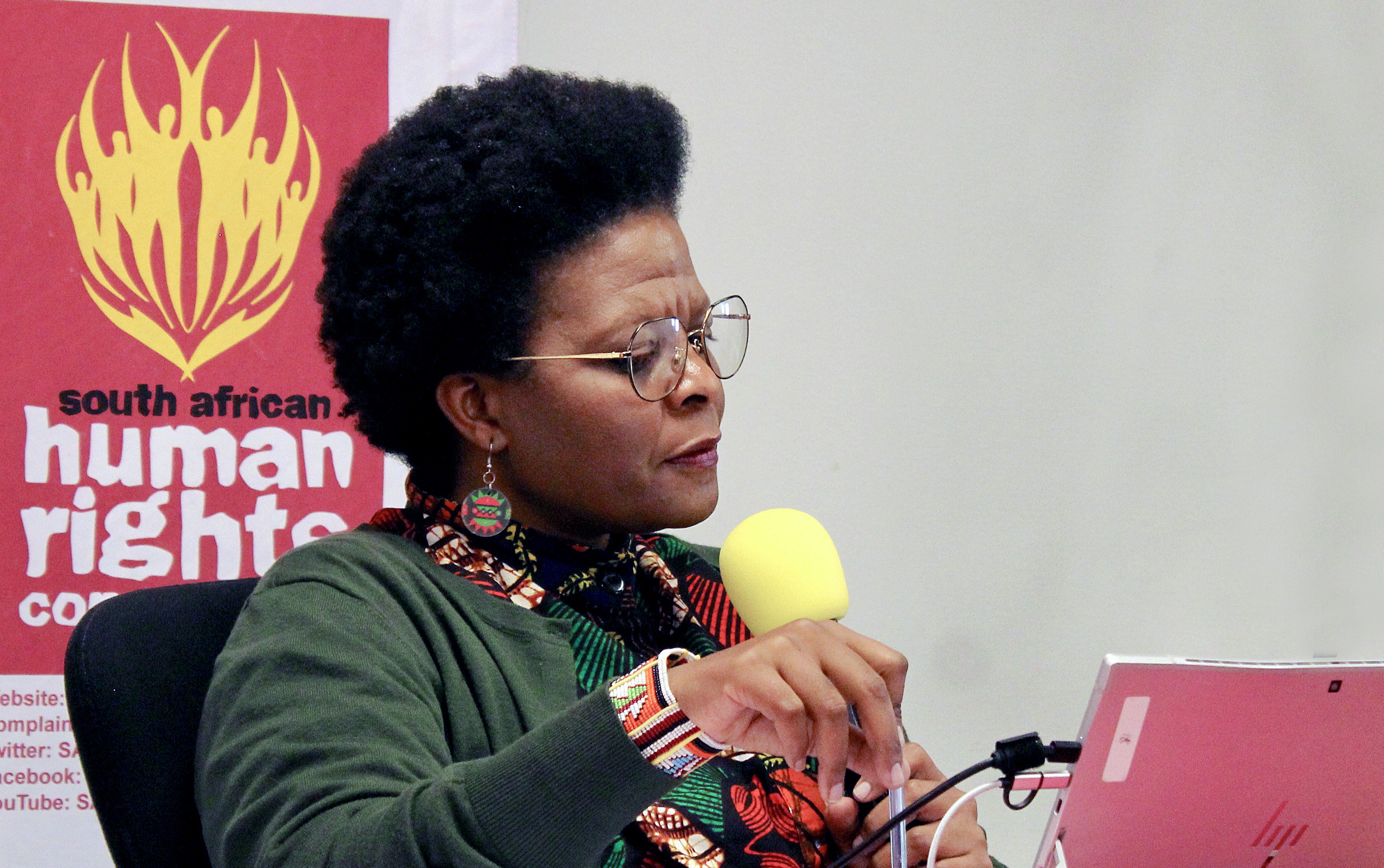
 Commissioner Philile Ntuli questions AgriSA on the importance of transformation within the agricultural sector post-1994. (Photo: Lillian Roberts)
On Wednesday 8 July, the South African Human Rights Commission (SAHRC) noted that both the newly appointed Minister of Forestry, Fisheries and the Environment David Maynier and Blade Nzimande, Minister of Science, Technology and Innovation, were unable to attend the second leg of the SAHRC inquiry into food systems
Food manufacturing company, Premier Foods, and Pioneer Foods, a packaged goods company and subsidiary of PepsiCo, both declined to make submissions.
Advocate Gishatha Singh appeared on behalf of Massmart, the majority-owned US multinational corporation, while Walmart CEO Miles van Rensburg had agreed to appear in person, after communication between Van Rensburg and his US counterparts, Singh said “internal approval” and “alignment across the business” was needed prior to the CEO appearing.
/file/attachments/orphans/PublicaffairsscienceandsustainabilitymanagerHloniMajoroandParushaPillaywhoservesastheB-BBEEManagerandGovernmentAffairsSpecialistforBayer_168511.jpg "Public affairs science and sustainability manager, Hloni Majoro, and Parusha Pillay, who serves as the B-BBEE Manager and Government Affairs Specialist for Bayer, submit limited clarifications on the written submission at the SAHRC inquiry into food systems. (Photo: Lillian Roberts)")
“Food security is a complex challenge that cannot be solved by any single actor,” said Hloni Majoro, public affairs science and sustainability manager at Bayer, during opening statements.
Evidence leader Professor StephenDevereux questioned the company about highly hazardous pesticides in their portfolio, such as the neonicotinoids pesticides, which harm pollinators of fruits and vegetables.
Majoro and Pillay asked to supplement with additional submissions.
Commissioner Philile Ntuli said that staff members who are not part of the executive and who are unhelpful are a “waste of the commission’s time” and said she seeks a “constructive engagement with the executives of Bayer”.
When Ntuli asked what they are allowed to communicate to the public, Pillay said “it is curated information that we are allowed to share”.
Farmers’ organisation
AgriSA operates as a “grassroots” farmers’ organisation, with individual farmers as members, CEO Johann Kotzé told the commission, explaining that they have 23 commodities produced and 53 corporates in South Africa as members.
He said their reason for existence is food security, and that they do attempt policy influence and lobbying.
/file/attachments/orphans/CEOofAgriSAJohannKotzAwithJanseRabietheLegalandPolicyExecutivewhoadmitsthereisatensionbetweenproducersandretailphoto_LillianRoberts_524097.jpg "CEO of AgriSA, Johann Kotzé, with Janse Rabie, the Legal and Policy Executive of AgriSA. (Photo: Lillian Roberts)")
Evidence leader Professor Hettie Schönfeldt questioned why they are not progressive in their thinking around the Health Promotion Levy (HPL), when sugar is driving the obesity curve.
Janse Rabie, the Legal and Policy Executive at AgriSA, responded that they cannot dictate consumer preferences, although they take dietary diversity seriously. He said they have seen the impact of the levy on farmers, saying it “costs the industry upwards of R1-billion a year”.
Kotzé spoke passionately about the Good Samaritan legislation they are lobbying for, where primary producers would be legally protected when donating cosmetically imperfect surplus crops.
Devereux pressed AgriSA for clarification on their membership numbers, specifically demographics and distinctions between small-scale and commercial farmers.
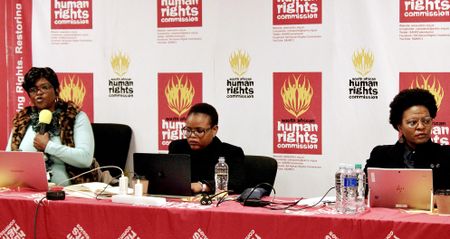
The apartheid government supported agriculture through capital, infrastructure, marketing, and land dispossession of South Africans, Commissioner Ntuli said. It is not a “question of a business, but a question of history” where the government “provided support to a minority at the expense of the majority”, she added.
“I don’t measure a farmer by being black or white or female or male,” Kotzé had said earlier.
Ntuli quoted this back at him, adding that it is not an attack on him as an individual but that they are interested in AgriSA, to which Kotzé replied that they will do their utmost to get the SAHRC their demographic data.
CropLife questioned
CropLife South Africa presented at the SAHRC on Thursday, 9 July, on its role as a not-for-profit industry association representing almost 200 companies involved in agricultural remedies, such as pesticides.
CEO Rodney Bell clarified that they promote responsible stewardship and training farmworkers on the use of pesticides and knowing their rights. Its membership categories include suppliers, distributors, and associate members.
When Deveraux questioned the use of highly hazardous pesticides in South Africa, despite their ban in Europe, Bell said they supported phased removal, based on scientific evidence.
/file/attachments/orphans/B4727143-B020-4D5E-A74E-54E3D38E384A_484917.jpeg "CEO of CropLife, Rod Bell, with advocacy and communications manager Elriza Theron, admitted that highly hazardous pesticides are inherently harmful. (Photo:Lillian Roberts)")
Bell’s personal view was that it will be difficult to feed the entire population overnight without sufficient plant protection.
Deveraux asked about the extent of CropLife’s relationship with the department of agriculture and whether they engage in lobbying for pesticides.
Bell said they have “no mandate to defend an individual active ingredient or product” and that their mandate is to interact with the government on the rules that impact the entire industry.
Meals for 9.8 million children
Siviwe Gwarube, minister of the Department of Basic Education (DBE), made a submission on Thursday regarding the National School Nutrition Programme (NSNP), which provides meals for 9.8 million children at 20,504 schools.
Muzi Ndlovu, Chief Directorate for Care and Support in Schools at South Africa’s national DBE, explained that a programme at this scale is not without challenges – funding, food inflation, food safety and uneven menus across provinces.
Gwarube said the department is piloting an early childhood development (ECD) programme, acknowledging that stunting has lifelong consequences. In a “constrained” financial environment, she said the focus is on the two to three-year-olds in the ECD centres, and is “obsessed about capturing all 7 million children” to make sure they are in a structured centre, with safe infrastructure, and qualified practitioners looking after them.
Gwarube indicated that they are working on food gardens and introducing small-scale food producers in order to bring down the costs.
There being 800 food gardens managed by DBE out of the 20,504 schools is “inadequate” Ntuli said, adding that the SAHRC is willing to assist the DBE in strengthening those programmes and making meaningful interventions in hunger.
Chairperson of the commission, Sandra Moshoaka, said that AgriSA has already talked about donating surplus food, and asked how the DBE could access AgriSA.
/file/attachments/orphans/ChairpersonoftheSAHRCcommissionSandraMakoashaleadstheinquiryintothefoodsystemsinSouthAfrica_899066.jpg "Chairperson of the SAHRC commission, Sandra Makoasha, leads the inquiry into the food systems in South Africa. (Photo: Lillian Roberts)")
The DBE will put a proposal for strengthening implementation and delivery of the NSNP before Cabinet, and they are hoping it will be approved before the end of the year, so implementation can begin in 2027, Gwarube said.
“With regards to the reform, one of the things that I indicated when I came into office was that we really need to make sure that we get value for money – and that, particularly, the thing that really exercises me – is how do we prevent inefficiencies in the delivery of food and the spending of public money?” Gwarube told Daily Maverick after her submission.
“Because in a fiscally constrained environment, we can’t have a scenario where food is not reaching children or money goes missing, and so it’s important that we design a full-reformed school nutrition programme that centres the learner in its delivery.”
Department of Health on malnutrition
The deputy director-general in the National Department of Health, Nicholas Crisp, outlined the key drivers of malnutrition on 9 July as poverty and inequality, household food insecurity, rising food prices, lower-cost foods of poor nutritional quality, and commercial determinants of health – the way food is “marketed, packaged, presented, distributed, and so on, has a direct bearing on health”.
He added that limited nutrition literacy and knowledge, inadequate access to safe water and sanitation and climate change are additional drivers.
“‘We see more non-communicable diseases than we’ve ever seen before… they are taking over from communicable diseases we’ve seen in the past,” Crisp said.
/file/attachments/orphans/MinisterofHealthAaronAaronMotsoalediandDeputydirector-generalintheNationalDepartmentofHealthNicholasCrisppresentontheregulationsthathaveimprovedpublichealthrelatingtonon-communicabledi_469015.jpg "Minister of Health, Aaron Aaron Motsoaledi, and Deputy Director-General in the National Department of Health, Nicholas Crisp, present on the regulations that have improved public health relating to non-communicable diseases through regulations such as the health promotion levy. (Photo: Lillian Roberts)")
Minister of Health Aaron Motsoaledi pointed to nutrients of concern such as salt, sugar and fat.
“Dealing with commercial determinants of health will greatly help us,” Motsoaledi said. He explained that the commercial industry is strong, with significant lobbying efforts and advertising.
“The state is struggling to keep up... when you want to regulate, they just say ‘you are becoming a nanny state, you can’t control us, all you must do is to educate the public’. In other words, you are saying, ‘allow me to poison the public, but educate them about my poison.’”
Retail protest
On Friday, 10 July, the last day of the hearings, when all major retailers – Shoprite, Pick n Pay, Spar, Food Lovers Market, and Woolworths – were notably absent, protestors gathered outside.
About a hundred protestors from Union Against Hunger (UAH), the Healthy Living Alliance (Heala), Amandla.Mobi, the Food and Allied Workers Union (Fawu) and Abahlali baseMjondolo were locked outside the gates – despite it being a public hearing – while chairperson Makoasha and fellow commissioners halted proceedings until some representatives could gain access.
Spar requested a three-month indulgence, Makoasha said, as the proceedings began.
/file/attachments/orphans/ActivistslockedoutofthepublichearingsoftheSAHRCwhileChairpersonofthecommissionSandraMakoashaworkstogetthemaccessintothehearingsonthenationalfoodsystemofSouthAfricaphoto_Lillian_220694.jpg "Activists locked out of public hearings of the SAHRC, while chairperson of the commission, Sandra Makoasha, works to get them access to the hearings on the national food system of South Africa. (Photo: Lillian Roberts)")
Shoprite reiterated throughout their written statement, read by evidence leader Stephen Devereux, that the R5 meals which it sells are a beacon of affordability, to which activists had signs in response: “R5 meals are not practical for families”. This was echoed again, after the proceedings, by Abahlali BaseMjondolo representative and chairperson of the women’s wing, Melita Ngcobo, to Daily Maverick.
In their 31-page submission, Shoprite said they have a R9-billion rand trust for employees, which increased black ownership in Shoprite to 19.2%. Their market share ranges from 24-34%. They invest in community programmes, providing 222,349 meals daily, supporting 33 mobile soup kitchens and community gardens.
In lieu of Shoprite receiving the UAH memorandum, national coordinator Esther Padi read it and gave it to the SAHRC commissioners.
“The commission will announce in due course the decision we may take against those [absent] stakeholders, including the retailers you have mentioned,” said chairperson Makoasha, upon receiving the memorandum. She thanked all who participated and said it is not the end of the inquiry.
“We cannot end when children are still hungry, when 14 million of us go to bed hungry, and 1,000 children died last year of malnutrition. The issue of food demands government, civil society, the South African Human Rights Commission at the centre, as well as businesses.
“Children do not eat policies, children do not eat promises.” DM
Comments
Scroll down to load comments...