




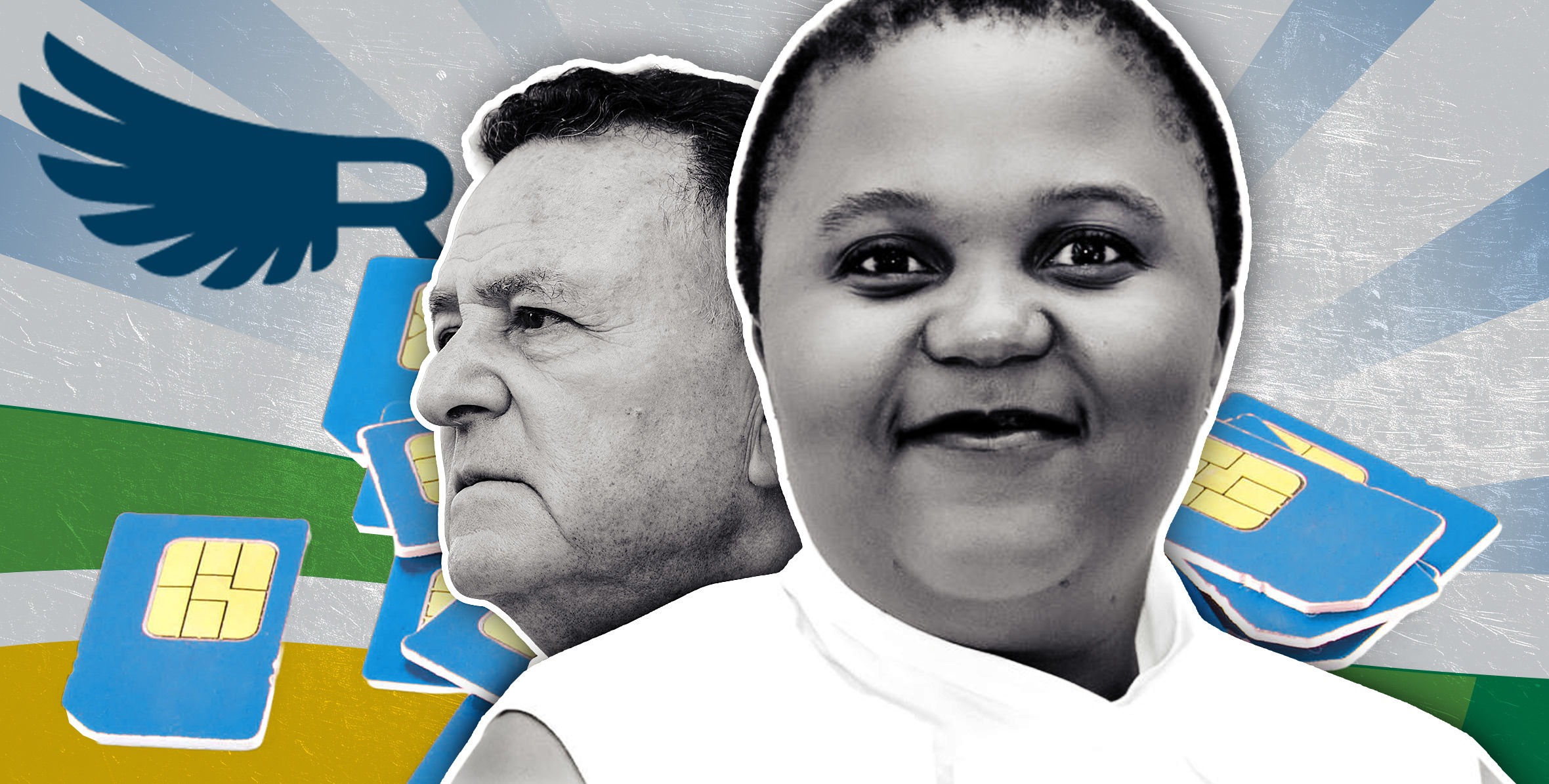
 Illustrative image: Tony Leon. (Photo: Gallo Images / Die Burger / Jaco Marais) | Kabelo Kgobisa-Ngcaba. (Photo: Supplied) | SIM cards. (Photo: iStock)
The month before she walked into Parliament as a DA MP in June 2024, Kabelo Kgobisa-Ngcaba was still the chief operations officer (COO) for Resolve Communications — the PR and lobbying firm founded by former DA leader Tony Leon, which now stands accused of trading on its proximity to the party to secure private meetings between its clients and DA GNU ministers and MPs.
Kgobisa-Ngcaba has confirmed to Daily Maverick that she left Resolve in May 2024, just before being sworn in as a DA MP in June 2024.
Daily Maverick’s investigation suggests that since taking her seat, Kgobisa-Ngcaba has used her position to pursue a narrow, technical cause with persistence: the tightening of South Africa’s SIM card registration law.
Although the problem of unregistered or irregularly registered SIM cards is increasingly recognised as helping facilitate certain forms of crime in South Africa, this is not an issue which has appeared anywhere in DA public policy to date.
Kgobisa-Ngcaba has tabled nine parliamentary questions on the subject across two ministerial portfolios, has written at least one opinion piece pushing for reform in this area and has given interviews proposing specific remedies.
Those remedies include the introduction of mandatory tamper-proof SIM card packaging: precisely what two Resolve clients in the SIM card packaging business were campaigning for at the same time.
In relation to the concerns raised about the relationship between Resolve Communications and the DA over the past fortnight, News24 reported DA federal council chairperson Ashor Sarupen as saying that no evidence had been presented that “any [DA] party process or public office was used to advance private commercial interests”.
The overlap between the nature of Kgobisa-Ngcaba’s engagement on this issue and the interests of two of Resolve’s clients may complicate Sarupen’s claim.
From the Resolve boardroom to the DA benches
Resolve Communications – launched by Leon in 2013 and operationally headed by former DA CEO Paul Boughey – has been in the spotlight since 28 June, when then agriculture minister John Steenhuisen claimed in an interview with News24 that Resolve had used its closeness to senior DA figures to arrange meetings between DA ministers and the firm’s private clients to push policies to benefit these clients.
Former DA Environment Minister Dion George subsequently corroborated Steenhuisen’s claim, while current DA Communications Minister Solly Malatsi wrote in a letter to Parliament’s communications committee that Resolve had approached him twice on behalf of clients since he took office, with the first such approach leading to a meeting relevant to this investigation.
Former DA MP Phumzile Van Damme, meanwhile, posted on X that Resolve’s attempts to lean on DA representatives on behalf of clients pre-dated the GNU and extended beyond ministers to MPs. Van Damme credited party veterans Helen Zille and James Selfe for intervening to stop the then junior MP from being “bullied” by Resolve staffers who pressured her to stop publicly criticising a Resolve client.
News24 subsequently reported on an email it had obtained which showed Resolve account manager Loftus Marais explicitly offering to draft parliamentary questions for DA MP Tony Chance on the topic of electric steel production.
Resolve itself has strenuously denied that any of its practices are improper, maintaining that such lobbying is standard practice internationally.
Sceptics have pointed out, however, that a notable difference is that South Africa does not have any laws or regulations to disclose and police this kind of lobbying. Most advanced democracies do – not because lobbying is automatically corrupt, but because undisclosed influence over politicians and their platforms can give rise to a situation where corruption, policy capture and public distrust can flourish.
The case of Kabelo-Ngcaba is different from the allegations made public thus far in one major respect: her transfer straight from the Resolve boardroom, where she had spent five years dealing with the issues of Resolve’s clients, to the DA parliamentary benches.
On 7 March 2024, the DA lodged its final candidate lists with the Electoral Commission. Half the National Assembly’s 400 seats are filled from parties’ regional lists, and Kgobisa-Ngcaba’s high-ranking placement at number five on the DA’s Western Cape list meant that she was guaranteed a parliamentary seat.
At the point when the DA’s list was lodged, Kgobisa-Ngcaba was Resolve’s COO, with the DA’s initial vetting and screening of candidates having kicked off in earnest in June 2023. Kgobisa-Ngcaba’s position at Resolve, in other words, would have been known to the DA throughout the period of the party’s selection process.
Daily Maverick asked DA parliamentary caucus leader George Michalakis whether any internal party policy existed enforcing a cooldown period between employment as a lobbyist and service as a DA MP.
Michalakis did not give direct responses to any of the five questions asked by Daily Maverick. On this point, he responded only: “Ms Kgobisa-Ngcaba went through our selection process, like all MPs, to become a member of Parliament”.
Resolve, meanwhile, claimed to Daily Maverick: “Ms Kgobisa-Ngcaba left the company more than two-and-a-half years ago to take up a seat in Parliament”.
This is an overstatement of the distance between Resolve and its former COO by around four months.
The Rica argument Parliament had already heard
Seven months before Kgobisa-Ngcaba entered Parliament, the case she would go on to build had already been made to it – and had gone nowhere.
In October 2023, the portfolio committee on justice and constitutional development – to which Kgobisa-Ngcaba would initially be deployed by the DA as an MP – heard six public submissions on the Regulation of Interception of Communications and Provision of Communication-Related Information Amendment (Rica) Bill.
Rica is the law that makes it mandatory for all SIM cards in South Africa to be registered to the owner’s personal details, in order to help combat crime, and the proposed amendments to the Bill were aimed at balancing this need with privacy and surveillance concerns.
Five of the public submissions were by individuals and organisations with concerns about the use of Rica for unlawful surveillance, particularly of journalists. One was an outlier.
It was by a company called Premium Ideas SA (Pisa), which described itself as “South Africa’s largest specialised telecommunications SIM card fulfilment house”, offering “SIM card packaging and logistics services”.
Pisa’s submission laid out a specific problem: the “proliferation of unpackaged, duplicated and/or pre-Rica’d SIM cards”.
Its solution: “Legislation should specify the minimum standards for [SIM card] packaging”, to prevent the SIM cards being tampered with before sale.
A core aspect of Pisa’s business happens to be the mass packaging of SIM cards, making the company’s commercial interest in this measure becoming a legislative requirement quite obvious.
The Department of Justice noted Pisa’s submission, but set it aside “for consideration during the comprehensive review of Rica”.
Whether Pisa was Resolve’s client at this point is unclear.
Resolve, despite having described itself in a 29 June press statement as “comfortable with scrutiny”, would not provide answers to 10 specific questions sent by Daily Maverick, opting instead to respond with a general comment which did not touch in any way on at least seven of the questions.
What is established, however, is that by November 2024, Pisa was Resolve’s client.
This was publicly confirmed by the DA’s Communications Minister Solly Malatsi in his letter to Parliament’s communications committee, in which he wrote that Resolve first approached him on behalf of Pisa on 1 November 2024 and that a meeting between his office and Pisa subsequently took place on 18 November 2024.
“The purpose of the meeting was to hear and understand Pisa’s concerns regarding Rica non-compliance, particularly in the mass distribution of improperly registered SIM-cards,” Malatsi wrote.
He added that he had also had a personal phone call with Resolve’s CEO Paul Boughey on the Pisa matter, which may suggest that Resolve was treating Pisa as a client of some significance by this point.
A pattern of parliamentary questions
In September 2024, around four months into her term as an MP, Kgobisa-Ngcaba would begin a pattern of parliamentary questioning devoted to the Rica issue.
Her first question on the matter was recorded on Parliament’s internal question paper dated 5 September 2024, and was directed to the Minister of Justice. One element of Kgobisa-Ngcaba’s question was a request for the “full details” of all individuals on the task team responsible for considering the Rica Amendment Bill.
On 2 November 2024, one day after Resolve had first approached Malatsi’s office on Pisa’s behalf, Kgobisa-Ngcaba published an op-ed in News24 headlined: “10 years without justice: The Senzo Meyiwa case and the urgent need for Rica reform”.
The piece used the anniversary of the murder of the soccer player, and a claim that a suspect’s phone was not registered to him, to argue that Rica was in urgent need of reform and enforcement.
Distributors should be stopped from pre-registering SIM cards, Kgobisa-Ngcaba wrote: an issue that had also been highlighted as a Rica weakness by Pisa in its parliamentary submission a year before.
“Third parties use generic details to register large numbers of SIM cards,” Pisa had complained.
“Third-party distributors mass [register] Rica thousands [of SIM cards] at one time,” Kgobisa-Ngcaba wrote.
The DA MP did not, at this point, suggest amending SIM card packaging as a remedy.
She focused on measures aimed at stricter SIM card buyer identity checks, calling for ID-verified registration or the use of biometrics, citing regulations in Nigeria, the UAE, the Philippines and Sweden.
Three months later, a company called Securi-Tech – another Resolve client – would issue a statement calling for Rica reform to “prevent mass SIM card registration by third-party providers”.
Securi-Tech, another company which offers SIM card packaging and security services, proposed that South Africa should look to countries like Nigeria, the UAE, the Philippines and Sweden for inspiration on the introduction of measures including biometric verification.
When Daily Maverick explored the company records for Securi-Tech and Pisa, we discovered that although Securi-Tech and Pisa are registered as two separate companies and have separate websites and premises, all four active Securi-Tech directors are also Pisa directors, and the two companies share the same registered address.
The two companies have separately lobbied Parliament on the same Rica issue: Pisa through its submission on the Rica Amendment Bill in October 2023, while Securi-Tech announced in February 2025 that it would be “formally writing to the chairperson of the parliamentary portfolio committee on justice, Xola Nqola” on the matter.
Could this double-lobbying by linked companies, apparently without disclosing the relationship, give rise to the impression that there was wider support within the industry for the specific proposal of tamper-proof packaging than is warranted?
Pisa’s Mohamed Hassim told Daily Maverick: “Pisa and Securi-Tech are separate legal entities, operating in different solution sets, but both form part of the same common group structure. Sister companies within a group making related submissions to Parliament is not unusual, particularly where, as is the case here, the entities share a common and genuine concern about an issue of national importance”.
Hassim, who communicated with Daily Maverick from a Pisa email address, is the Pisa executive recorded by Malatsi as attending the meeting with the Communication Minister’s office in November 2024. As of October 2025, he was also described in news reporting as the Chief Information Officer of Securi-Tech.
The move from the Justice committee
On 29 November 2024, Kgobisa-Ngcaba’s fourth question to the Justice Minister was published on the Rica issue, her most precise yet: had any telecommunications provider ever been convicted for contravening section 40 of Rica, the provision governing SIM card registration?
By the time Kgobisa-Ngcaba posed this question, she had not been a member of Parliament’s justice committee for almost three months.
On 4 September 2024, parliamentary records show that she moved to the correctional services committee, where she became – and remains – the DA’s deputy spokesperson on prison-related matters.
The Rica legislation and reform issues with which Kgobisa-Ngcaba was seized had far less relevance to her new portfolio: they fell squarely within Justice, and in terms of enforcement, within Police.
The fact that Kgobisa-Ngcaba would pose Rica-related questions to the Minister of Justice – and subsequently the Minister of Police – for more than six months after moving away from the justice portfolio is not in itself improper in any way: MPs are permitted to pose questions on any matter.
That makes it all the more surprising that Kgobisa-Ngcaba claimed to Daily Maverick this week, in defence of her pattern of questioning: “At the time the questions were posed, this issue fell within the scope of my portfolio, which was Justice and Constitutional Development”.
That would appear to be contradicted by the recorded timeline of her questioning.
The dates of her inquiries recorded on Parliament’s internal question papers suggest that all nine of her Rica questions were tabled after she left the committee that made it her brief. Just one – her first question on Rica, published one day after she left the justice committee – looks likely to have been submitted by Kgobisa-Ngcaba while still a sitting member of the committee.
In November 2024, she posed three more such questions to the Minister of Police, with the first two aimed at establishing the effectiveness of Rica as a criminal detection and prosecution tool in its current form.
The third asked: “What percentage of extortion, kidnapping, murder, robbery and cash-in-transit cases involved unregistered SIM cards?”
Then Police Minister Senzo Mchunu eventually provided the relevant figures on 6 January 2025: in extortion cases, 61.82% involved unregistered SIM cards.
But for kidnapping, murder, robbery and cash-in-transit, that figure was 0% – an unhelpful statistic for anyone seeking to build a case around unregistered SIM cards as a major criminal weapon.
Kgobisa-Ngcaba did not let the matter go, subsequently asking a follow-up question on 20 March 2025, suggesting that the 0% figure reflected a failure to capture data on this, rather than an accurate finding.
But Mchunu stuck to his guns: the figure, he replied, “demonstrates that there was no involvement of unregistered SIM cards in the commission of such crime”.
A Securi-Tech statement highlighting the extortion statistic released by Resolve on 12 February 2025, prior to Kgobisa-Ngcaba submitting her follow-up question, used the same sceptical framing as the MP would adopt in her follow-up when it came to the other crime categories: “There is currently a lack of data on the extent to which unregistered SIM cards are used in other serious crimes such as the planning of kidnapping and murder”.
A month-old statistic, suddenly everywhere
The week of 12 February 2025 saw a flurry of media coverage devoted to the Rica issue, all of which was focused on the statistic extracted by Kgobisa-Ngcaba from Mchunu, that 61.82% of extortion cases involved an unregistered SIM card. Given the fact that Mchunu’s written response had been delivered more than a month earlier, the sudden explosion of coverage highlighting the extortion figure at this point is strong evidence of a concerted communications campaign.
At least three such news pieces – published on the Citizen, IOL and TechCentral within a two-day period – would feature original comment from Kgobisa-Ngcaba paired with references to a statement from Securi-Tech released the same week.
Resolve did not answer a question posed by Daily Maverick as to whether it had ever offered a journalist an interview with Kgobisa-Ngcaba on the Rica issue.
The components of all three articles were, however, remarkably consistent: leading with the answer given to Kgobisa-Ngcaba by Mchunu in Parliament, moving to personal comment from Kgobisa-Ngcaba stressing the need for Rica reform, and quoting from the Securi-Tech statement released in the same week.
One intriguing detail is worth noting: both the Citizen and the TechCentral articles specify, in identical wording, that the statistic from Mchunu was given in response to a parliamentary question posed by Kgobisa-Ngcaba “in her previous role as a member of the portfolio committee on justice & constitutional development”.
This arguably unnecessary detail appears to be false. Kgobisa-Ngcaba’s question first appeared in Parliament’s Internal Question Paper on 1 November 2024. Parliament’s records contain no indication that it had been tabled earlier or carried over from a previous question paper or after a parliamentary recess. This would mean that the question was posed some two months after Kgobisa-Ngcaba left the justice committee.
The stand-out focus of the comment given by Kgobisa-Ngcaba to two of the three outlets was her very specific proposed solution to combat the issue of unregistered or pre-registered SIM cards: introduce mandatory tamper-proof packaging.
She told the Citizen: “We need to bring back secure, tamper-proof packaging just to simply introduce hurdles and make it harder to pre-register the SIM cards”.
TechCentral reported: “A solution, said Kgobisa-Ngcaba, is to mandate that the ‘flimsy’ packaging used for SIM cards by the mobile operators be made of much thicker plastic that can only be opened with a pair of scissors”.
This happened to match the exact remedy proposed by Securi-Tech in the statement quoted in the same articles: “Tamper-proof packaging and biometric verification are practical solutions that can make a real difference in curbing this crisis”.
It was the same measure that Pisa had tried to convince Parliament in October 2023 should be written into law.
TechCentral included a passing disclaimer: Securi-Tech, it reported, was a company “with whom Kgobisa-Ngcaba has previously worked (but with whom she is no longer associated)”.
Resolve did not answer Daily Maverick’s question as to the accounts on which Kgobisa-Ngcaba had worked during her time at Resolve, but the general comment Resolve supplied included the description of Kgobisa-Ngcaba as someone “with some past knowledge of the import of this [Rica] issue” – without specifying the source of this knowledge.
The denial that disappeared
DA Chief Whip Michalakis told Daily Maverick that MPs routinely received “representations and suggested lines of inquiry” from stakeholders including public affairs firms.
“At no point are we aware that Ms Kgobisa-Ngcaba received any inappropriate benefits from any lobby group,” Michalakis said – a suggestion which Daily Maverick had not put to him.
Resolve, for its part, told Daily Maverick that the firm “did not play a role in Ms Kgobisa-Ngcaba’s use of parliamentary questions directed at highlighting a major enabler of crime, fraud, and corruption in South Africa”.
Kgobisa-Ngcaba maintains that her line of enquiry on Rica was “a vital security matter in the public interest”.
The MP’s short statement to Daily Maverick once again made the case for addressing the weaknesses in the Rica framework by introducing mandatory packaging requirements.
“South Africa has tens of millions of inadequately packaged SIM cards flooding the market every year. This allows bad actors to remove, Rica, and repackage the SIM cards prior to any sale,” Kgobisa-Ngcaba wrote.
Daily Maverick’s research suggests that this particular remedy is absent from the international best practice recommendations for enhancing SIM security, including those of the Global System for Mobile Communications Association, which spans 220 countries and territories worldwide – including those with a similar SIM card-related security problem to South Africa’s.
The first statement Kgobisa-Ngcaba sent to Daily Maverick in response to questions ended with a denial of any wrongdoing. A subsequent statement she sent to replace the first one was identical in all respects but one: the denial of wrongdoing had been removed. DM
Comments
Scroll down to load comments...