




 Capitec CEO Graham Lee was interviewed by Koshiek Karan at the bank’s BizTalks event in the Cape Town CBD. Unfortunately, the logo of the biggest bank in the business space (Standard Bank) also made an appearance. (Photo: Lindsey Schutters)
A hazard of the Daily Maverick job is that the articles that this method of reporting produces can be read as different things by the different departments within an organisation. The guys on the tech side of the banking juggernaut Jannie Mouton built in the Stellenbosch foothills loved the Sherlocking characterisation in a previous article.
The marketing department, however, didn’t see it as a compliment. So the writer responsible for the former article was closely handled and watched when attending the #BizTalks session which was a coming-out party for Capitec’s business ambitions.

Despite all the crowing about becoming the biggest bank in the land by the merits of its R407-billion market value, the 60% share price surge in 2025, and the client base of 25 million individuals, it seems that the business space is Capitec’s new white whale.
In its FY26 reporting, business banking contributed 5% of Capitec earnings (about R840-million), with its division-specific headline earnings growing by 20%.
If you reverse the maths, it implies that in FY25, business banking contributed about R700-million to headline earnings, representing a steady, managed growth trajectory from a smaller base – and an easy target on which to lean the full weight of Capitec’s disruptive innovations.
The fastest follower
When Daily Maverick asked CEO Graham Lee how Capitec was planning to avoid the trappings of its own success, like the perennial payday outage memes that plagued its services in the personal and private banking space, he was quite candid in his response:
“We were stupid enough to make those mistakes, but not stupid enough to not learn from them.”
On stage, to the audience of potential and current business customers, Lee sang a more confident tune. “Our whole business is built to scale,” he explained.
“It’s built to have scale now but beyond that to scale further into the future. So let’s [take] an example from a systems perspective: We can 10x tomorrow what our current system bodies are. We design that deliberately.”
How that translates to the massive balance sheet wins is simple data arithmetic (obvious to those who have been watching the bank’s moves).
/file/dailymaverick/wp-content/uploads/2025/10/Graham-Lee-07-1.jpg "Capitec CEO Graham Lee. (Photo: Capitec)")
By using that scale to drive down unit costs, Capitec can pass savings back to clients through lower fees, which creates a flywheel that attracts more clients and further amplifies scale economies.
The more clients Capitec wins, the more data it gathers. This deeper view of the South African economy allows the bank to deliver deeper business insights, marketing tools and precise credit scoring back to its clients.
It’s also not of small consequence that the market Capitec is now chasing share in is the hottest one in all of banking. The primary competitive focus for South African major banks has shifted towards medium-sized companies (with annual revenues of R100-million to R1.5-billion).
/file/attachments/orphans/IMG_20260709_193519_488731.jpg "While Capitec may rule the roost by customer metrics, a view of the Cape Town CBD skyline is still illuminated by the other big banks. (Photo: Lindsey Schutters)")
Bank executives target this segment because these businesses are cash-rich, fast-growing, and generate highly attractive returns on equity (ROE) well in excess of 30%, nearly double the returns of highly volatile retail portfolios.
For the Stellenbosch outfit in FY25, Business Banking recorded an exceptionally low annualised credit loss ratio of 1.7% (the number of loans a lender expects to – or did – write off).
While this ratio ticked up to 2.4% in FY26, it remains highly conservative and remarkably safe when contrasted against the Personal Banking credit loss ratio (8.1% in FY25 and 8.2% in FY26).
Playing with the big boys now
On the acquisition side, active business clients grew 71% to 456,000 in FY26, with active business app users rising 65% to 172,000.
In December 2025, the bank launched the zero-monthly-fee Entrepreneur Account to capture sole proprietors, rapidly onboarding 78,000 informal businesses by February 2026.
Standard Bank is the biggest fish in the pond, holding a dominant 28% share of South Africa’s mid-corporate market. Standard Bank’s Business and Commercial Banking (BCB) division is targeting deposits of more than R725-billion by 2028 (up from R514-billion in 2025) and expects to capture a significant portion of Africa’s R150-billion mid-corporate revenue pool.
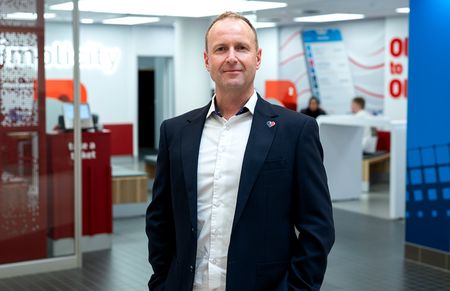
Lee, of course, chose to concentrate not on the obvious incentives of chasing this market, but rather on presenting Capitec’s competitive advantage.
“Business banking for us wasn’t a step forward in chasing the market, it was obvious that businesses needed what our personal bank clients already have, which is simplicity that core banking can be delivered at scale with just the accessibility that is needed, the simplicity that’s needed, the affordability clearly which is needed and the personal service which means understanding their circumstances.”
Capitec is unwilling to share a specific target it has in mind to mark as success in its latest effort, and that also made it difficult to pin Lee down on the exact technical measures that they have put in place to make their business banking dreams an undisrupted reality.
But he did share the lessons in response to Daily Maverick’s probing:
“Let’s call it the transaction economics of every single transaction going through your systems. We made sure we understood that... to a very, very detailed level and then we are continuing to invest in staying ahead… not just narrowly ahead but far ahead of our volumes in terms of infrastructure, in terms of people, in terms of redundancy of systems, and so we are in a completely different place.”
With under 2% of the business banking market currently on its books, Capitec can afford to stretch itself a little to take on more low-risk credit sign-ups. But it can’t afford to burn new businesses with monthly outages or any of the other disruptions that were easy to paper over with clever marketing while it was scaling personal banking customers.
These are the businesses that it must commit to help grow. DM
Comments
Scroll down to load comments...