



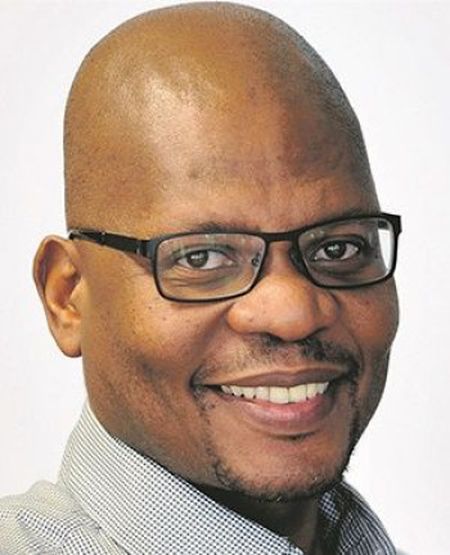
 Mondli Makhanya (Illustrative image: Bernard Kotze using Figma | ChatGPTimage2)
 It was the state of emergency that South Africa’s local government system has long needed. An ice-cold bucket of water that a family matriarch throws at a hungover husband or son to force them to wake up and go to work. Or the harsh corporal punishment that schools meted out in the bad old days (some would say the good old days) to bring into line some errant students. (As an aside, is it just not ironic that many of us who went through that corporal punishment era speak so nostalgically about how it made us better adults while also extolling the Constitutional Court’s decision to outlaw the violent punishment of minors. This lowly newspaperman is one of them, he admits shamefully.)
This week, National Treasury announced that it was administering that cold shower and disciplinary cane to South Africa’s local government system when it announced that it was withholding billions in equitable share transfers to 69 municipalities, which include several metros. Treasury said the move was meant “to instil fiscal discipline and ensure that public money is properly managed; that unauthorised, irregular, fruitless and wasteful expenditure is addressed and that municipal officials and office bearers are held accountable where required by law”.
It said that the “municipalities have been given sufficient notice in writing and urged to take measures to change their financial management positions ahead of the withholding of funds. They were also given a platform to send, in writing, reasons why their funds should not be withheld.”
Furthermore, this mismanagement of the municipalities was also affecting the health of institutions beyond themselves. “... It is also threatening the financial sustainability of bulk suppliers (water boards and Eskom). In addition, failure to pay third parties negatively impacts on the ability of statutory bodies to continue operating optimally,” Treasury said.
This week’s action was a long-overdue rebuke for municipalities which have long been chastised by the Auditor-General and other arms of government but have remained stubbornly delinquent. One of them, the great big City of Johannesburg, was recently warned by Finance Minister Enoch Godongwana that it was in financial dire straits. The mayor of Johannesburg laughably argues that there is no crisis in his city, much to the astonishment of the citizens.
To truly understand the plight of municipalities you have to look at the management teams appointed by the political authorities. They fall into different categories: competent but malleable, incompetent but politically convenient and competent but politically impossible to manage. The first two survive well in the system and even thrive – but thrive for their own purposes. Because they are there to serve their political masters and their own needs, the institution that is supposed to serve and the people who are meant to benefit from it suffer. Those who belong in the last category get bullied, marginalised and eventually pushed out or go in search of greener pastures.
A person who belonged in the last category was one Lindiwe Msengana-Ndlela. Highly qualified, she was a veteran public servant who had served with distinction in various government roles. So when she was appointed city manager of the failing Nelson Mandela Bay municipality the move was hailed as a major step towards rescuing the metro, which is the Eastern Cape’s economic hub. Her arrival was met with applause from the then dominant ANC, the opposition DA and smaller parties, the private sector and civil society organisations. All accepted that she was not going to be a messiah, but having a highly effective head of the city’s administrative arm was a big step.
Msengana-Ndlela did not disappoint. She quickly moved to fix systems, introduce a culture of accountability and insulate the administration from political interference. That is when the applause from the ANC began to fade, then die down and subsequently turn to hostility. This silly woman’s big sin was to stand in the way of big deals that were favoured by the ANC’s bigwigs in the city and the province. She dared to think that corruption was terrible and even felt it was okay to act in accordance with the prescripts of the law. As well as standing in the way of large contracts she also resisted attempts to appoint wrong people into the administration and rejected the hiring of 16 uMkhonto weSizwe (MK) veterans as bodyguards to the mayor and deputy mayor at great cost to the municipality. The absurdity!
What followed her rather stupid actions aimed at protecting the public purse and serving the residents of Nelson Mandela Bay was a vicious campaign of vilification and intimidation.
The ANC’s machinery was mobilised against her. It was ostensibly led by Ben Fihla, an unfortunate fossil who had been plucked from Parliament’s back benches to lead Nelson Mandela Bay because the party’s factions were warring so badly that the city had become ungovernable. But Fihla was just the titular head of the metro. He often slept in meetings and continued to doze when his office door was closed. Legend had it that he often had to be woken from slumber to sign documents he knew nothing about. Deputy mayor Thando Ngcolomba was the real power and worked in tandem with other ANC leaders to make Msengana-Ndlela’s life a misery, she revealed in a letter to the then local government and traditional affairs MEC, Mlibo Qoboshiyane.
In the letter she said that she had been warned by Fihla – when he was awake – about the “violence and the ultimate price that is paid by those who do not submit to majority rule”. The violence nearly materialised when she was confronted by MK veterans in her car. A lesser person would have stepped away from the position but she opted to stay and fight the good fight.
Needless to say, the pleas for help from the provincial administration fell on deaf ears. Who the heck was she to even think the ANC would act against errant comrades? She was eventually booted out and went to court to continue the battle. The City, no longer led by Fihla and Ngcolomba, failed to mount a defence and in 2015 Msengana-Ndlela was awarded a multimillion-rand payout. Even the terrible duo did not come forward to defend themselves or even refute her version of events. Her case was not the last. Her successors suffered the same treatment and were forced out of office prematurely, albeit under different leaders of the same party. The problem basically persisted and still persists.
The torture of Msengana-Ndlela for merely doing her job stands as a cautionary tale of what happens to many civil servants who try to serve the public to the best of their ability. The local government is where this mostly manifests itself. It is as prevalent in the metros as it is in smaller rural municipalities. The ANC’s big dogs see this level of government as an easy feeding trough. Damn the public and to hell with the businesses that keep the municipality afloat and employ its ratepayers.
Nelson Mandela Bay, now under an ANC-led coalition, was one of the municipalities on the receiving end of the Treasury hot klap this week. It shows how entrenched the culture of impropriety and maladministration has become. Treasury’s declaration of a state of emergency is only just the beginning. It is an effective administrative tool, but the more difficult bit will be to root out the culture of rot. That might need some kind of martial law, whatever form that takes. DM