




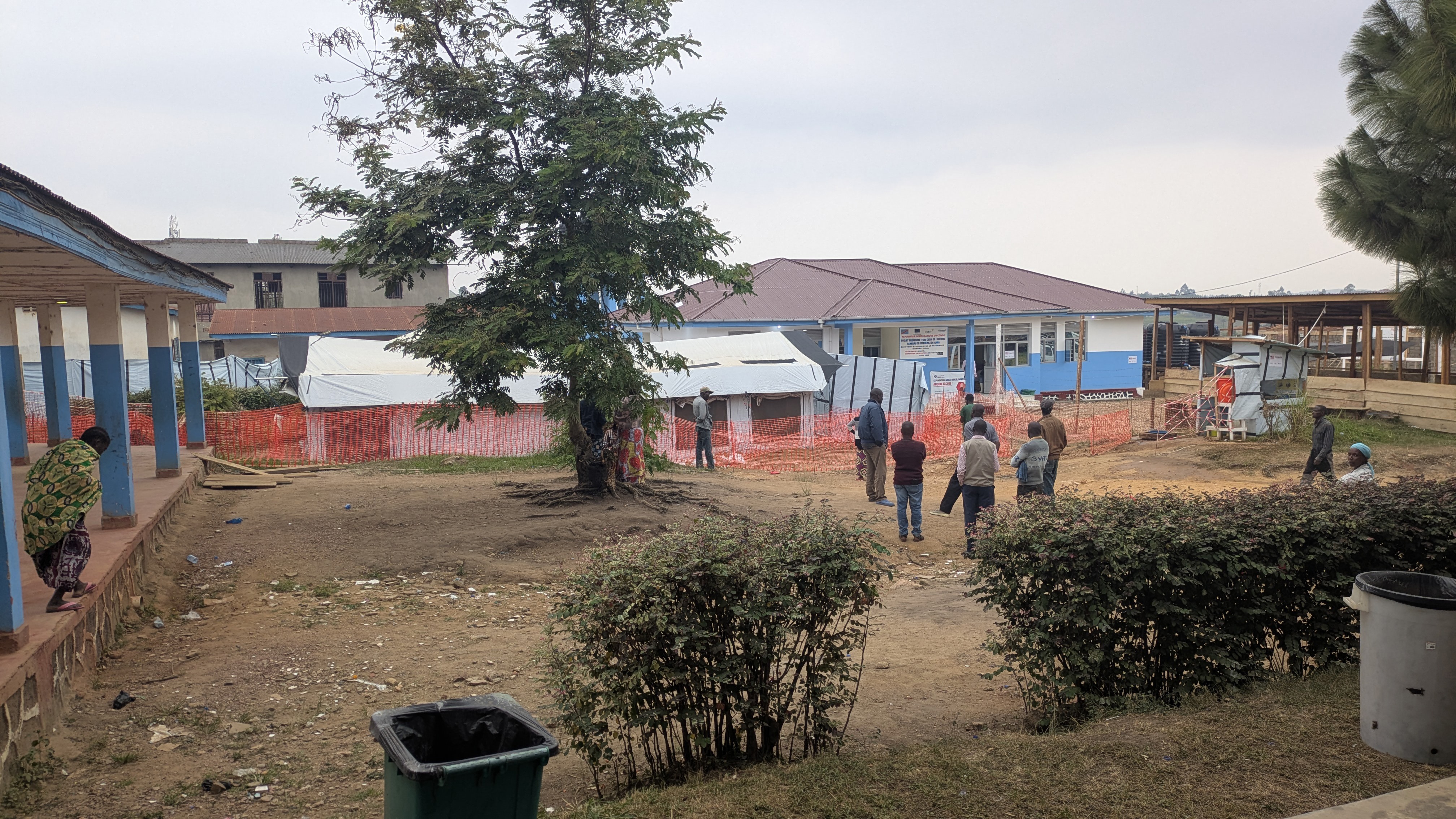
 An Ebola treatment centre set up at the Bunia General Referral Hospital in Ituri Province, DRC. (Photo: Patrick Kahondwa, Bird Story Agency)
In northeastern Democratic Republic of Congo, Ituri has become the centre of the country’s latest Ebola response. Home to an estimated five million people, the province has long grappled with armed conflict, mass displacement and recurring disease outbreaks, making epidemic control especially challenging. Its capital, Bunia, near the borders with Uganda and South Sudan, serves as the administrative and humanitarian hub for a region where insecurity and public health emergencies have repeatedly collided.
Throughout the region, community health workers have become the backbone of the outbreak response. Far more than patient caregivers, these trusted local men and women are the familiar faces who counter fear, misinformation and mistrust in neighbourhoods where confidence in the health system is often weakest. Their daily work has helped extend the response far beyond clinics and treatment centres into the communities where Ebola is most effectively contained.
By 2 July more than 1,400 people had been diagnosed with the new strain of Ebola, nearly 210 people had recovered and nearly 440 people had died of the disease in the DRC since World Health Organization (WHO) director-general Dr Tedros Adhanom Ghebreyesus declared a public health emergency of international concern on 17 May 2026, according to the WHO.
Normally, community volunteers work to raise awareness in communities about the importance of vaccination and other preventative measures against diseases with epidemic potential. But since the declaration of the Ebola epidemic, their daily lives have changed dramatically.
Every day, they roam the streets, megaphone in hand, to inform the community about the risks of Ebola and the measures citizens can take to protect themselves. In markets, at community meetings and in other public spaces they address residents’ concerns and combat persistent rumours.
/file/attachments/orphans/807993_159953.jpg "An Ebola awareness message displayed along Boulevard de la Libération in Bunia, Ituri Province. (Photo: Patrick Kahondwa / Bird Story Agency)")
Aristote Banga is one of the hundreds of community health workers engaged in the Ebola response in Ituri. On some days, he wakes up before sunrise. He begins his outreach with a simple goal, to reach as many people as possible. From house to house, in markets, places of worship and busy public spaces, he explains how the virus is transmitted, the symptoms that should raise concern and the importance of immediately reporting any suspected case to health authorities rather than keeping sick relatives at home. But convincing people is never easy.
“Some people ask us whether Ebola really exists. Others believe that once a patient is taken to a treatment centre, they never come back. Many also question whether there is any treatment at all, or even doubt the existence of the disease,” he explains.
Rumours remain one of the biggest obstacles to the response, and one of the daily challenges Aristote must confront. With each visit, he works to dismantle deeply rooted misconceptions.
“Some residents believe Ebola is an invention created to attract international funding. Others remain suspicious of health facilities and treatment centres,” he says.
Despite this resistance, he is determined to continue: “People need to understand that Ebola exists and everyone must play their part to stop this epidemic. We have already lost several loved ones, and if awareness is not increased, we will be far from stopping this epidemic despite other measures that may be put in place.”
National and regional health leaders say the success of the Ebola response will depend not only on medical expertise but also on strong community trust and sustained investment in local health systems. They argue that lessons from previous outbreaks have shown the importance of working through existing provincial and community health structures, rather than parallel emergency systems, to build resilience and strengthen long-term epidemic preparedness.
Religious leaders mobilised
Alongside community health workers, religious leaders are playing a leading role in the Ebola response in Ituri. Thanks to their close ties with communities and the trust they enjoy among their followers, they are helping to promote acceptance of preventative measures and combat the rumours that still surround the disease. This is the case of Sheikh Shukrani Byaruma, the imam and head of the Islamic provincial entity in Ituri.
“We play the role of awareness-raisers, educators and community liaisons. In collaboration with health authorities, training sessions are organised for imams and other community leaders to provide them with reliable information on Ebola and to help them disseminate prevention messages within their communities,” Shukrani said.
According to him, these training sessions allow religious leaders to convey clear messages and strengthen community confidence in public health measures.
“Our mission is to show the faithful that Ebola is a very real disease. We encourage them to respect the measures recommended by health authorities, to consult health facilities quickly if they experience symptoms, and to avoid any contact with people who are sick or have died from the disease,” he added.
Despite years of experience responding to Ebola outbreaks, mistrust remains a significant obstacle in parts of Ituri. In several instances, that scepticism has escalated into attacks on Ebola treatment centres, underscoring why trusted community health workers have become such a critical bridge between health authorities and local residents.
/file/attachments/orphans/809803_556087.jpg "An Ebola awareness message displayed at the entrance to Bunia General Referral Hospital in Bunia, Ituri Province. (Photo: Patrick Kahondwa / Bird Story Agency)")
Urgent need to contain the epidemic
Across Bunia, brightly coloured posters urging people to report symptoms early, avoid contact with suspected cases and seek treatment are displayed on clinic walls, roadside noticeboards and in busy public spaces. Inside health facilities, doctors and nurses work in gloves, masks, gowns and face shields to protect themselves and their patients, although periodic shortages of personal protective equipment have strained some treatment centres. With support from international partners, a network of Ebola treatment centres and specialised care units has been established across Ituri, providing dedicated spaces to isolate and care for patients while helping to prevent further transmission.
Behind every confirmed Ebola case is a chain of work that often goes unseen: health workers tracing dozens of contacts, community volunteers visiting homes, laboratories testing samples, ambulances transporting patients and health teams racing to protect those most at risk. This complex response is coordinated through provincial and health-zone plans, but officials say the needs on the ground remain immense despite support from the Congolese government and its partners. The lack of resources is one of the main challenges. Teams do not always have the necessary vehicles to carry out investigations, contact tracing or patient transport.
“Some teams go into the field by taxi, motorcycle or even on foot to find suspected cases. This is not an ideal situation for an Ebola response. Added to this are regular shortages of personal protective equipment (PPE), which is essential to ensure the safety of responders. Without PPE we cannot investigate cases, treat patients or conduct safe and dignified burials,” explains a member of a response team who requested anonymity.
/file/attachments/orphans/809802_741033.jpg "An Ebola treatment centre at the Bunia General Referral Hospital in Ituri Province. (Photo: Patrick Kahondwa / Bird Story Agency)")
/file/attachments/orphans/807963_864287.jpg "An Ebola awareness poster displayed on the fence of the Catholic aid organization Caritas in Bunia, Ituri Province. (Photo: Patrick Kahondwa / Bird Story Agency)")
An epidemic unlike any other
While Ituri has already experienced several Ebola outbreaks, health authorities emphasise that the current epidemic has unprecedented characteristics.
“This is the umpteenth epidemic we’ve experienced, but it’s the first time this strain has hit Ituri. We’re facing a new situation that considerably complicates our work,” said a local health facility official.
Unlike the Zaire strain, against which scientific advances have led to the development of a vaccine and specific treatments, the currently circulating Bundibugyo strain does not yet benefit from these tools. This deprives healthcare teams of essential resources to prevent infections in exposed individuals and improve patient care.
According to Dr Richard Kitenge, incident manager of the Ebola response, the current epidemic has characteristics that clearly distinguish it from previous outbreaks: “This epidemic is not similar to previous ones. Its particularity is that it is occurring in a mining area, characterised by a high population density and significant movement of people.”
Despite this, health authorities are drawing on the experience gained during previous Ebola outbreaks.
“All the procedures we are applying today are those that have been developed and tested during previous epidemics. Contact tracing, epidemiological surveillance, alert investigation, patient care protocols, infection prevention and control, and dignified and safe burials remain the cornerstones of our response,” said Kitenge.
Without a vaccine or specific treatment, every suspected case depends on rapid detection, trusted relationships and communities willing to work alongside health authorities. In Ituri, health workers say those relationships may prove to be the most powerful tool they have.
“Sometimes we’re tempted to give up,” says Angel Bahati, a response worker using a pseudonym. “But since it’s our community, we give it our all.” DM
Comments
Scroll down to load comments...