




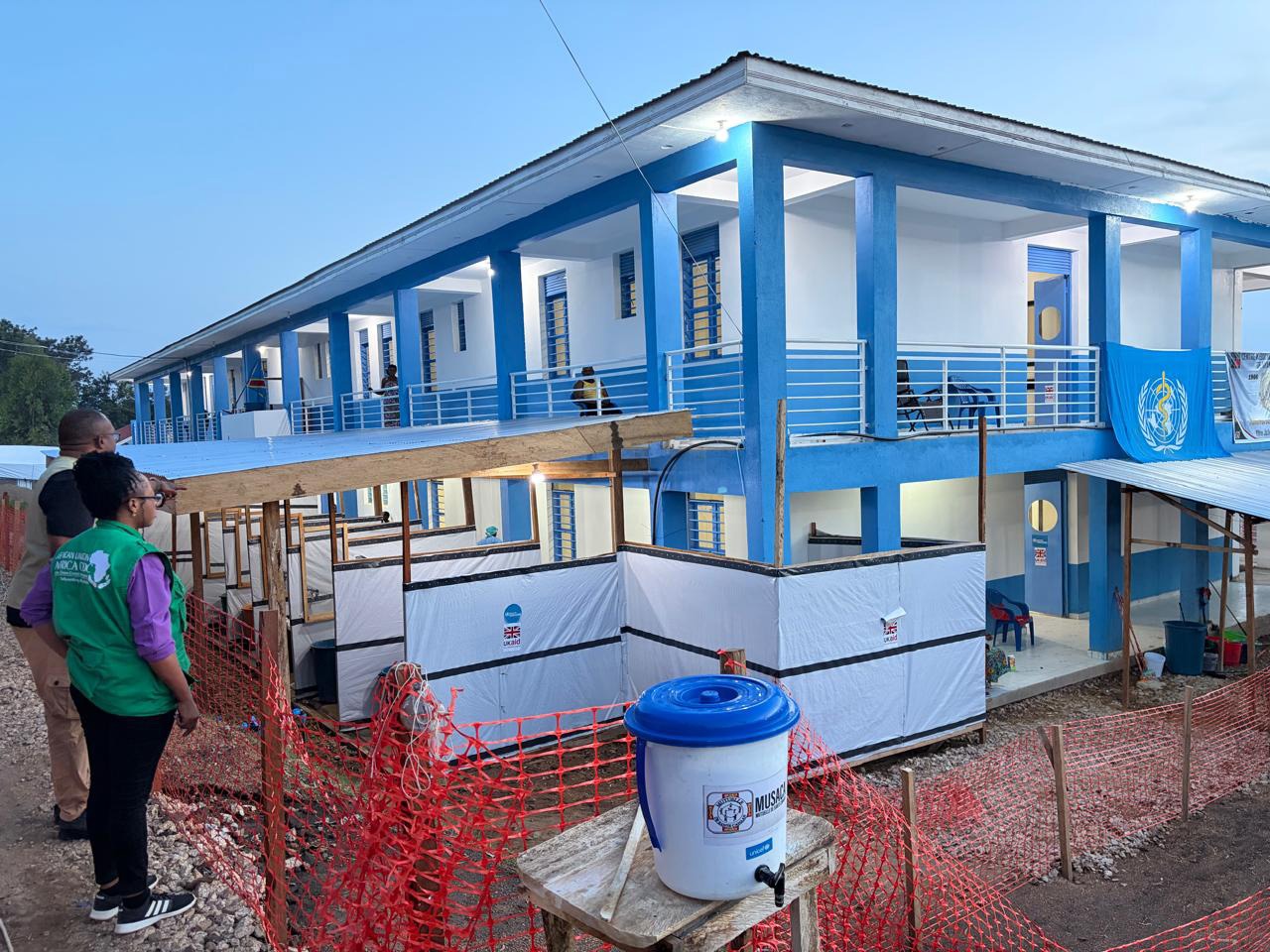
 One of the largest hospitals for Ebola patients in Bunia, approximately 80 beds. The area you can see with the plastic sheeting is the personal protective equipment doffing area for staff. (Photo: Patrick Kahondwa / Bird Story Agency)
 As dusk settles over Bunia, the bustling capital of Ituri Province in northeastern Democratic Republic of Congo, near the borders of Uganda and South Sudan, workers in protective boots move between newly erected structures beside one of the city’s largest treatment facilities. Under floodlights and with the sound of hammering, teams continue building additional wards and support areas, expanding the capacity of a hospital that can accommodate about 80 Ebola patients. Plastic-screened corridors and carefully marked doffing zones for personal protective equipment stand as visible reminders of the discipline required to contain one of the world’s deadliest diseases.
The scene captures both the urgency of the latest Ebola outbreak in the DRC and a less-familiar reality: the response is not beginning from scratch. In a region that has confronted Ebola many times, systems, infrastructure and expertise built over years of experience are being mobilised once again. Behind the temporary isolation units, local health authorities, national public health institutions, African scientists, community health workers and international partners are working side by side under African leadership to detect cases, trace contacts and prevent wider transmission. Surveillance teams, laboratory networks and emergency response units that have been strengthened through successive outbreaks are now being activated across the region.
While Ebola remains a serious threat, this outbreak is unfolding at a moment when African governments, researchers and continental institutions are playing an increasingly central role in coordinating the response, demonstrating how local, national and international actors can work together to protect public health and strengthen preparedness for future emergencies.
/file/attachments/orphans/PIC6_705663.jpeg "Healthcare workers engaging in full personal protective equipment with ebola patients. (Photo: Patrick Kahondwa / Bird Story Agency)")
Early in June, following the Africa Centres for Disease Control (CDC) and Prevention’s declaration of the outbreak as a Public Health Emergency of Continental Security, senior African and global health leaders travelled to the DRC to support the response. Leading those efforts was Africa CDC director-general, Dr Jean Kaseya, a Congolese public health specialist who has been working alongside World Health Organization (WHO) director-general Dr Tedros Adhanom Ghebreyesus and DRC health authorities to coordinate surveillance, preparedness and cross-border response measures. Their presence reflects a broader shift in outbreak management, with African institutions increasingly at the centre of efforts to detect, contain and respond to public health threats.
At a June briefing, the WHO leader was clear: “The only way to beat this outbreak is through close partnership, working together under the leadership of the affected countries in one coordinated effort, guided by a simple principle: one plan, one budget, one team.”
According to the WHO, the Bundibugyo virus disease (BVD) outbreak continues to evolve rapidly, with sustained transmission and rising case numbers. In line with the UN, as of 4 July, the country’s government had recorded 1,561 confirmed cases, including 506 deaths and 254 people recovered. More than 10,000 contacts are being monitored. In neighbouring Uganda, 19 confirmed cases and two deaths have been reported, with authorities linking the outbreak to transmission originating in the DRC.
/file/attachments/orphans/PIC2_325320.jpeg "Dr Tony Wawima, a Congolese doctor with a PhD in Virology from Leuven, is the lab director. He took Prof Salim Abdool Karim through the steps for Ebola testing. Each step is in a separate BSL 2+ room. (Photo: Bird Story Agency)")
CDC Africa spokesperson Saran Koly told Bird: “The continent is in a different place from where it was during the west African Ebola epidemic. Africa now has a continental public health institution with an emergency mandate. Many member states have more capable national public health institutes, more experienced responders, better laboratory networks, stronger surveillance capacity and clearer mechanisms for regional coordination. The lessons from Ebola, Covid-19 and Mpox have shaped how Africa prepares, communicates and acts,” she said.
Koly noted that the current response also emphasised cross-border coordination. “Outbreaks do not respect administrative boundaries. In eastern DRC, movements across communities, provinces and borders require fast information-sharing, preparedness in neighbouring countries, point-of-entry measures where appropriate, and constant coordination between national authorities and regional partners,” she noted.
/file/attachments/orphans/PIC8_604717.jpeg "Another view of the hospital in Bunia. (Photo: Patrick Kahondwa, Bird Story Agency)")
A familiar threat, but a different response
In declaring the 17th Ebola outbreak, DRC health minister Dr Kamba Mulamba Samuel Roger said the response would be guided by the principle of “one coordination team, one plan and one budget”, underscoring the government’s determination to ensure that national authorities, African institutions and international partners worked within a single coordinated framework.
The Bundibugyo strain of Ebola is a rarer form of the virus for which there are currently no approved vaccines or treatments. Infectious disease expert and Centre for the Aids Programme of Research in South Africa executive director Salim Abdool Karim, who visited the DRC in the second week of June as part of the emergency response, explained that standard diagnostics used for the more common Zaire strain do not work, making PCR (polymerase chain reaction) laboratory testing essential and slowing down diagnosis.
“We’re dealing with Bundibugyo Ebola, a non-Zaire strain. Our standard diagnostics don’t work against this strain, and while we have vaccines and treatments for Zaire Ebola, they’re not effective here,” he explained.
/file/attachments/orphans/PIC1_251059.jpeg "Dr Tony Wawima, a Congolese doctor with a PhD in Virology from Leuven, is the lab Director. He took Prof Slim through the steps for Ebola testing. (Photo: Bird Story Agency)")
Abdool Karim described the outbreak as one of the most difficult he has witnessed. He said the challenge was not the skill of healthcare workers, but the harsh conditions they are working under, including conflict, displacement, food shortages and limited access to resources.
Without effective vaccines or treatments, Abdool Karim said the response depends heavily on three public health measures: early case detection, isolation and infection control, and contact tracing.
“When I was there, they were literally building individual isolation wards because the hospitals didn’t have enough space to safely isolate patients.”
He also stressed the importance of safe and dignified burials, as Ebola victims remain highly infectious after death. However, he warned that these protocols often clash with cultural burial traditions, making community trust and education critical to the response.
“Communities are upset when they are handed a sealed black bag and told they cannot open it. They want to see their loved one, to touch them, to perform rituals.” Among the changes being investigated are body bags with transparent areas for the faces.
/file/attachments/orphans/PIC7_927913.jpeg "Dr Wawima explains how the RADIONE machine works with each assay run with the reagent panel pre-aliquoted for each test. (Photo: Patrick Kahondwa / Bird Story Agency)")
The rise of the Africa CDC
Despite these challenges, Abdool Karim said one of the biggest differences in this outbreak is the strong leadership of African institutions. He described the response as “Africa-led”, with one unified response system jointly led by the WHO and Africa CDC.
Working with national health authorities, the Africa CDC supports disease surveillance, information sharing and risk assessment across borders, helping countries detect and respond to outbreaks more quickly. Drawing on lessons from Ebola, Covid-19 and Mpox, the Africa CDC has emphasised the importance of maintaining essential public health measures while minimising unnecessary disruptions to trade, travel and economic activity.
“African leadership gives the response legitimacy,” said Koly. “It brings decisions closer to the realities of communities, health workers and governments on the ground. It also builds public confidence, because people can see that the response sits within their own institutions and is accountable to their own realities.”
/file/attachments/orphans/PIC3_974000.jpg "The INRB ebola sequencing lab. (Photo: Patrick Kahondwa / Bird Story Agency)")
What cooperation looks like on the ground
While continental institutions coordinate the broader response, the Africa CDC says the success of the effort ultimately depends on people working closest to affected communities. Koly highlighted the role of frontline health workers, community leaders, surveillance teams, local authorities and logistics personnel who continue to operate in challenging conditions to contain the outbreak.
Community health workers are often the first to engage with families, address concerns and help communities understand public health measures. “They know the fears, the rumours, the histories and the daily realities,” said Koly.
Their role is especially important in building trust: “Trust is operational,” she said, because it influences whether people report symptoms, seek treatment and cooperate with response teams.
From dependence to ownership
During a high-level virtual meeting of African heads of state, government leaders and international partners convened by Burundian President and African Union chairperson Évariste Ndayishimiye to coordinate the response to the Ebola outbreak, South African President Cyril Ramaphosa, speaking in his capacity as the African Union Champion for Pandemic Preparedness, Prevention and Response, announced that South Africa would increase its contribution to the response effort to $13.5-million, reaffirming the country’s commitment to supporting affected countries and strengthening Africa’s collective capacity to respond to public health emergencies.
“Africa is no longer waiting passively for others to act,” said Ramaphosa, adding: “This contribution is a demonstration of our confidence in Africa CDC as the public health agency of Africa and in the importance of collective continental action.”
Tedros told the high-level preparatory gathering in May that the challenge was significant: “We are facing an extremely serious and difficult outbreak. It will get worse before it gets better. But we know this virus and we know how to stop it. We have stopped every previous Ebola outbreak and we will stop this one too,” he said.
The question, he said, was speed: “How many more lives will be lost before we do. WHO is fully committed to working under the leadership of the government of the DRC and Uganda and side by side with Africa CDC and all our partners. We will not rest until we bring this outbreak under control.”
/file/attachments/orphans/PIC4_826672.jpeg "Public awareness posters at Kinshasa International Airport. (Photo: Patrick Kahondwa / Bird Story Agency)")
Challenges remain
Despite this, health leaders know that there are still funding gaps, pressure on health workers, a need for vaccines and the lingering risk of regional spread.
“Africa is more prepared than it was a decade ago. The continent has stronger institutions, more experienced responders, better coordination platforms and a clearer political commitment to health security. Africa CDC’s work with member states reflects that shift,” said Koly. “The warning is equally clear. Preparedness still needs faster financing, more reliable supply chains, more local manufacturing, better-equipped health systems, stronger data systems and sustained investment in the health workforce and community health structures.”
Looking ahead, Abdool Karim – whose organisation is supporting the work through data analysis and epidemiological modelling that will help predict how the virus is spreading and what resources will be needed – says the outbreak offers three key lessons for Africa: be prepared, engage communities and stand together.
“Africa is responding with stronger institutions, deeper technical experience and a clearer political understanding that health security is part of sovereignty. The response is being led by the government of DRC, supported by African expertise, continental coordination and partners who understand the urgency of aligning behind national and regional priorities,” Koly noted.
“This outbreak is testing the continent. It is also showing what Africa can build when leadership, science, solidarity and community action move in the same direction.” DM
Additional reporting and editing by Paula Fray.