



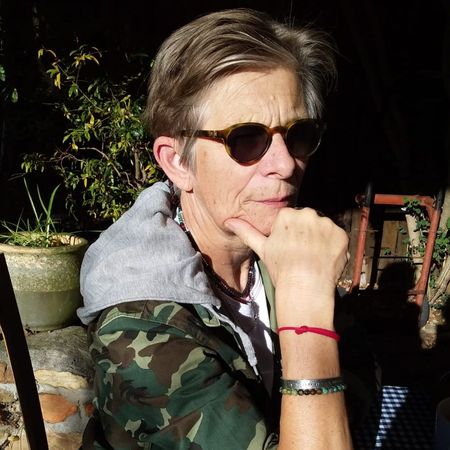
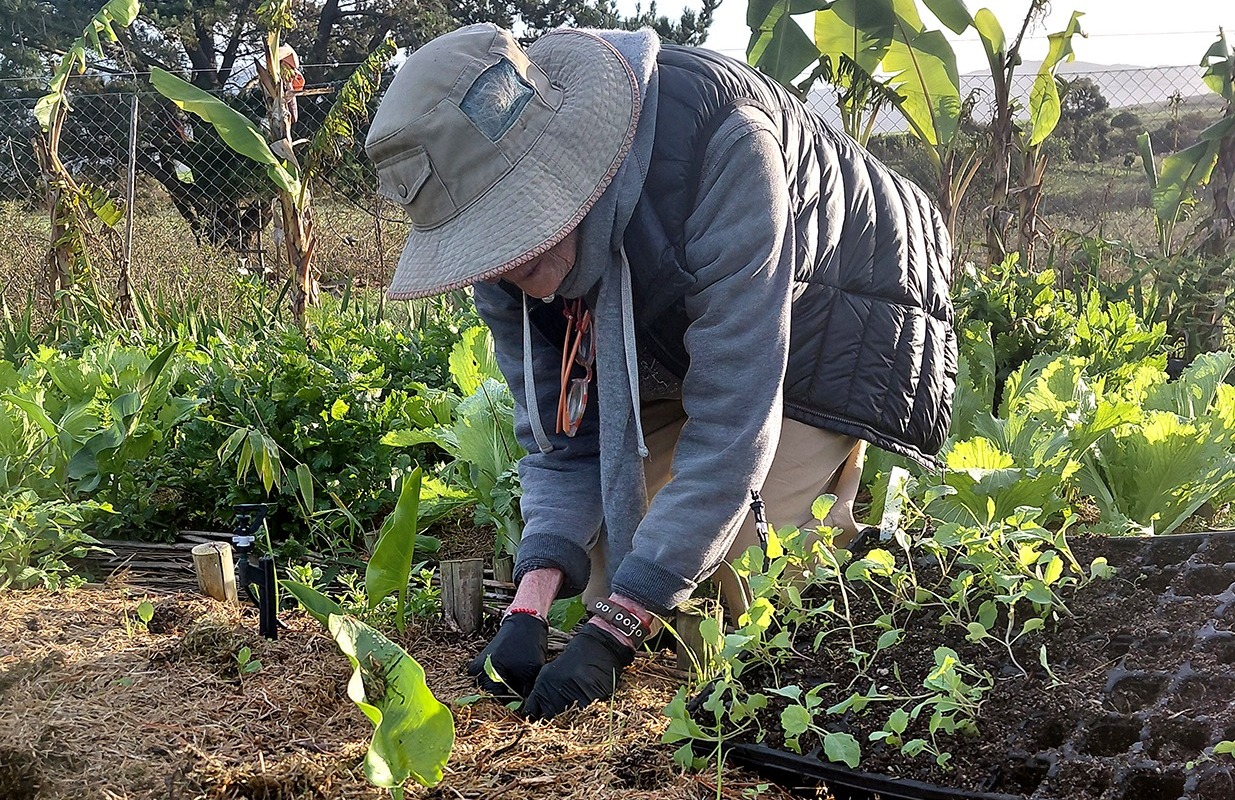
 The familiar planting veg seedlings. (Photo: Lucinda Jolly)
“Got me down on my knees,” like the song says. But this isn’t about begging Layla to “ease my worried mind”, Eric. Unless Layla hangs out in a veggie garden or happens to be a beautiful butter lettuce, pak choi or yellow beetroot. So, let’s park that.
But I am on my 60-plus-year-old knees, and my guitar’s a yellow gardening fork, and my rock star outfit is a pair of industrial gumboots, a capacious pair of hardy skaters’ shorts, and a raincoat associated with nurses. I am rocking it in a vegetable garden on a farm in the Overberg on a working farm holiday.
Using what could be described as a pierce-place-and-pinch technique, I’m busy placing elephant garlic bulbs – right side up – in a raised veg bed retained by a beautifully fashioned basket border of woven striplings.
Apparently, the English king favours them too. It’s an icebreaker exercise marking the beginning of my first working farm holiday.
/file/attachments/orphans/ThefamiliarandIonourfarmingholidayatGoodluckHomestead_157338.jpg "The familiar and I on our farming holiday at Goodluck Homestead. (Photo: Lucinda Jolly)")
/file/attachments/orphans/SandveldReds-indigenouspigs_525980.jpg "Sandveld Reds – indigenous pigs. (Photo: Lucinda Jolly)")
My and my partner’s responsibilities are feeding the livestock: pretty rabbits of all colours that live with squeaky guinea pigs, indigenous Sandveld Red pigs, planting seedlings, milling and sorting the cannabis and sorghum for medicinal oil and original African beer, writing labels, making biscotti, soap and all sorts of jams and compotes to stock the dinky farm shop. Making up little baskets of fresh delights for guests in the three different-sized eco cottages that Alex built, and winkling out the stubborn invader Port Jackson saplings that came post-fire with a witchy fork.
With eco-conscious travel trending, agritourism is booming. It’s a fast-growing trend in travel that includes a preference for slow travel and “farm-to-table” experiences, particularly among younger travellers looking for authentic rural, or “farm charm” stays.
The menu features regenerative and sustainable tourism, organic or solar-powered harvest experiences and luxury farm stays, all favouring remote escapes, with waterfall visits being the biggest wellness travel destination.
/file/attachments/orphans/ThefamiliarattheentrancetoVaalvleifarmandGoodluckHomestead_726387.jpg "The familiar at the entrance to Vaalvlei farm and Goodluck Homestead. (Photo: Lucinda Jolly)")
/file/attachments/orphans/GoodluckHomesteadfarmhouse_581555.jpg "The Goodluck Homestead farmhouse. (Photo: Lucinda Jolly)")
In April this year, Goodluck Homestead, situated on the beautiful Vaalvlei Farm in the Overberg, posted an invitation on Instagram for people to work on a farm in lieu of board, lodging and an evening meal.
We grabbed the opportunity with both hands, but I drew a non-negotiable line at ironing.
As retirees with limited incomes, my familiar and I can no longer afford even the most basic of places away, so this was a godsend. Interestingly, both of us are descendants of farming stock. The familiar grew up on a dairy farm in the Natal Midlands, surrounded by space, freedom and horses. And I am the daughter of an Eastern Cape farmer’s son who escaped to the big smoke as soon as he could trade a horse for a motorbike. So, this felt like an auspicious completion of a metaphorical cycle.
The name Goodluck Homestead on Vaalvlei Farm has a decidedly Asian ring to it, like the Chinese Good Luck Candies that sweeten auspicious celebrations, so I was curious about its origins. But shareholder Tabby Robertshaw (along with her partner Alex Chouler) disabused me of any such Orientalisms.
It’s the name of the couple’s previous farm cottage up in the mountains on Walshacres Farm in Stanford.
Tabby, short for Tabatha – so named and so spelt by her father after the child of a witch in a Seventies TV programme called Bewitched – wasn’t always a farmer. English, fair and pale blue-eyed, Tabby is grounded, super-efficient, practical and bursting with ideas, very good-hearted, and the alpha female of four big rescue dogs, mother to a hand-reared indigenous veld goat, Cocopop, who comes when Tabby calls, and two teenagers.
/file/attachments/orphans/Tabbywiththedogwholoveshermost_261351.jpg "Tabby with the dog who loves her most. (Photo: Lucinda Jolly)")
/file/attachments/orphans/CocopoptheingenousveldgaothandrearedbyTabbyashismotherrejectedher_626815.jpg "Cocopop the ingenious veld goat hand reared by Tabby as his mother rejected him. (Photo: Lucinda Jolly)")
She began her professional life training as a chef at Silwood Kitchens, leaving for London before completing the course. Even in prestigious restaurants, her chefing life meant long hours and poor pay.
She hit paydirt working for an investment company in the directors’ dining room under an executive chef from Thailand, whom she credits with influencing her food, and a “brilliant” Italian head chef. Her partner, Alex, was working as a landscape gardener and florist.
But after two successive miserable English summers, the homing pull was too strong to resist. What clinched Tabby’s decision to move from chefing to farming was the amount of waste she experienced in the restaurant trade. If you were to ask Tabby the single force that drives her, it would be the elimination of waste.
“There was just so much wastage and I couldn’t bear it,” she said. “Restaurant food is governed by so many health and safety rules, the only way forward was to open my own restaurant and sort out all the waste myself,” she said.
Back home on the farm, Tabby was pregnant with her first child when she realised that she just wasn’t cut out to be a stay-at-home mum. An opportunity came knocking in the shape of a restaurant of their own.
Finally, the agency she wanted was hers. She could change the menu on a whim and didn’t have to explain to anyone because she was the boss.
/file/attachments/orphans/Araisedvegbedanditswovenretainerwall_699317.jpg "A raised veg bed and its woven retainer wall. (Photo: Lucinda Jolly)")
/file/attachments/orphans/Fuzzythepetpigthatgotawayfromlandinguponthedinnertablebecausehewastoosmall_758945.jpeg "Fuzzy the pet pig that got away from landing up on the dinner table because he was too small. (Photo: Lucinda Jolly)")
“It was so much fun,” she said, and most importantly she “wasn’t going to bin food waste when it could turn into something beautiful”. The various waste products had their specialised buckets and were all taken back to the farm to be dispensed to the various animals.
The couple ran the restaurant Graze for nine years while simultaneously running the farm, doing landscaping and extra catering jobs, as well as raising a family. The first five years of running the restaurant were great, but the last four were about “suffering through”. As Tabby points out: “At the end of the day, I was still just cooking for rich white people; nothing much had changed.”
Leaving the restaurant meant two choices: either close down and start a new business or go and work for someone.
In the end, lockdown forced Graze to close. “I hate saying this because it was so terrible, but it was like the best three weeks of my life.” The couple received an offer to sell that went bad. Eventually, they sold everything and began giving small workshops, including veggie gardening and coastal foraging.
But it was the wonderful lunch provided at the end of these workshops that was the real reason for the attendance. “They didn’t want to grow veggies,” Tabby said matter-of-factly. “They just wanted to eat.”
Which is understandable given Graze’s reputation for tasty, original food. And best of all, one workshop a month earned more money than the restaurant did.
Then came the offer they had been waiting for. A regular restaurant customer bought a farm called Vaalvlei in the Overberg and was keen for Tabby and Alex to manage it for him.
/file/attachments/orphans/thetopecocottage_383167.jpg "The top eco cottage. (Photo: Lucinda Jolly)")
/file/attachments/orphans/DSCF9664_705333.jpg "Boathouse at the dam. (Photo: Lucinda Jolly)")
Good Luck Cottage had been good to them, but it was becoming cramped and Alex wanted to build eco buildings. Many of the buildings on the new farm needed refurbishing or rebuilding, and the previous farmer was heavy on agricultural chemicals, a practice that had to be stopped.
It was a fairly steep learning curve for the couple, with some unexpected results, like realising that they had planted the veg garden in a swampy area and built the shed in a waterway.
The farm has been through almost biblical visitations of fire and floods. A flood in 2023 and then three years later, a massive fire where 3.8km fire jumps were recorded in a 12m-per-second wind. “That’s literally coals falling from the sky and igniting the whole farm at once,” she explained. Evidence of this is in the charred stumps of trees, burnt fences and a rash of Port Jackson invader saplings.
The farm also produces wines. The Sauvignon Blanc, Shiraz and Rosé are grown in iron-rich ferricrete (koffieklip) and clay soil, providing minerality and the ability to hold moisture in dry times.
The 20-year-old vines were given a three-year detox from pesticides and herbicides to restore them to a more natural state. Alex McFarlane of McFarlane Wines, a winemaker known for her fastidiousness and who specialises in “better practice farming”, is currently the winemaker.
An ardent forager, Tabby named each wine after a mushroom: Pantherina, a dark toadstool with white spots, for the Sauvignon Blanc; Blusher, after Amanita Rubescens, for the Rosé; and Fly Agaric, with its bright red cap and white spots, for the Syrah.
The couple’s day starts at 5am with walking her four large dogs. Then it’s milking the cows, getting the kids’ breakfast and driving them to the bus stop.
Work begins in earnest. It could be veggie gardening, making jams and compotes from boysenberries and rhubarb, making biscotti or butchering pigs. All of which takes place in the butchery, Tabby’s lab, referred to by her friends as the “bitchery”.
Later it’s collecting the kids, making supper and finally taking a long soak in the outside fire bath Alex built for her under the Milky Way.
/file/attachments/orphans/Tabbysfirebath_242669.jpg "Tabby's fire bath. (Photo: Lucinda Jolly)")
Tabby’s worst tasks are the endless paperwork, which keeps her away from the real work, and those guests in the eco cottages who complain about the density of the pillows, like the Goldilocks story revisited.
To rewind and recharge, there are weekends away camping close by.
Why volunteers? Tabby and Alex “wanted volunteers specifically to share the farm experience, especially for those wanting to homestead one day”.
“We also enjoy meeting like-minded people and people who are not afraid to get their hands dirty. And for the kids to meet people from other countries and network for future travels. And so far, it’s been a great experience for us and we’ve made some lifelong friends.”
But the main reason is for volunteers to do the mundane jobs that Alex and Tabby can’t get to.
Some believe that the idea of nature is a human concept. It’s an idea that sees a conceptual boundary between humans and the rest of the living world, one that encourages a separation between us and the natural world. But whether we acknowledge it, or are conscious of it or not, we are a part of it.
By separating ourselves from nature, we can ignore our intrinsic role in it and are then able to justify the destruction of ancient forests and ecosystems. It’s the same approach used in the hierarchical classification and commodification of human beings and its ugly offspring: racism, sexism, misogyny and bigotry.
This chance to work on a farm is a real opportunity to reconnect with nature. Slow time, big skies, good physical work. To both receive and to give of your time and care. For some workers, the time on the farm was a life-changing experience.
For as the late Buddhist and activist Thích Nhât Hạnh reminds us: “We are here to awaken from the illusion of our separateness.” This idea of interconnectedness suggesting that human wellbeing and the health of the natural environment are inseparable, and that caring for the Earth is ultimately an act of caring for ourselves. DM
To sign up to be a volunteer, email Tabby at info@vaalvlei.co.za
Comments
Scroll down to load comments...