



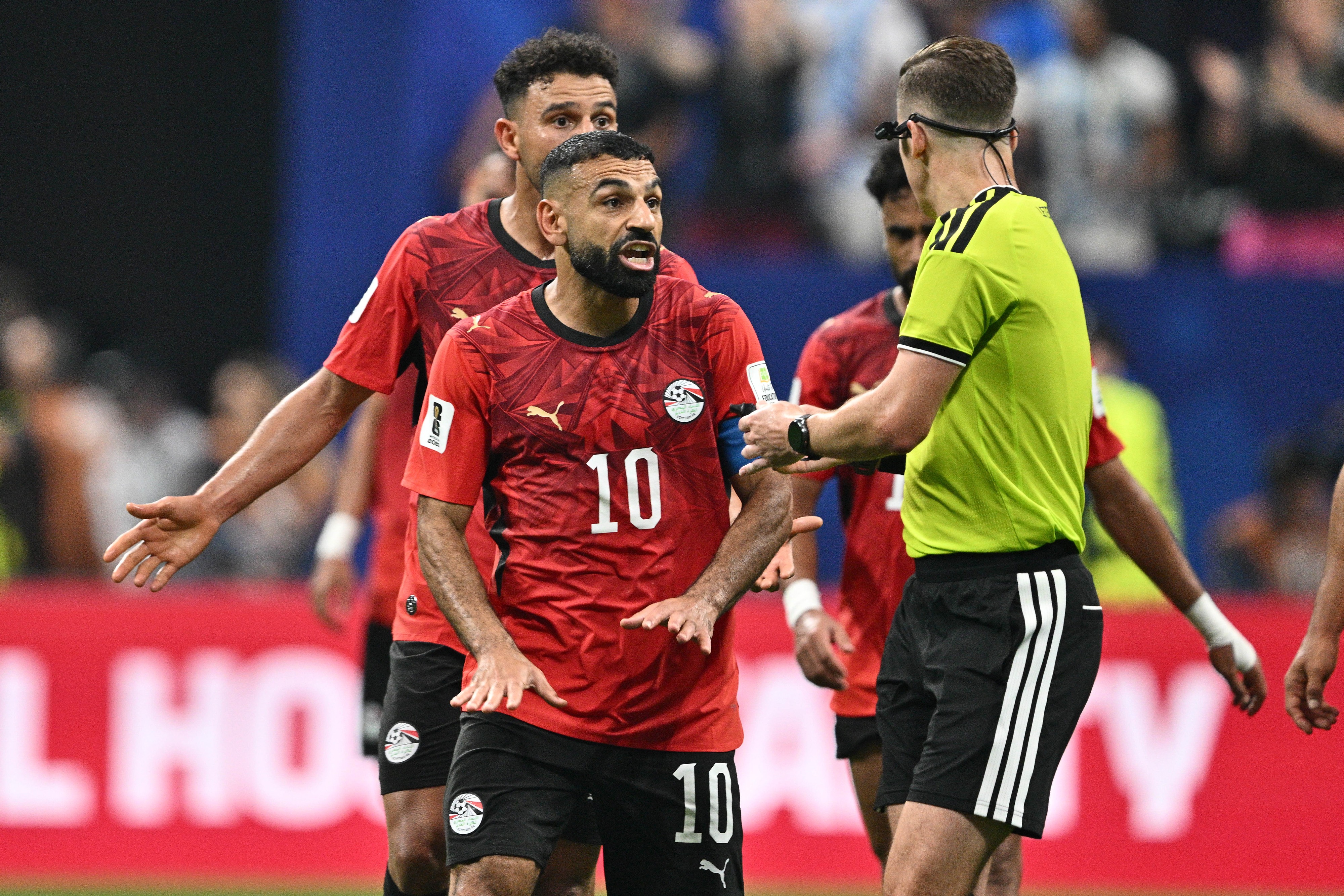
 Egypt’s 3-2 loss to Argentina in the round of 16 at the 2026 Fifa World Cup is just one of example of matches where refereeing decisions at the tournament have been questioned. (Photo: Sebastian Frej / Getty Images)
 The video assistant referee (VAR) technology made its Fifa World Cup debut eight years ago, at the 2018 edition of the global soccer tournament. Some of its original detractors, such as Argentinian soccer coach Marcelo Bielsa, have warmed up to it.
Nevertheless, its existence in soccer remains a major point of discussion for different stakeholders in the sport. From Bielsa and his fellow coaches, to players and even spectators of the sport.
People who have welcomed the introduction of the technology in the world’s most popular sport argue that it bolsters the integrity of the game. On the other hand, critics have said that too much technology in sport takes away from its authenticity and the organic emotions in matches, even if it increases the chances of match officials making correct and fair decisions.
Pro-VAR stance
A couple of years ago, Bielsa was part of the latter group of people. As a thorough soccer purist, the 70-year-old denounced the technology, stating: “For me, the introduction of technology like VAR does a lot of harm to football. This sport has a particularity: when it becomes completely predictable, it loses its appeal.”
But while coaching Uruguay at the ongoing 2026 World Cup, Bielsa revealed that his stance towards the technology had softened. The veteran tactician was criticising Fifa’s introduction of mandatory “hydration breaks” at the tournament, which is taking place in the US, Mexico and Canada, when he praised the technology.
/file/attachments/orphans/GettyImages-2283566498_871011.jpg "Veteran Marcelo Bielsa was anti-VAR, but his stance has since softened. (Photo: Juan Luis Diaz / Quality Sport Images / Getty Images)")
“I’m saying that before this decision [to introduce hydration breaks], football had one characteristic and now it has a different one. I’m saying that people fall in love with the game because of its characteristics,” Bielsa said.
“There are great successes, like the influence of VAR, which has improved the game. But this other attempt (hydration breaks) has consequences that are not positive. These aren’t just my opinions, but a general view,” the veteran coach added.
Anti-VAR sentiment
Despite Bielsa’s altered stance on VAR, many still believe that the technology has done a disservice to soccer. One such person is former Croatia coach Zlatko Dalić, who vacated his post after his team was eliminated from the ongoing soccer spectacle.
The former midfielder had been at the helm of the Croatian men’s soccer side since 2017. After Croatia fell in the round of 32 following a 2-1 loss to Portugal in this World Cup, Dalić was highly critical of VAR.
His criticism came after his team was denied a stoppage-time equaliser in the match after technology installed in the World Cup balls showed the match officials that in the lead-up to the chalked-off equaliser, the ball had grazed Croatian striker Igor Matanović, before it fell to his teammate Mario Pašalić (who was offside).
That combination of factors led to the goal being ruled out, to the disappointment of the Croatians.
/file/attachments/orphans/GettyImages-2283813013_139364.jpg "Croatians, including coach Zlatko Dalić and captain Luka Modrić, felt aggrieved by the officiating during their round of 32 match against Portugal at the 2026 World Cup. (Photo: Sanjin Strukic / Pixsell / MB Media / Getty Images)")
“You were able to see to what extent emotions have been literally killed. Altogether these decisions take you back and actually take the joy out of football,” Dalić said.
“I’m not saying that sometimes VAR can’t be of help. But it kills the emotions, it kills everything within you, it kills what you are experiencing… It’s not easy to deal with all of this.”
Egyptians criticise referee
Egypt felt equally aggrieved after being eliminated from the World Cup’s round of 16 by reigning world champions Argentina. The Egyptians had a second goal ruled out for a foul in the build-up to the finishing strike by Mostafa Ziko.
Ziko eventually scored what the officials ruled as a legitimate second for Egypt a few minutes after his chalked-off goal. However, Argentina fought from 2-0 down to win the match 3-2 and dump out the Africans.
/file/attachments/orphans/GettyImages-2285133234_740313.jpg "Egypt questioned the way referee François Letexier handled their 2026 Fifa World Cup round of 16 match against world champions Argentina on 7 July 2026. (Photo: Zhizhao Wu / Getty Images)")
The Egyptians also felt that they had a fair penalty ruled out when their talisman Mohamed Salah tumbled in the box while under pressure from Argentinian Julián Alvarez on the cusp on 90 minutes. Referee François Letexier waved play on and VAR agreed with the on-field decision, to the frustration of the Pharaohs. A couple of minutes later Lionel Messi scored the winner for Argentina.
“The referee was unjust. It was clear injustice. He wasted the efforts of an entire country and seemed determined to be against us from the very beginning,” bemoaned Ziko after the match. “It was a rigged game… Congratulations [in advance] to Argentina on wining another World Cup.”
Fifa head of refs speaks
But Fifa has hit back at assertions of their officials being rogue and favouring certain teams in their decision making, whether it is the on-pitch referees or the VAR officials.
/file/attachments/orphans/GettyImages-2285102386_176992.jpg "Despite criticism of referees such as François Letexier, Fifa says it is happy with the officiating at the 2026 Fifa World Cup. (Photo: Ian MacNicol / Getty Images)")
“Overall, we are happy. However, with such a high number of matches played in a relatively short period of time, it is normal that some things do not go as expected. When that happens, the referees are ready to work even harder to ensure they are fully prepared for the next match,” said Fifa’s head of referees Pierluigi Collina.
“Of course, constructive discussion about decisions will always be part of football. But unfounded allegations have no place in our sport. Nobody can question the integrity of the Fifa World Cup match officials. When this happens, it may provoke reactions that lead to threats against them and their families. This is not right,” Collina said.
“Equally, nobody can claim that Fifa refereeing can be influenced by anyone, not even by the president [Gianni Infantino]. He has always shown his full support while trusting us to work with complete independence. Match officials make honest decisions. Just like players and coaches, they always try to do their best,” added Collina.
“Of course, there will always be an element of subjectivity in some decisions. But we are happy with how this principle has been applied throughout the tournament.”
VAR was supposed to ease the work of referees. However, judging from some incidents at the 2026 World Cup, it has added even more pressure on the officials. However, it is equally true that no team wants to lose. When they do, the referee can sometimes be the scapegoat. DM