




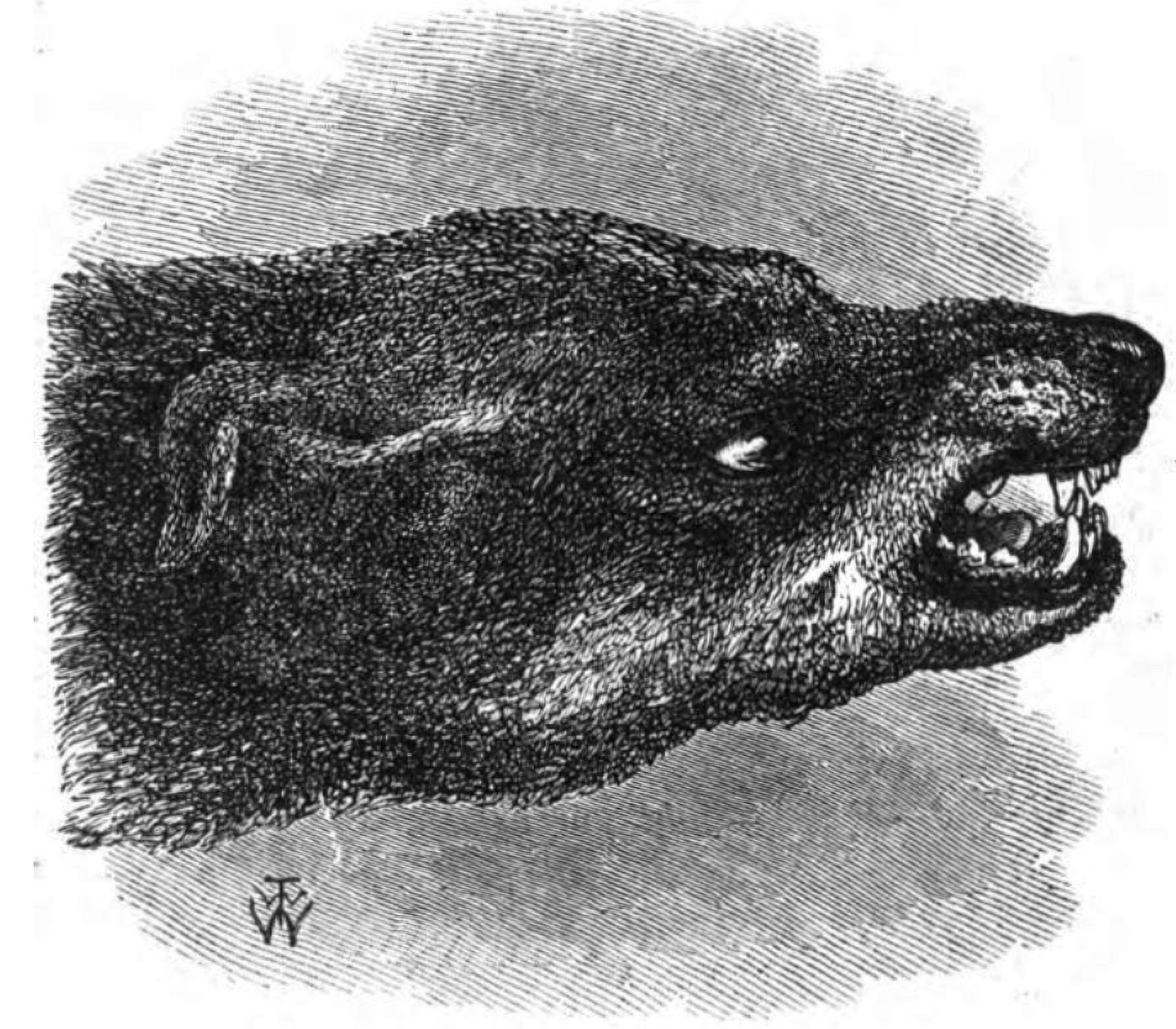
 Head of snarling dog. (Photo: The Expression of the Emotions in Man and Animals / Charles Darwin)
/file/attachments/2993/NOtesfromasmallfinal_223993.jpg)
In 2008 the NSPCA in South Africa brought a case in the Supreme Court of Appeal against a breeder named Peter Openshaw who was feeding blesbok to captive tigers. It failed, but became a landmark case for another reason.
In a secondary finding, Judge Edwin Cameron found that South African animal welfare statutes recognise that animals are sentient beings capable of suffering and pain, even though they do not confer legal rights on animals.
Animal sentience – the ability of animals to feel, suffer, respond, anticipate, fear, enjoy, bond and perhaps even grieve – is now one of the liveliest debates in biology and animal behaviour studies.
It spills beyond laboratories and journals into farming, zoos, conservation, pet ownership, slaughter, welfare law and, in SA, the growing legal and ethical language around animal “wellbeing”.
But 136 years earlier in one of his lesser-known works, Charles Darwin had already walked deep into this territory. Long before modern debates about sentience, cognition and welfare, he was asking a deceptively simple question: What do animals feel, and how do we know?
Making the ordinary revolutionary
The book was The Expression of the Emotions in Man and Animals, published in 1872. It’s not as famous as On the Origin of Species, nor as startling as The Descent of Man. It sits alongside Darwin’s other patient investigations – into worms, barnacles, pigeons, orchids and climbing plants – as one of those studies in which he took something apparently ordinary and made it revolutionary.
/file/attachments/orphans/Emotionsbook_501698.jpeg "The Expression of the Emotions in Man and Animals. (Photo: Supplied)")
That ordinary thing was expression. A dog wagging its tail. A cat arching its back. A horse laying back its ears. A chimpanzee pouting after an orange was snatched away. A frightened monkey staring at a turtle. A hippopotamus clattering her teeth in pain. These were not charming anecdotes for Darwin. They were evidence.
His central problem was profound. If humans evolved from other animals, then human emotion could not be treated as a miraculous possession of our species alone.
Our faces, gestures, cries, blushes, snarls, smiles and grimaces had to have a history. They had to be connected to older bodily habits shared, at least in part, with other mammals.
To understand human emotion, Darwin believed, one had to look to dogs, horses, cats, monkeys and other animals – and backward, into evolutionary time.
/file/attachments/orphans/Darwinexpressions-9_216672.jpg "Dog in a hostile frame of mind. (Photo: The Expression of the Emotions in Man and Animals / Charles Darwin)")
/file/attachments/orphans/Darwinexpressions-8_760783.jpg "Dog in a humble and affectionate frame of mind. (Photo: The Expression of the Emotions in Man and Animals / Charles Darwin)")
Humans, he said, are complicated witnesses. We pose, conceal, exaggerate, perform and obey social rules. Animals, by contrast, offered Darwin something closer to raw expression.
He wrote that observing “the several passions in some of the commoner animals” was “of paramount importance”. In animals, he added, “we are not so likely to be biassed by our imagination” and their expressions “are not conventional”.
Darwin’s great insight
Darwin’s great insight was that expressions often began as practical actions. A movement that was once useful in a particular situation could, over generations, become associated with a feeling. Later it might appear even when it no longer served its original purpose.
His first principle was that “certain complex actions” become linked with “certain states of the mind”; when the state returns, the same movements may be performed “though they may not then be of the least use”. The body remembers.
An impatient horse, for instance, paws the ground. Darwin saw this as the nearest approach the animal could make to starting forward. “A horse when eager to start on a journey,” he wrote, paws the ground. When they’re are about to be fed, “they paw the pavement or the straw”. The animal wants movement, it’s expressing a desire.
A frightened horse gave Darwin an even more dramatic example. One of his own horses was startled by a drilling machine covered with a tarpaulin. The animal raised its head, fixed its eyes and ears forward, snorted through dilated nostrils, and would have dashed away had Darwin not prevented it.
The meaning, for Darwin, lay not in theatrical display but in inherited preparation. Terror had long led the horse to “dashing away at full speed from the cause of danger”. It was expressing an emotional launch sequence.
/file/attachments/orphans/Darwinexpressions-7_207613.jpg "Cat, savage and prepared to fight. (Photo: The Expression of the Emotions in Man and Animals / Charles Darwin)")
/file/attachments/orphans/Darwinexpressions-6_533292.jpg "Cat in an affectionate frame of mind. (Photo: The Expression of the Emotions in Man and Animals / Charles Darwin)")
The same logic appears in dogs, whose emotional range Darwin clearly admired. He objected to the idea that animals express only rage and fear.
“Man himself,” he wrote, “cannot express love and humility” as plainly as a dog with “drooping ears, hanging lips, flexuous body and wagging tail… The animal is at such times in an excited condition from joy.”
A dog’s affection was, for Darwin, almost embarrassingly eloquent. It had no need of sonnets. It arrived as a whole-body sentence.
A cat provided another perfect Darwinian lesson. When angry or threatened, it crouches, draws back its ears, shows its teeth, lashes its tail and prepares to strike. When affectionate, almost everything reverses.
“All the movements of a cat, when feeling affectionate,” Darwin wrote, “are in complete antithesis” to its savage posture. It stands upright, raises its tail, pricks its ears and rubs against a person or object. Emotion has shape. Anger lowers and arms the body, affection lifts and softens it.
Darwin was especially interested in ears. In many animals, he thought, drawing back the ears was linked to fighting with the teeth. Horses, dogs, cats, camels and even hippos drew their ears back when threatening or savage.
A practical defence
“Even the hippopotamus,” he noted, when threatening another with its “widely-open enormous mouth”, draws back its small ears “just like a horse”. This was not just a “look”. It was once a practical defence: keep the ears out of reach in a fight. Over time, the movement became expressive.
The monkeys gave Darwin some of his most vivid scenes. At London’s Zoological Gardens, a freshwater turtle was placed among monkeys. They showed, he wrote, “unbounded astonishment, as well as some fear”: motionless staring, wide-open eyes, retreating, then turning back to stare again.
/file/attachments/orphans/Darwinexpressions-4_530868.jpg "Chimpanzee disappointed and sulky. (Photo: The Expression of the Emotions in Man and Animals / Charles Darwin)")
/file/attachments/orphans/Darwinexpressions-2_339849.jpg "Head of snarling man. (Photo: The Expression of the Emotions in Man and Animals / Charles Darwin)")
In another case, a young chimpanzee became sulky after being offered an orange and then deprived of it. Darwin observed that its lips protruded, “sometimes to a wonderful degree” and that a similar pout may be seen, though less strongly, in sulky children.
This is where Darwin’s study becomes more than animal observation. The chimpanzee’s pout suggested continuity. Human children did not invent pouting from culture alone. Their expressions might carry traces of an older primate inheritance. The emotional life of humans was not separate from the emotional life of animals; it was rooted in it.
That argument was enormously important for Darwin’s larger evolutionary project. The Expression of the Emotions helped support the claim that humans were not a kingdom apart.
Darwin put this bluntly: bristling hair under terror or uncovering teeth in rage could hardly be understood “except on the belief that man once existed in a much lower and animal-like condition”.
If people and other mammals expressed fear, rage, pleasure, affection, attention and distress through related bodily mechanisms, then the gap between human and animal narrowed.
What is striking today is how modern the question feels. Current animal welfare science asks whether animals merely react or whether they experience states that matter to them. Are they frightened, frustrated, bored, relieved, attached, playful, distressed? Can they suffer psychologically as well as physically?
Early framework
Should law recognise not only cruelty, but also compromised wellbeing? Darwin did not answer these questions in today’s terms, and he certainly did not have the tools of modern neuroscience, ethology or welfare assessment. But he supplied an early framework: look carefully at behaviour, compare species, distrust easy human exceptionalism and take animal expression seriously.
There is also something unexpectedly generous in Darwin’s approach. He does not reduce animals to machines of instinct as did Descartes who, writing in the 17th century, called them “biological machines without rational souls or conscious feeling”. Nor does he simply project human feelings onto them.
Instead, he watches. He asks what a movement does, where it may have come from, what bodily history it might preserve. The result is a science of attention.
In that sense, Darwin “got there first” not because he solved the modern sentience debate, but because he recognised its foundation.
Animal feeling is not a sentimental afterthought. It’s central to understanding life, evolution and ourselves. Long before animal wellbeing became a legal and scientific concern, Darwin was already listening to those signals – and taking them seriously. DM


Comments
Scroll down to load comments...