




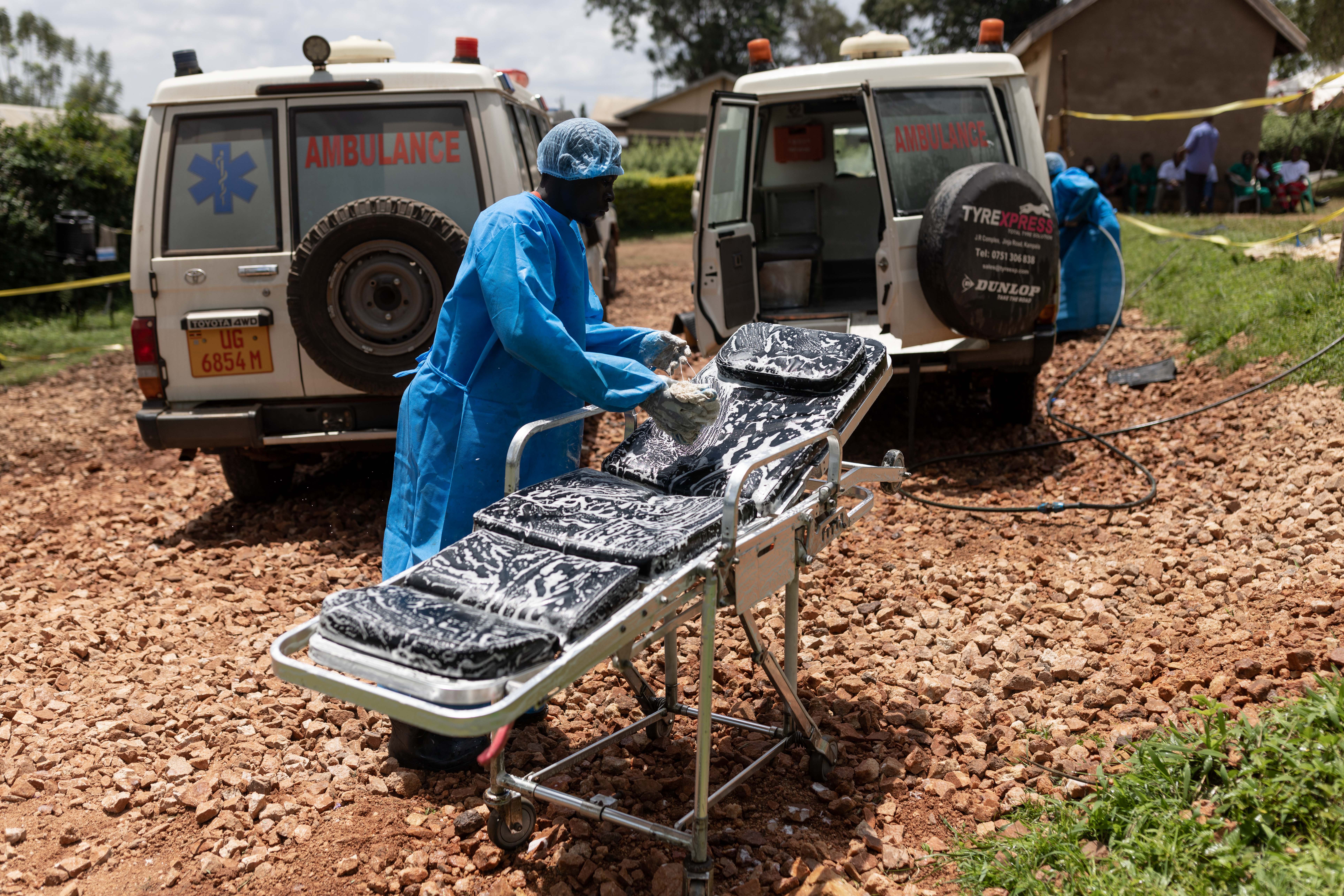
 Red Cross workers clean ambulances prior to transporting Ebola victims to a hospital on October 13, 2022 in Mubende, Uganda. Emergency response teams, isolation centres and treatment tents have been set up by the Ugandan health authorities around the central Mubende district after 19 recorded deaths and 54 confirmed cases from an outbreak of the Ebola virus. The first death from this outbreak of the Ebola-Sudan strain of the virus was announced on 19 September and as yet, there is no vaccine for this strain. (Photo: Luke Dray/Getty Images)
The outbreak, declared on May 15, has so far infected 1,759 people across the eastern provinces of Ituri, North Kivu and South Kivu, according to the government’s latest situation report published Wednesday night.
But that case total does not include two cases in Kisangani, the capital of Tshopo province and one of Congo’s biggest cities, the situation report said.
One of those cases is linked to the health zone of Niania in Ituri province, where the first cases were reported. But the second case “does not appear to have a geographic link” beyond Kisangani, it said.
The positive test results are in the process of being validated by confirmatory testing, after which they will be included in the official case total, it said.
Response teams have in the meantime begun strengthening surveillance, contact tracing and other containment measures in Kisangani, it said.
Reuters reported last week that Congolese health authorities were tracing people potentially exposed to Ebola in two provinces not previously affected by the outbreak: Tshopo and Haut-Uele.
The situation report published late Wednesday documented 51 new cases and 20 new deaths in the previous 24 hours.
The World Health Organization said this week that the outbreak had not yet stabilised and was still expanding as population movement fuelled transmission.
(Reporting by Congo newsroom; Writing by Amindeh Blaise Atabong; Editing by Robbie Corey-Boulet and Stephen Coates)
Comments
Scroll down to load comments...