




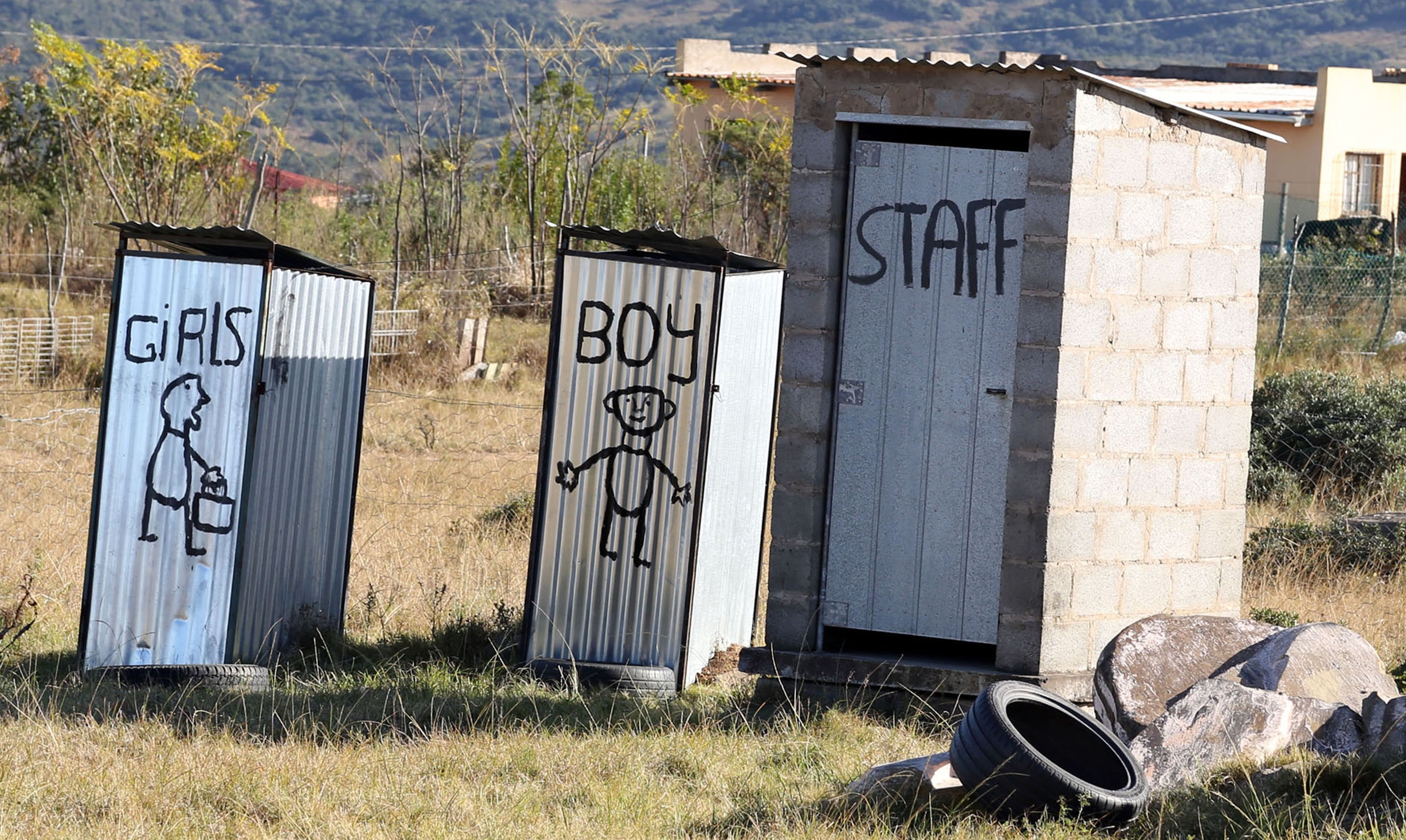
 Makeshift toilets at a crèche in Mathanga village in the Eastern Cape, South Africa. (Photo: Gallo Images / Daily Dispatch / Alan Eason)
On Monday, 6 July 2026, Basic Education Minister Siviwe Gwarube announced that the Department of Basic Education had completed all pit-toilet eradication projects identified in the 2018 Sanitation Appropriate for Education (Safe) Initiative audit.
Speaking during an oversight visit to Dimbaza Primary School in the Eastern Cape, Gwarube said all 3,372 schools on the Safe list had now been provided with safe and appropriate sanitation facilities. The completed projects now provide safer sanitation for more than three million learners and improved working conditions for over 48,000 teachers.
Gwarube framed the announcement as a historic milestone that honours the memory of children like Michael Komape, Lumka Mkhethwa, and Langalam Viki, whose tragic deaths in pit latrines catalysed the drive to eradicate them.
She emphasised that the announcement does not suggest that every pit toilet in the country has disappeared, noting that some schools may have developed sanitation challenges after the original 2018 audit, others may have been unintentionally omitted, while some communities have retained old pit toilet structures despite receiving new facilities.
However, civil society organisations and non-profit organisations caution that the reality on the ground in many provinces does not yet reflect the department’s claims. They point to ongoing reports of learners still using unsafe pit latrines, schools omitted from the Safe audit, and the failure to remove old pit toilets after building new toilets.
/file/dailymaverick/wp-content/uploads/2025/04/6_grid_Pit.jpg "Tragic pit toilet deaths (clockwise from top left): Oratile Diloane. (Photo: Supplied) | Lister Magongwa. (Image: Kristin-BeetleBattles / Facebook) | Michael Komape. (Photo: Supplied /News24.com / Wikipedia) | Langalam Viki. (Photo: Supplied) | Unecebo Mboteni . (Photo: Supplied) | Siyamthanda Mtunu. (Photo: Supplied)")
The demolition deficit
Thato Gaffane, an attorney in the Education Rights Programme at SECTION27, said they welcomed the formal completion of the Safe initiative and Gwarube stating that provincial education departments must conduct an audit to identify other schools that may need eradication and replacement of pit toilets.
“We continue to be worried about the state of pit toilets in SA. There are still quite a lot of schools, particularly in under-resourced areas, where pit toilets continue to be a thing. There are also areas where even though proper sanitation facilities have been built, pit toilets remain, and they’re not demolished, which poses health and safety risks for the learners in those particular areas,” said Gaffane.
/file/dailymaverick/wp-content/uploads/2024/12/MC-EE-Oped_8.jpg "Pit toilets at schools have not been eradicated and pose many dangers to small children. (Photo: Sandile Ndlovu / Sowetan / Gallo Images)")
Gaffane explained that SECTION27 did not currently have a definitive national estimate for the number of remaining pit latrines across SA, but was aware that Eastern Cape, KwaZulu-Natal and Mpumalanga faced ongoing challenges. Regarding Limpopo, Gaffane explained that while the provincial department’s latest tracking indicates that no public schools relied solely on pit latrines any more, there were still many schools that had them as they had not been demolished.
A decade of shifted goalposts
In response to Gwarube’s announcement, Equal Education tracked a decade-long history of missed deadlines and unfulfilled government promises regarding school sanitation.
The organisation pointed out that pit latrines were formally recognised as unlawful more than a decade ago under the 2013 Minimum Uniform Norms and Standards for School Infrastructure. Under those original regulations, the government was legally mandated to eradicate all public school pit toilets by 2016.
Following the government’s failure to meet that target, the Safe initiative was launched in 2018 after the Department of Basic Education lost its appeal against Equal Education’s court case to tighten the law of norms and standards for public school infrastructure. The launch brought a fresh presidential commitment to clear all pit latrines by 2022. When Gwarube assumed office, she stated that all remaining pit toilets across the country would be eradicated by 31 March 2025.

“The deadline and goalposts for eradication have been shifted time and again without any measure of accountability or consequences enacted against those who have failed to live up to their promises,” said Mahfouz Raffee, Equal Education’s Head of Research.
The delayed national audit
A central criticism raised by Equal Education is the department’s continued reliance on the 2018 Safe database, which they argue is an incomplete snapshot of the country’s actual school infrastructure needs.
According to Equal Education, the department has long been aware of these gaps. In April 2025, the department officially committed to conducting a new national audit to identify omitted schools and assess worsening sanitation needs. However, more than a year later, that database has still not been made public.
“Without an updated national audit, the minister and the department will continue to evade accountability for ongoing rights violations,” said Raffee.
As there is no active national repository tracking the post-handover condition of public school restrooms, the department remains unaccountable for how many of its 3,372 upgraded Safe facilities are currently broken, waterless or blocked.
“The Department of Basic Education’s failure to complete a comprehensive, up-to-date national infrastructure audit means that the government continues to plan and budget using outdated information,” said Raffee.
“Learners whose schools were excluded from the 2018 audit remain invisible in official planning, despite their continued exposure to dangerous and undignified sanitation. An outdated database cannot be the basis for declaring success while children remain at risk.”
/file/dailymaverick/wp-content/uploads/Adam-Main.jpg "A dilapidated pit toilet at Utjane Primary School in Utjane Village, Limpopo. The toilet is still used by learners of all ages. (Photo: Adam Yates)")
To rectify this, the organisation has called for Gwarube to immediately “commission and publish a comprehensive national audit of school infrastructure, including sanitation, so that the full extent of infrastructure backlogs is publicly known”. This data must be accompanied by a rigorous, publicly accessible monitoring system to actively track the functional lifespan of existing toilets and prevent future contractor abandonment.
Echoing these calls for urgent data transparency, Amnesty International South Africa Executive Director Shenilla Mohamed said that they welcomed the long overdue development of clearing the targeted Safe backlog, but there were many schools still using pit toilets that had not been accounted for.
“Going forward, the department must conduct an updated audit of all schools still using pit toilets, which includes those that were not part of the Safe initiative, and include Early Childhood Development (ECD) centres. It must then outline how it plans to eradicate all remaining pit toilets in schools and ECD centres with clear timelines,” said Mohamed.
/file/attachments/orphans/Photo-1_719273.jpg "On Monday, 6 July 2026, Basic Education Minister Siviwe Gwarube announced that the Department of Basic Education had completed all pit-toilet eradication projects identified in the 2018 Sanitation Appropriate for Education (Safe) Initiative audit. (Photo: Deon Ferreira)")
The reality on the ground
To demonstrate how the sanitation crisis persists beyond the confines of government lists, Equal Education highlighted the current situation at Mathukulula Secondary School in KwaZulu-Natal.
In 2024, a contractor was appointed to eradicate and replace the school’s pit toilets. However, after having only laid the foundations for a new toilet block, the contractor abandoned the site. No new contractor has been appointed due to budget constraints in the KwaZulu-Natal Department of Education, and today, learners at the school are still reliant on unsafe sanitation facilities, and the school lacks access to clean water on site.
“This highlights the absurdity of celebrating the completion of the Safe programme while still depriving learners of the barest of resources to facilitate their education,” said Raffee.
/file/dailymaverick/wp-content/uploads/2025/10/unnamed-1-3.jpg "At Dr MJ Madiba Secondary School, Enviro Loos are filthy and in need of repair. (Photo: Liezl Human)")
Marion Wagner, CEO of Breadline Africa, a non-profit organisation providing educational infrastructure for early childhood development, congratulated the Department of Basic Education and all its partners on the significant progress that has been made in replacing unsafe pit toilets in schools.
Since 2023, the organisation has completed safe sanitation projects at 53 schools, yet more than 400 schools have applied for assistance.
“In just one municipal district in KwaZulu-Natal, more than 100 schools have requested support. The Eastern Cape Department of Education has also advised us that more than 700 schools in the province are still using pit toilets. Based on what we are seeing across the country, we believe that around 3,000 schools may still be relying on unsafe sanitation facilities,” said Wagner.
She added that the progress achieved so far demonstrated what was possible and that the next step was to build on that momentum.
“If the government, the private sector, donors and civil society continue working together, and if public investment can be matched by private funding and delivery capacity, we can accelerate the replacement of unsafe sanitation and ensure that every learner has access to safe, dignified school facilities,” she said. DM
Comments
Scroll down to load comments...