





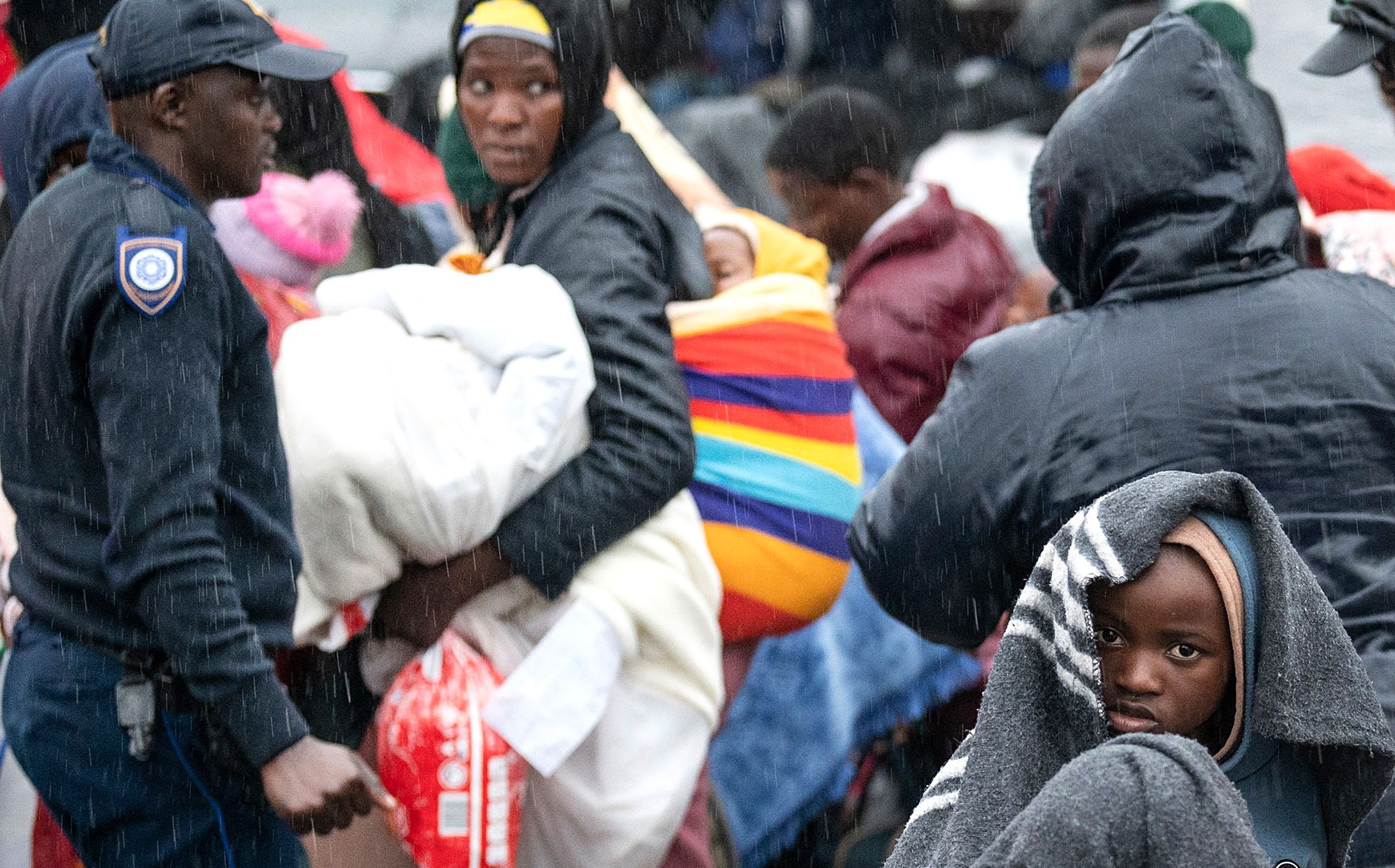
 Zimbabweans in the rain outside the Zimbabwe consulate, waiting to be moved to Home Affairs in Epping, Cape Town, amid the repatriation crisis on 28 June 2026. The voluntary repatriation came amid fears of intimidation, threats of violence and challenges with documentation. (Photo: Gallo Images / Brenton Geach)
Thousands of school-going children from Zimbabwean families are being withdrawn from South African schools due to anti-migrant unrest in the country, raising serious concerns about the educational futures of learners, according to the Zimbabwean Exemption Permit (ZEP) Coordinating Committee.
While Edward Muchatuta, national coordinator of the committee, estimated that the number of children affected was in the thousands, he noted that tracking cases on the ground had become increasingly difficult.
The group relies on a network of provincial and area coordinators to gather information, and with the environment for foreign nationals becoming more hostile, many of these people are on the run or hiding their identities as migrants.
The disruption of education is most troubling for the matric class of 2026, with many Grade 12 learners already registered to write their final National Senior Certificate examinations in November. The children of migrant parents and guardians who are fleeing the country are being abruptly pulled from their classrooms.
/file/attachments/orphans/ED_613883_616055_304340.jpg "Zimbabweans in the rain outside the Zimbabwe consulate, waiting to be moved to Home Affairs in Epping, Cape Town, amid the repatriation crisis on 28 June 2026. The voluntary repatriation came amid fears of intimidation, threats of violence and challenges with documentation. (Photo: Gallo Images / Brenton Geach)")
“Imagine you are at school, you have been doing well, studying well and preparing for exams, then at the 11th hour being told that you have to relocate. Some children have been telling us that they are even prepared to commit suicide if they are going to be forced to go to Zimbabwe,” said Muchatuta.
Documented migrants flee
*Jessie, a Zimbabwean who has lived and worked in South Africa for 17 years, told Daily Maverick that despite possessing documentation, her family was planning to return to Zimbabwe simply to escape the rising hostility.
“Staying would literally mean that we will be in a toxic environment where you’re not wanted,” she said.
The relocation directly threatens her oldest son’s prospects of completing his high school education this year. He is already a repeat student, having lost a year when he transitioned from the Zimbabwean education system to the South African one in 2015.
“He won’t be able to write his matric this year. He really wants to write his matric, so that he can start focusing on going to university and furthering his education. But he is already facing stigma and discrimination from the teachers, fellow students and even neighbours, so when he goes to school, he’s moving around in a toxic environment for him,” she said.
/file/attachments/orphans/P2_969348.jpg "Protesters marched through the Johannesburg CBD on Tuesday, 30 June 2026. Several people who were suspected by protesters of being foreign nationals were confronted by the crowd. A small group was shielded from assault by people who intervened and escorted them to safety. (Photo: Leon Sadiki)")
Several of his classmates have already fled back to Zimbabwe due to the rising pressures.
“He might try to [push] to stay, but his mental state is not okay for him to really sit down and continue studying… [so] that he will be able to write matric and come out with positive results,” said Jessie.
Her younger son, in Grade 5, could also face an academic setback because the Zimbabwean academic year is under way. “If we are to go today, he has to wait until next year, so he’s literally going to sit for seven months before he can start again, and repeat Grade 5 next year,” Jessie said.
She expressed deep concern over the long-term impacts of children being out of school for almost a year, warning that prolonged displacement renders them highly vulnerable.
“You’re looking at children becoming idle. Some might opt to take drugs or something to kill time, and then we’ve literally destroyed the future for our children in such a short space of time,” she said.
/file/attachments/orphans/ED_613892_843200_225505.jpg "Zimbabweans in the rain outside the Zimbabwe consulate, waiting to be moved to Home Affairs in Epping, Cape Town, amid the repatriation crisis on 28 June 2026. The voluntary repatriation came amid fears of intimidation, threats of violence and challenges with documentation. (Photo: Gallo Images / Brenton Geach)")
Jessie noted that holding legal permits had offered little protection, explaining that the current enforcement actions on the ground made little distinction between undocumented migrants and those with papers. She described a volatile environment, particularly within informal settlements, where community groups and authorities conducted targeted raids.
“They are literally going into people’s houses, whether you’re documented or not, and just throwing you out. We have seen circumstances where documents are being torn up, so it’s not like I can just relax and say, ‘I’m okay’. I’m not okay,” she said.
Jessie urged the South African and Zimbabwean governments to collaborate on a solution to education challenges for returning families.
Compounding academic setbacks
Many of the affected learners have already faced compounding academic setbacks. Those who moved from Zimbabwe to South Africa had to repeat a grade upon arrival to adjust to the local system. A return to Zimbabwe means they will probably have to repeat a grade for a second time, a cycle that Muchatuta warns will rob them of critical years.
“How many years are those children going to lose? Consider the investment because all these years they are learning in South Africa, and at the last minute they are being told to switch to the Zimbabwe education system,” he said.
Muchatuta said that a mid-year curriculum pivot was “totally impossible”.
The committee estimates it would take at least three years for these students to integrate and sit for Zimbabwean final exams.
/file/attachments/2992/Xeno-4_614973_868938_397619.jpg "On a dirty pavement outside Durban’s Home Affairs Refugee Reception Centre, a huddle of terrified people waits for 30 June 2026, the ominous deadline anti-illegal immigration groups set for undocumented foreigners to leave South Africa. (Photo: Supplied)")
Muchatuta said a large portion of these children had studied Afrikaans for the past 10 years, but in Zimbabwe, they would have to take Shona or Ndebele — languages they had never studied.
Furthermore, core South African subjects such as mathematical literacy and life orientation do not exist in the Zimbabwean syllabus, which also features entirely different structural programming for mathematics, science and history, alongside a lack of the continuous Curriculum and Assessment Policy Statement (Caps) practical assignments students are accustomed to.
Younger learners are facing a similar deadlock, with primary school transitions effectively frozen. National exam registration for Grade 7 in Zimbabwe closed in March, meaning children uprooted from South Africa mid-year are disqualified from moving into Form 1 (Grade 7) next year. According to the committee, the same disruption is affecting other grades, leaving hundreds of primary school pupils entirely out of sync with the academic calendar.
/file/attachments/orphans/IMG_8616_472010.jpg "A young girl peers through the crowd at the Malawian consulate in Sandton as families await assistance with repatriations. (Photo: Reitumetse Pilane)")
Appeal to education departments
In response to the crisis, the committee has tabled an urgent appeal to the education departments of both South Africa and Zimbabwe to implement immediate emergency measures.
Their proposal calls for affected learners to be permitted to continue with the South African syllabus within Zimbabwe, alongside the establishment of joint examination centres in Beitbridge or at the Musina Repatriation Centre so the matric class of 2026 can sit for their finals. The committee emphasised that parents are prepared to self-fund these support programmes by using a network of qualified returning teachers and tutors who previously taught in South Africa.
“As parents, we are saying we are prepared to fund the education of our children like we have been doing before. What we want is just a political will from the South African government and the Zimbabwean government,” said Muchatuta.
In January 2026, the South African Department of Basic Education (DBE) firmly rejected claims that foreign learners were placing undue pressure on the education system, labelling such assertions as “patently false” and statistically incorrect. The 1.8% of foreign learners in South African schools includes the children of diplomats, United Nations agencies and international organisations.
That same month, Minister of Basic Education Siviwe Gwarube issued a parliamentary reply, saying there were 253,618 foreign learners enrolled and 3,240 foreign educators employed across the country’s public schools.
Daily Maverick sent questions to the Department of Basic Education about its strategies to assist foreign learners facing relocation to other countries, including Zimbabwe. At the time of publication, the department had not replied.
/file/attachments/orphans/WhatsAppImage2026-07-03at175020_986804.jpeg "The temporary repatriation processing centre in Musina, Limpopo, on 2 July 2026. (Photo: Siyabulela Duda / GCIS)")
Families in limbo
/file/attachments/orphans/IMG_8619_953531.jpg "Malawian nationals continue to seek assistance with voluntary repatriation at the Sandton consulate on Monday, 6 July. The consulate remains closed, leaving many with no option but to camp outside. (Photo: Reitumetse Pilane)")
Speaking to Daily Maverick from outside the Malawi Consulate General in Johannesburg, *Jane, a representative of Kopanang Africa Against Xenophobia (Kaax), said that many people were still stuck, waiting to be processed for voluntary repatriation back to their home countries.
She estimated that about 500 people were camped on the street outside the consulate general on Monday, 6 July, of whom 52 were babies, some as young as a few weeks old. A further 150 people arrived at the site on Tuesday.
A water truck and mobile clinic were stationed outside the facility to help those in need. Jane noted that mothers with young babies were sleeping on mattresses under a nearby tree at night.
“People are just all over the place, and for the little ones, school has been disrupted,” she said.
“The little ones, I don’t think they have any idea what their parents are going through... But I spoke to a few of the teenagers, especially the Zimbabwean kids… and they are actually confused. ‘We don’t know where we’re going. What life are we going to have there? We have to go and start afresh. We have to leave everything behind.’ They’re just scared.
“Even the… higher education students have concerns, because they are also being targeted. In the schools, the children are being targeted… They are actually being bullied.”
She noted that many children of migrant parents had been born in South Africa and spent most of their lives there.
A child born in South Africa to parents who are foreign nationals does not automatically acquire South African citizenship, but can apply for citizenship at the age of 18.
Jane said that parents seeking repatriation to their home countries were unlikely to leave their children behind to continue their education in South Africa.
This view was echoed by the Scalabrini Centre of Cape Town, a nonprofit in the Western Cape promoting the rights of migrants and refugees. It noted that families it had engaged with “consistently expressed a strong desire to remain together”.
“One particularly complex situation arises where a foreign national parent has a child with a South African citizen. In these cases, families may face extremely difficult decisions if immigration enforcement affects one parent, while the child and other parent have a legal right to remain in South Africa,” said the centre.
/file/attachments/orphans/6I1A5695_533731.jpg "Arrested foreign nationals during an operation targeting undocumented migrants in Durban’s Point area on 29 June 2026. (Photo: Felix Dlangamandla)")
Arrested for deportation
Amid the government crackdown on undocumented foreign nationals in South Africa, there have been reports of parents of minor children being arrested for deportation.
On 4 July, Kaax flagged a case in Johannesburg where a Malawian woman with a two-week-old baby was allegedly arrested due to a lack of documentation. Kaax said that the woman’s baby was taken by the Department of Social Development while she was in police custody, adding that separating a breastfeeding infant from its mother was a violation of the Constitution.
According to the Scalabrini Centre, when the arrest or detention of a parent or caregiver may leave a child without appropriate care, the matter should be referred without delay to the relevant Department of Social Development or designated child protection organisation. A social worker should assess the child’s circumstances, determine whether suitable care arrangements are available, and ensure that all decisions are guided by the child’s best interests.
“Children should never be left without appropriate care as a consequence of immigration enforcement. Where necessary, child protection interventions should include immediate safety assessments, placement with suitable caregivers where appropriate, and ongoing case management. Authorities should also make every reasonable effort to preserve family unity wherever this can be achieved safely and lawfully,” said the centre.
The centre noted that while there were examples of positive cooperation between immigration officials, social workers and civil society organisations, child protection considerations were not integrated into immigration enforcement processes as consistently as they should be.
/file/attachments/orphans/WFD_7800_567448.jpg "Arrested foreign nationals during an operation targeting undocumented migrants in Durban’s Point area on 29 June 2026. (Photo: Felix Dlangamandla)")
“Where enforcement operations occur rapidly, there may be limited opportunity to conduct comprehensive child protection assessments, particularly where there are questions regarding children’s care arrangements, documentation or family circumstances. This can increase the risk of family separation or leave children in situations of uncertainty at a time when they require stability and protection,” the centre said.
“The Scalabrini Centre believes that stronger coordination between the Department of Home Affairs, the South African Police Service, the Department of Social Development and child protection organisations is essential.”
Children taken by the Department of Social Development were returned to their parents at the point of deportation, or upon the parents’ release, according to Jane. She noted that in some cases, Kaax had helped parents with the reunification process.
“It must actually be a scary situation [for the child], being in... strangers’ hands. You don’t see your mother for one week, two weeks,” she said.
However, Jane noted that the Department of Social Development took good care of the children it was charged with, providing food and shelter, as well as transport to their respective schools.
Daily Maverick asked the SAPS as well as the departments of Social Development and Home Affairs about the child protection protocols involved in immigration enforcement proceedings, but had not received a response at the time of publishing. DM
*Jessie and Jane are pseudonyms ascribed to sources who chose to remain anonymous out of concern for backlash.
Comments
Scroll down to load comments...