




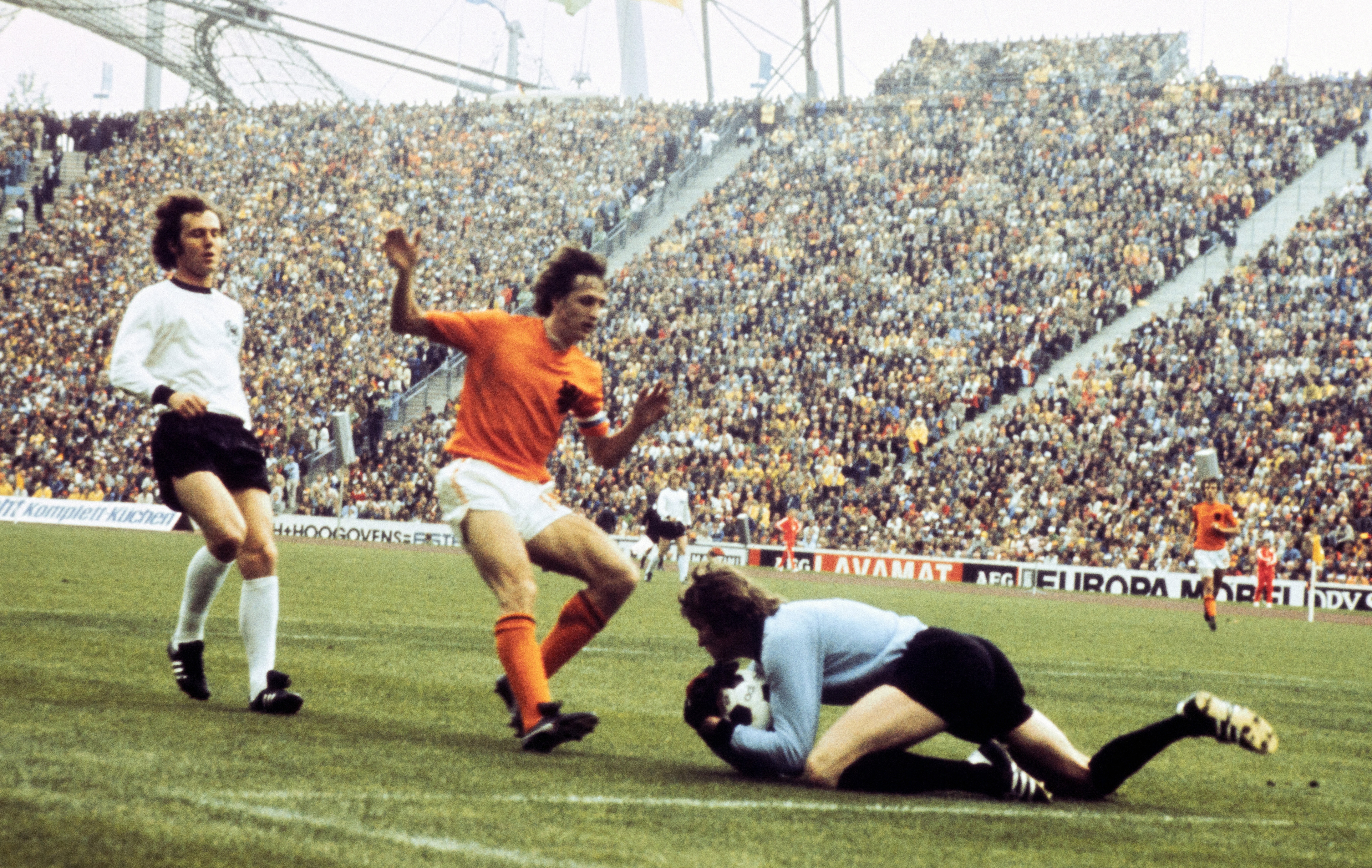
 West German goalkeeper Sepp Maier catches the ball in front of Dutch forward Johan Cruyff as defender Franz Beckenbauer (left) looks on. Cruyff’s Holland were the best team in the world and invented ‘total football’. But they lost the 1974 World Cup final on 7 July 1974 in Munich against a pragmatic West Germany. (Photo:AFP)
The conventional prism of history – whether it’s wars, revolutions, elections or mere football tournaments – is in terms of the winners. They get chronicled, remembered and lionised. But, for me, the losers are more intriguing. The What If, the What Could Have Been, the Where Did It All Go Wrong stories have more nuance and texture with an essential dollop of heartache and a hint of injustice.
The Fifa World Cup is rich in these tragic yarns because of its massive significance and its quadrennial nature. A gilded team that misses out on glory won’t get another shot for four long years, by which time they, and the game, will be very different.
So, let’s take a wander through the World Cup graveyard of dreams (with a big nod to David Goldblatt’s exceptional history of football, The Ball is Round).
1930s Austria. Italy won consecutive World Cups in 1934 and 1938 but the defining team of the era was the Austrian “Wunderteam” which reinvented the game with a higher-tempo, fluid passing style dubbed the “Danubian Whirl”. They beat all major European opposition, including Italy, and were led by the deceptively lightweight Matthias Sindelar, the “Mozart of Football”, who was what we now call a false nine who could create and score. At the 1934 World Cup in Italy, the Austrians were the favourites but lost a physical, cantankerous, dubiously refereed semifinal to the hosts. Come 1938, they qualified easily for the finals in France but the Nazi annexation of Austria (the Anschluss) prior to the tournament meant their players were reluctantly folded into the German side. Sindelar refused to play in German colours and died mysteriously one year later. The merged German team ultimately performed very poorly in France, much to the chagrin of the Nazi propagandists. Austria’s moment had passed. They would never be World Cup contenders again.
1950 Italy. Justifiable Italian dreams of a third consecutive World Cup (with an interregnum for World War 2) vanished a year before the tournament when a plane carrying the champion Torino club team back from a game in Portugal crashed in thick fog into the basilica of Superga on a hilltop above Turin. The entire squad perished. They were the finest club side in the world and almost every player was in the national team. When a denuded Italian side finally travelled to Brazil for the tournament, they refused to fly and travelled by boat instead. They went out in the first round. It would be 20 years before Italy would once again play a significant role in World Cup finals.
/file/attachments/orphans/GettyImages-185763145_857841.jpg "Hungarian captain Ferenc Puskas (1927-2006, second from right) scores his team’s second goal in the 17th minute of a friendly international at the Nepstadion, Budapest, on 23 May 1954. Looking on are England keeper Gil Merrick (1922-2010, left, rear) and centre-half Syd Owen (1922-1999, right). Hungary won 7-1, in England’s worst footballing defeat to date. (Photo: Keystone / Hulton Archive / Getty Images)")
1954 Hungary. Just as Austria’s Wunderteam had done in the 1930s, the Marvelous Magyars transformed world football between 1950 and 1956, when they played 50 matches, winning 42, drawing seven and losing only once. The Hungarian victories included a seminal 6-3 thrashing of England at Wembley (where the hosts had never lost before), an Olympic gold medal and an 8-3 drubbing of West Germany in the group phase of the 1954 World Cup finals in Switzerland. Sadly, Hungary’s only loss in this glorious run was in the final itself, to that same German side when the Hungarians led 2-0 at halftime but faded in the heavy conditions and lost 3-2 to their fitter opponents. Their superstar was Ferenc Puskás, after whom Fifa’s “Beautiful Goal of the Year” trophy is named. A brilliant striker, he became a Real Madrid legend while leading them to five league titles and three European Cups. The 1956 revolution in Hungary, brutally suppressed by the Soviet Union, destroyed this great side. Hungary have not been top table contenders since.
/file/attachments/orphans/AFP_20100624_dpa_2071118_v1_HighRes_SoccerWorldCup1954RunnerUpHungary_249963.jpg "Hungary’s national soccer team forms a line for the presentation of the national anthems on 4 July 1954 at Wankdorf Stadium in Bern just before the World Cup final against Germany. From left: Ferenc Puskás, Gyula Grosics, Gyula Lóránt, Nándor Hidegkuti, József Bozsik, Mihály Lantos, József Zakariás, Jenő Buzánszky, József Tóth, Sándor Kocsis and Zoltán Czibor. (Photo: dpa Picture-Alliance via AFP)")
1974 Netherlands. Up to this point the Dutch had achieved nothing in international football, not even appearing at the World Cup finals since 1938. And they barely qualified for this edition in West Germany. But the brilliant Ajax Amsterdam side was now a major force in European football and coach Rinus Michels was about to trigger a revolution. Orchestrated by the unique genius that was Johan Cruyff, the team – which included stellar talents like Johan Neeskens, Ruud Krol (who would later manage Orlando Pirates), Wim van Hanegem (my personal favourite) and the first of the sweeper-keepers in Jan Jongbloed – played what became known as Total Football, with players interchanging positions in a way that opponents found impossible to mark. It was utterly thrilling, skilful, glitzy football. The Clockwork Orange, as they were also nicknamed, swept into the final against their dogged, less-stylish German rivals and were a goal to the good with a penalty inside just one minute but then showboated and never pressed their advantage. The hosts, led by “Kaiser Franz” Beckenbauer and Gerd “Der Bomber” Müller, fought their way back and won 2-1. The non-Teutonic football world mourned. The temperamental football savant, Cruyff, went on to become a Barcelona icon as both a player and a manager. The Dutch have reached the World Cup final twice since the Munich loss (1978 and 2010) but are yet to win the trophy.
/file/attachments/2994/4031790_127766.jpg "Brazilian midfielder Sócrates in action against the USSR during the 1982 World Cup at Sanchez Pizjuan stadium in Seville. (Photo: EPA)")
1982 Brazil. Since their fabled, fabulous cup win with Pelé & co in Mexico in 1970, Brazil had been a pale shadow of themselves, but the side that arrived in Spain in 1982 felt and smelt like the real deal. They were led by the charismatic, intellectual, chain-smoking Sócrates who strolled imperiously around the pitch and linked with the likes of Zico, Falcão and Éder to effortlessly create space. They seemed destined for golden glory, and only needed a draw against the ever-pragmatic Italy in the second round to qualify for the semifinals. But the Seleção’s defence was casual in the extreme. Twice they sloppily went behind, twice they equalised, then Paolo Rossi completed a famous hat-trick in the 74th minute to send the most fluent team I have ever seen home without a medal. The game is known by some as “the day football died” because subsequent Brazilian coaches felt the lesson of the match was that the Samba Kings had to rein in their traditional flamboyance and become more disciplined and physical.
1986 France. The French arrived in Mexico as reigning European champions and with, arguably, the greatest midfield of all-time – talisman Michel Platini, Alain Giresse, Jean Tigana and Luis Fernandez. They were known as The Magic Square or The Four Musketeers and I watched them in León bewilder a strong Soviet Union. The most talented side in the tournament and definitely the best to watch, they knocked out defending champions Italy and then Brazil before the West Germans (ever the party poopers) burst their bubble in a hard-fought semi. This luminous team soon fell apart and none of them was in the squad when France finally won its first World Cup, on home soil in 1998.
/file/attachments/orphans/GettyImages-2262318571_514275.jpg "Michel Platini of France during the World Cup in Mexico in 1986. (Photo: Agency / Getty Images)")
2010 Ghana. No game has ever broken the hearts of an entire continent like Uruguay’s quarterfinal win over Ghana on penalties at Soccer City before 84,000 on a chilly July Johannesburg night. Having navigated their way out of a tough group, and beaten the USA in the round of 16, on the back of goals by Asamoah Gyan, this talented and experienced Ghanaian side, with John Mensah, Sulley Muntari, André Ayew, Kevin-Prince Boateng and Stephen Appiah in their ranks, were on the brink of becoming the first African team to reach the semis when Dominic Adiyiah’s header looked certain to cross the line for the winner late in extra time.
/file/attachments/orphans/GettyImages-102590093_174289.jpg "Luis Suárez of Uruguay handles the ball on the goal line, for which he was sent off, during the 2010 World Cup quarterfinal against Ghana at Soccer City. (Photo: Michael Steele / Getty Images)")
But the ever-controversial Luis Suárez blatantly blocked the ball with his hands. He was sent off and Gyan then smashed the resulting penalty onto the crossbar. The resilient Uruguayans won the nail-biting shootout and Suárez was a hero in Montevideo and a cartoon villain everywhere else on the planet. Ghana’s next World Cup campaign in 2014 was an ill-disciplined mess and their Golden Generation was gone. As for Suárez, it somehow seems appropriate that, during those 2014 finals in Brazil, he was suspended for nine matches after biting Italian defender Giorgio Chiellini. DM
Comments
Scroll down to load comments...