




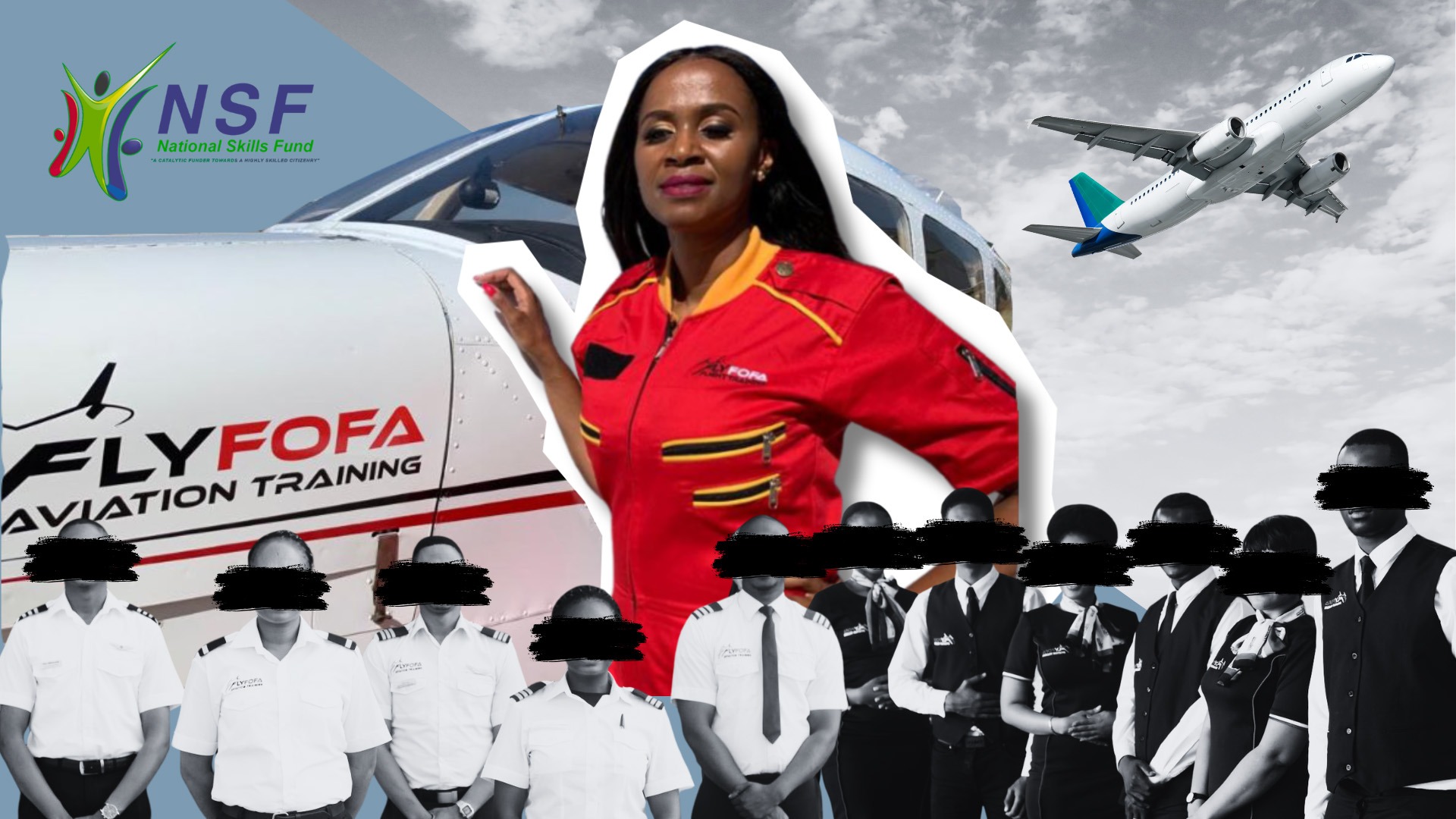
 Flyfofa Aviation & Training CEO and sole director Jacobeth Fisha (pictured) is at the centre of an NSF-funded bursary project dogged by inflated flying-hour claims, self-dealing and an R85-million court case surrounding Flyfofa’s sister company. (Flyfofa / Envato)
 In 2024, the National Skills Fund (NSF) awarded R148-million in funding to Wonderboom-based Flyfofa Aviation Training to train Gauteng residents from impoverished schools.
On its website, Flyfofa Aviation Training described this as offering “a life changing bursary program to young people from Gauteng”, covering options such as cabin crew training, advanced pilot hour-building and earning a remote pilot drone certificate.
However, within a year of receiving the funding, it appears Flyfofa began doctoring the flying hours, claiming what the NSF says turned out to be an inflated number of flying hours in the hour-building programme.
When the NSF compared the actual student pilots and their pilot’s logbooks against the claimed flying hours submitted by Flyfofa, there was a significant mismatch – a gap serious enough that the NSF had to issue the school with a noncompliance letter, accusing it of submitting false information.
That means the students were not getting all the hours, but the school was pocketing the extra money. According to the NSF, the discrepancy amounted to R3 879 159.89, reflected in credit notes later issued by Flyfofa.
The NSF told us the hours claimed were signed off by the school’s head of training and its chief executive and sole director, Jacobeth Fisha.
We will come back to Jacobeth later, but neither she nor anyone else at the company bothered to respond to questions sent by amaBhungane.
/file/attachments/orphans/Graphic1-Mapping-the-noncompliance_561391.jpg "Image credits: Corlia Kruger / The Citizen; Canva; Flyfofa (Facebook and X)")
On discovery of the discrepancies, the NSF suspended its contractual tranche payments, but these were resumed after it was agreed that Flyfofa would provide credit notes for the relevant expenses, a letter of commitment to deliver the outstanding flying hours, and a recovery plan for the outstanding flying hours.
If the hours aren’t recovered by 30 June 2026, Flyfofa is supposed to repay the money.
As of 6 July, the NSF told us Flyfofa had not responded to their last letter: “As far as we are aware – they have not recovered the outstanding hours as at 30 June 2026.”
And the padded hour-building claims were not the only red flag uncovered by the NSF, as we’ll see.
Tip-off
The NSF is funded by a 1% tax on every employer’s payroll and exists to train unemployed young people. It operates with an annual allocated budget of about R5-billion with about R4-billion spent in the 2024/25 financial year.
Our ongoing investigations into the NSF began in January 2026 with a story about PetroSA’s attempt to leverage NSF funding.
That same month we received an anonymous tip-off about Flyfofa Aviation Training and several quite detailed allegations were made.
The NSF bursary in this case was reserved for students from quintile 1, 2 and 3, no-fee schools, the poorest in the country, for the drone and cabin crew courses – and previous disadvantage was also a qualifying factor in selection for the hour-building programme, although applicants were required to have a pilot’s licence already. The source told amaBhungane the intake didn’t match that on the ground. Some students came from private schools, they claimed. Others, the source said, were related to the people running the recruitment process. Flyfofa did not respond to any of this and amaBhungane was not able to confirm these claims. The NSF said it wasn’t aware of the allegations.
/file/attachments/orphans/Graphic2-The-Flyfofa-Pitch_838552.jpg "Image credits: Canva; Flyfofa (Facebook and X)")
Money moving
The NSF’s agreements require project money to run through a single, dedicated bank account in order for the NSF to monitor the account and prevent the misuse of the funds. Flyfofa had one but NSF told us that the school made bulk transfers out of the account. This was a breach of contract; the NSF flagged them and ordered every payment routed through the account to be backed with documents proving it matched real expenditure. The NSF now also requires weekly bank statements to track expenditure.
The matter has been referred to the NSF directorate of internal audit for attention.
While the NSF tranche payments were on hold, Flyfofa stopped paying some student accommodation providers and allegedly fell behind on payments to drone examiners and medical practitioners. The NSF confirmed the accommodation nonpayment. It says paying the examiners and doctors was never its responsibility, since its contract is with the school alone.
Self-dealing
There is also money moving inside the same circle of companies. Flyfofa Aviation Training paid Teejay Properties R11-million for accommodation and transport, and JMF Promotions R2-million for uniforms, learner materials and toolkits.
Jacobeth Fisha is a director of both companies, while her husband, Thabo Fisha, is a co-director in Teejay Properties. On his LinkedIn page Thabo also describes himself as “executive chairman” of Flyfofa Airways & Aviation Training.
On paper it appears as if Flyfofa Aviation Training contracted two separate companies to provide accommodation, transport services and merchandise, but in actual fact it was a husband and wife, doing dealings with each other.
/file/attachments/orphans/Graphic3-Keeping-it-in-the-family_180216.jpg "Image credits: Canva; Flyfofa (Facebook and X)")
The NSF says it only learnt of the arrangement once it queried the payments. The fund said it has subsequently ordered Flyfofa Aviation Training to prove the deals were struck at market value. To this request, says the NSF, it found the documents unconvincing and the matter is still ongoing, pending a resolution.
The sister company: Flyfofa Airways
The Flyfofa name has attracted controversy almost from the beginning.
A report in the publication Spotlight (also published in Daily Maverick) connected FlyFofa Airways to a contested air ambulance tender awarded in 2015. Flyfofa Airways is a sister company formed on the same day (28 November 2013) as Flyfofa Aviation Training and Jacobeth Fisha is currently its sole director.
The story, drawing on earlier reporting from Erika Gibson, revealed that Thabo Fisha had in September 2015 been dismissed from a senior position at the South African Civil Aviation Authority and had shortly afterwards emerged as the chief operating officer at Flyfofa Airways – and there were concerns raised in the industry about the speed with which Flyfofa had been granted an air operating certificate.
Flyfofa Airways, the SIU and the R85m claim
In 2016, the airline company won a tender from South African Airways (SAA) to supply two Boeing 737-300 freighters on a lease. The Special Investigating Unit (SIU) isn’t contesting that original deal. Its problem is what came after: an extension signed in 2019 that turned the arrangement into a lease covering one of the two planes, ZS-TGG, for a further 36 months, even though that aircraft had spent December 2018 to August 2019 grounded for operational issues.
SAA kept paying regardless and the SIU wants the R85-million those invoices covered back, arguing that the extension breached Treasury rules on changing a contract’s scope without a fresh tender.
On 31 January 2020, President Cyril Ramaphosa signed a proclamation that allowed the SIU to investigate the affairs of SAA, and Flyfofa Airways’ contract was one of the contracts flagged.
/file/attachments/orphans/Graphic4-The-R85million-question_846867.jpg "Image credits: Canva; Flyfofa (Facebook and X)")
The SIU argues that Flyfofa Airways misrepresented its ownership of the aircraft to win the tender, telling SAA it would buy its own fleet once the deal was signed. Flyfofa denies this, saying in its responding affidavit by Thabo Fisha that all was above board.
According to the court papers, Flyfofa Airways’ own financials from that period, filed as part of the case, showed no audited statements and that the company was entirely debt funded. The tender was awarded anyway. The case, filed in 2023, still hasn’t concluded.
What it comes down to
The SIU filed its papers in 2023 and the aviation training contract was awarded in 2024, but the NSF did not pick up the potential red flag raised by the case against Flyofa Airways – although the companies share common principals.
“Flyfofa Aviation Training did not appear on the NSF restricted supplier list or the National Treasury restriction database,” the NSF told us, which is how R148-million reached a company whose sister business, run by the same director from the same address, was already accused of misrepresenting itself to win an earlier public contract.
Asked whether the Special Tribunal case was serious enough to justify pulling the funding, the NSF drew a technical line: “NSF entered into a contract with FlyFOFA Aviation Training (Pty) Ltd, whereas the matter currently before the Special Tribunal concerns FlyFOFA Airways (Pty) Ltd, however, the NSF will engage FlyFofa regarding the Special Tribunal matter allegations that FlyFofa claimed payment from South African Airways for flying hours during a period when the aircraft was grounded and proceed accordingly.”
For now, Flyfofa is still in business and continues to receive funding from the NSF.
To its credit, the NSF answered every question amaBhungane put to it, in detail, an openness few government funders manage. Flyfofa Aviation Training and its director answered none of them, on the hours, the aircraft, the recruitment, the related party deals or the tribunal case. We sent an initial request on 20 May and a follow-up on 11 June 2026. In addition, we left WhatsApp messages and repeated phone calls, to no avail.
That silence, as much as the missing hours, is the story here. DM
This story was produced by the amaBhungane Centre for Investigative Journalism. Sign up for the newsletter.