




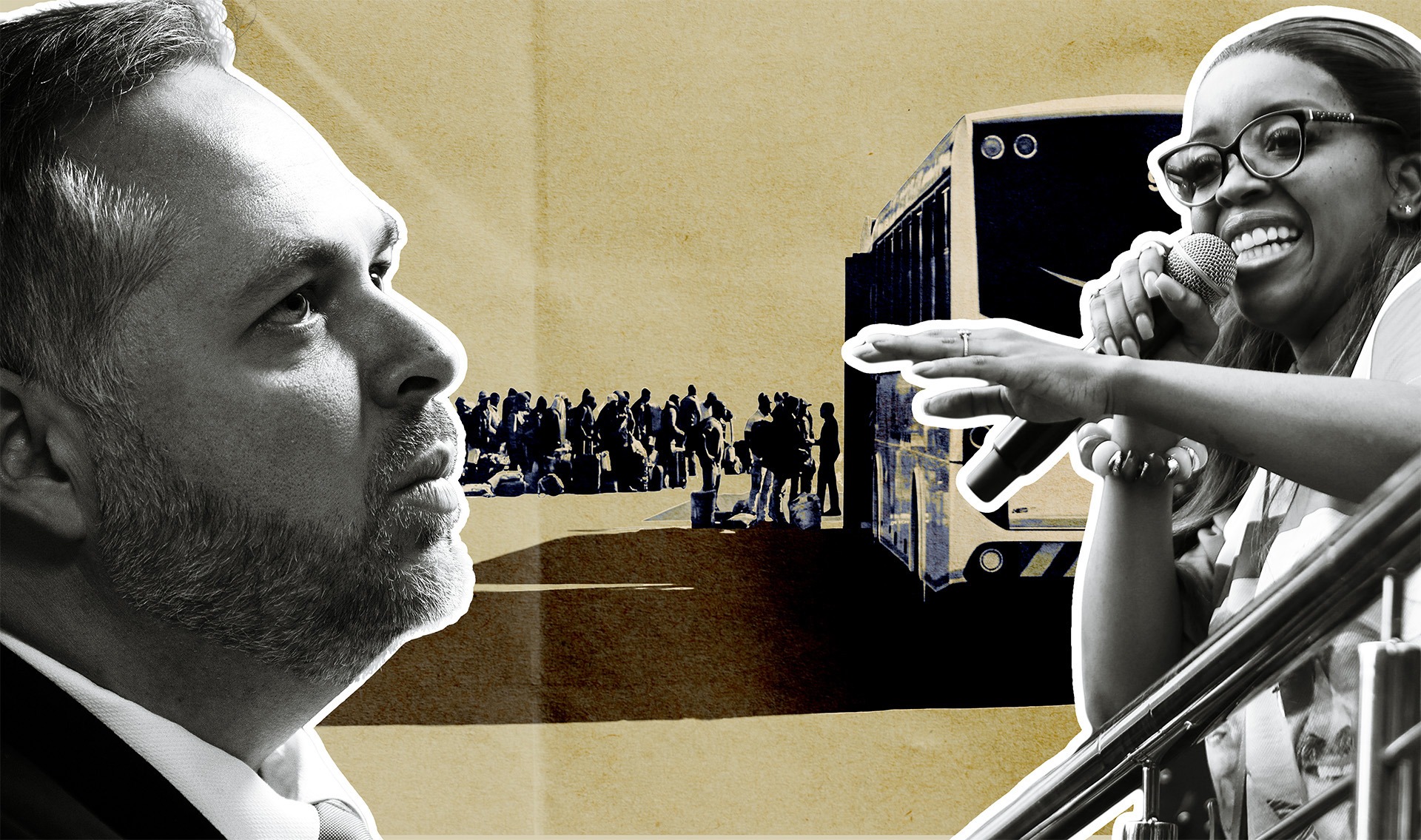
 Illustrative image: Minister of Home Affairs Leon Schreiber. (Photo: Gallo Images / Die Burger / Jaco Marais) | March and March leader Jacinta Ngobese-Zuma addresses scores of people outside the Point police station in Durban on 30 June 2026. (Photo: Felix Dlangamandla) | Malawians seeking voluntary repatriation. (Photo: Felix Dlangamandla)
 Honourable Minister Leon Schreiber,
What is the difference between you and Ms Jacinta Ngobese-Zuma?
One marched with placards.
The other marches with policy.
One shouted “leave”.
The other organises the departure.
One stood outside the gates.
The other opens them.
Yet for the frightened family carrying its life in two bags, does the journey feel any different?
This question is not asked in anger. It is asked from the dust of the ground where displaced families sat, where humanity and immigration meet every day.
I applaud your determination to restore order to South Africa’s immigration system. Every sovereign nation has both the right and the responsibility to regulate who enters, who remains, and who must leave. Order matters. The rule of law matters. Borders matter.
But so does dignity.
From the ground, we have witnessed an operation that has become increasingly efficient at moving people yet often struggles to protect them while they are moved. The buses leave faster. The queues move quicker. Processing improves each day. Yet alongside this efficiency are newborns, heavily pregnant women, separated children, exhausted families, confused elderly people and people who cannot even locate the clinic after spending days inside the centre. Efficiency should never become the measure of humanity.
What is the difference between you and Ms Jacinta Ngobese-Zuma?
If one says “go home”
and the other says “we will help you go home”,
but neither pauses to ask: “Are you safe? Are you documented? Do you even need to leave?”
Then perhaps we have become excellent at moving people before understanding their stories.
One question remained with many of us on the ground: why are fully documented migrants, possessing valid permits, visas, lawful documentation, not first assessed to determine whether they actually require repatriation?
If a documented migrant has been forced to leave because of fear, intimidation or threats from their community, is that first an immigration matter or is it a protection matter?
Should the first response not be to ask whether the government can help restore safety, protect lawful residents and allow them to continue exercising the rights their documentation already grants them?
If the law recognises their presence, why should fear be stronger than the law? Why should intimidation become more powerful than a valid permit?
Why should a lawful resident abandon employment, education, healthcare and family because society has decided they no longer belong?
If South Africa issued the document, should South Africa not also defend the rights that accompany the document?
What is the difference between you and Ms Jacinta Ngobese-Zuma?
One tells people they are not wanted.
The other processes them efficiently once they agree to leave.
But somewhere between rejection and departure, who speaks for dignity?
Another troubling question: where individuals are fully documented, voluntarily choose to leave temporarily until tensions subside, and simply require assistance to reach the border, why are they not permitted to travel directly through the Border Management Authority like any other lawful traveller?
Why must they enter repatriation centres? Why risk receiving notices that may later affect future movement?
Why should someone exercising a lawful right to depart temporarily be processed alongside those who are undocumented or subject to immigration enforcement?
Surely there must be room within the system to distinguish between those requiring immigration enforcement and those exercising lawful freedom of movement under valid documentation.
The law has categories.
Compassion should have them too.
The “repatriation” operation has also revealed another truth.
Communities have often arrived before institutions: faith organisations, community volunteers, local organisations, ordinary citizens.
These have carried much of the humanitarian response, feeding strangers, comforting children, interpreting languages, calming frightened families, directing vulnerable people to clinics and simply reminding others that compassion has no nationality.
The government has increasingly strengthened coordination.
But perhaps coordination must now evolve beyond logistics.
It must become protection.
Because borders separate countries.
They should never separate people from their dignity.
What is the difference between you and Ms Jacinta Ngobese-Zuma?
Perhaps history will answer.
Perhaps history will remember one who removed people.
Or perhaps it will remember one who restored confidence that South Africa can enforce its laws without diminishing humanity.
Minister, this letter is not an accusation. It is simply a thought from someone who has watched thousands forced to leave.
A thought from someone who believes immigration enforcement and constitutional dignity can walk together.
A thought that lawful immigration control becomes stronger, not weaker, when every decision is accompanied by fairness, compassion and careful assessment of vulnerability.
Because when the buses have crossed the border, when the tents have been dismantled and the cameras have left, what will remain is not only the record of how efficiently South Africa processed people.
History will ask a different question. How humanely did South Africa treat them while they were here?
Respectfully,
A humanitarian observer from the field. DM
The author has asked to remain anonymous due to the risks of speaking out when working in the field.
Comments
Scroll down to load comments...